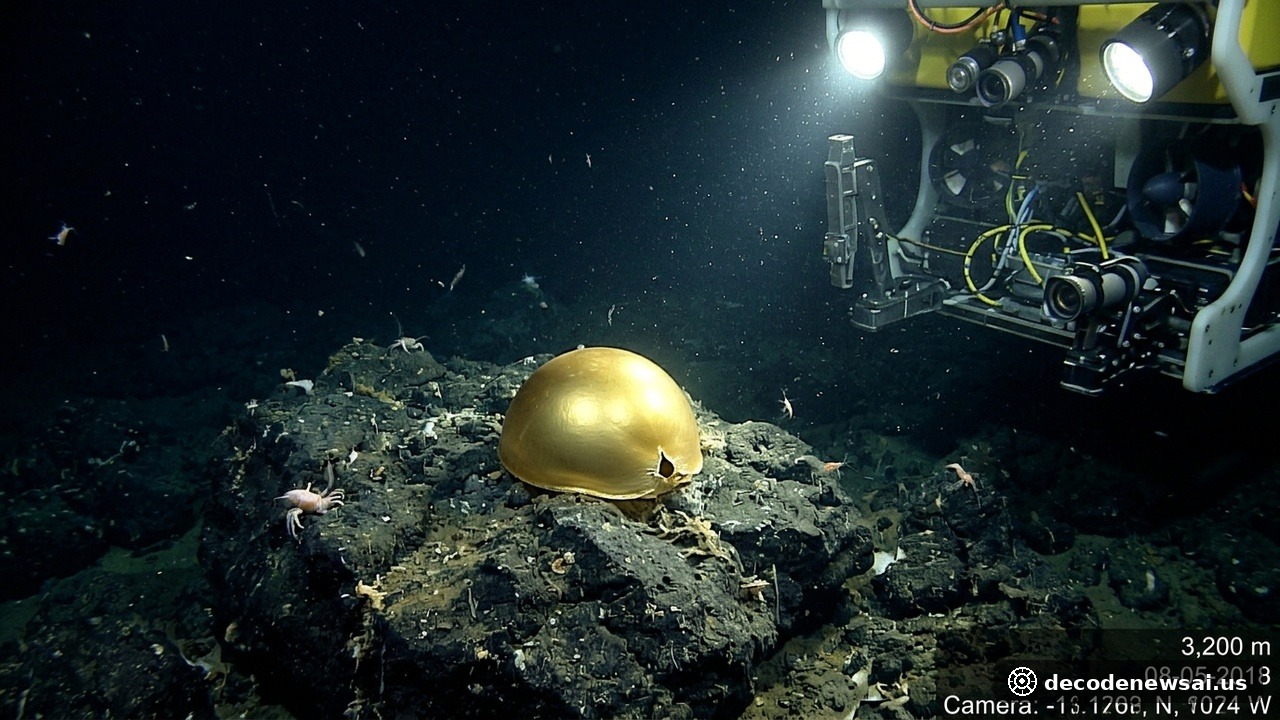
During an oceanographic exploration expedition in the Gulf of Alaska, scientists operating a deep-sea remotely operated vehicle (ROV) uncovered a smooth, dome-shaped object possessing an unmistakable metallic sheen at a depth of roughly 3,200 meters. The unusual finding, immediately dubbed the "mysterious golden orb," sparked widespread international speculation among marine biologists, with early theories suggesting an unknown invertebrate egg casing, an undocumented deep-sea sponge, or an entirely new biological phylum. Following rigorous electron microscopy examinations and comprehensive whole-genome sequencing conducted in specialized research facilities, scientists have officially unraveled the true biological identity of the specimen.
The remarkable discovery took place during the Seascape Alaska 5 expedition organized and funded by the National Oceanic and Atmospheric Administration (NOAA). While surveying an extinct underwater volcano roughly 3,200 meters (approximately 2 miles) below the ocean surface where natural sunlight never penetrates, the ROV's ultra-high-definition cameras captured a gleaming, rounded structure firmly anchored to a barren basalt rock formation. The specimen measured approximately 10 centimeters in diameter and featured a conspicuous circular hole or puncture near its base, creating the appearance of a hatched biological capsule.
Initial Field Discovery and Robotic Sample Extraction
Operating thousands of meters beneath the surface under crushing ambient hydrostatic pressure and near-freezing water temperatures, the mission crew deployed the robotic submersible's articulated manipulator arm to physically investigate the anomaly. Live video streamed globally to participating oceanographers revealed that the golden orb did not possess a rigid mineral shell; instead, gentle mechanical contact demonstrated that the object was remarkably soft, fleshy, and pliable, exhibiting a fibrous, skin-like consistency.
Using a specialized suction sampler attached to the ROV, the exploration team carefully detached the specimen from the basalt substrate and drew it into an onboard collection canister without structural disintegration. Following the conclusion of the research cruise, the preserved sample was transported to laboratory facilities at the Smithsonian Institution. Initial analytical sweeps proved perplexing because the surface of the orb was heavily populated by dense colonies of exotic marine micro-organisms, which initially obscured pure host DNA profiles and prevented immediate taxonomic classification.
Advanced Microscopy and Whole-Genome DNA Sequencing
To pierce through the biological ambiguity, researchers conducted detailed structural examinations utilizing high-resolution scanning electron microscopes. The resulting microstructural images revealed that the orb's fibrous matrix was composed primarily of chitin. Chitin represents a resilient structural polysaccharide widespread throughout the natural world, notably forming the rigid wing casings of beetles, the hard shells of marine crustaceans, and the supportive cuticles of diverse marine invertebrates.
Microscopic evaluation further revealed that the tissue was blanketed in spirocysts, a specialized class of stinging and adhesive cells exclusive to the phylum Cnidaria. This vast taxonomic phylum encompasses more than 11,000 recognized species of aquatic organisms, including sea anemones, corals, and jellyfish. The definitive breakthrough occurred when geneticists conducted whole-genome DNA sequencing on internal structural fragments protected from external microbial colonization. The genomic profile confirmed authentic animal DNA containing substantial sequence matches to Relicanthus daphneae, an enigmatic giant deep-sea cnidarian species closely related to sea anemones.
Relicanthus daphneae is an extraordinary deep-sea creature previously observed near hydrothermal vents and abyssal plains across the Pacific, Indian, and Southern Oceans. The organism features an expansive central column surrounded by up to 192 elongated tentacles capable of extending more than 2 meters in length. Highly territorial in nature, the animal reacts with extreme hostility whenever its sprawling tentacles make physical contact with adjacent rivals. Geneticists and taxonomists determined that the golden orb retrieved from the seafloor was not a protective egg casing or a living organism in itself, but rather the discarded basal cuticle that Relicanthus daphneae secretes from its pedal disc to cement its immense body to submarine rock faces.
Ecological Implications of Discarded Cuticles and Remaining Ocean Mysteries
The identification provides valuable new insights into the behavioral ecology and reproductive strategies of deep-sea fauna. Scientists concluded that when environmental parameters deteriorate, food supplies diminish, or territorial conflicts arise, Relicanthus daphneae possesses the capacity to detach from its anchoring footpad, deliberately abandoning the mucus-derived cuticle sheath to creep across the seabed in search of new substrate. Marine biologists note that in several related anemone species, abandoned anchoring pads retain cellular regeneration potential, allowing juvenile polyps to sprout from discarded cuticles in a specialized form of asexual reproduction.
Despite solving the core identity of the orb, scientists emphasize that several compelling mysteries remain unresolved. Researchers have not yet determined the precise biophysical mechanism that produces the object's vibrant metallic gold luster under robotic lighting, nor have they concluded whether the distinct circular aperture represents a structural detachment scar or the result of scavengers feeding on the discarded organic matrix. Furthermore, microbiologists discovered that the micro-ecosystems flourishing on the cuticle include unique bacteria critical to the ocean's nitrogen cycle, suggesting that these abandoned structures serve as essential biological oases across otherwise desolate abyssal plains.