Observational Milestones and Experimental Metrics of the B0 Meson Decay
- Experimental Instrument Employed: Large Hadron Collider beauty (LHCb) Detector
- Search Timeline from Theory to Evidence: 42-Year Multi-Decade Search (Theorized 1984)
- Quantum Decay Probability Rarity: Occurrence of Parts per Billion Across Decays
- Theoretical Baseline Tested: Standard Model Flavor-Changing Neutral Currents
Why Did Physicists Pursue the B0 Meson Decay for Four Decades?
Under the Standard Model of fundamental particles, matter consists of quarks and leptons interacting through four gauge forces. The neutral B0 meson represents a bound composite state comprising a heavy bottom antiquark and a down quark held together by the strong nuclear force. Standard Model conservation laws, governed by the Glashow-Iliopoulos-Maiani mechanism and electroweak parity symmetries, strictly prohibit tree-level flavor-changing neutral currents that would allow direct quark transformations via single photon or Z boson exchanges.
Consequently, bottom-to-down transitions can occur only through higher-order loop diagrams, popularly known as penguin or box topologies, involving the simultaneous exchange of virtual top quarks and heavy W bosons. Mathematical formulations demonstrate that this transition occurs in fewer than one out of every ten billion meson events. Because this process is naturally suppressed, it serves as a sensitive probe for physics beyond the Standard Model. Any measured anomaly in the decay rate would indicate the presence of uncataloged particles, such as supersymmetric bosons, leptoquarks, or dark sector mediators.
How Did the LHCb Collaboration Extract the Signal from Massive Collision Noise?
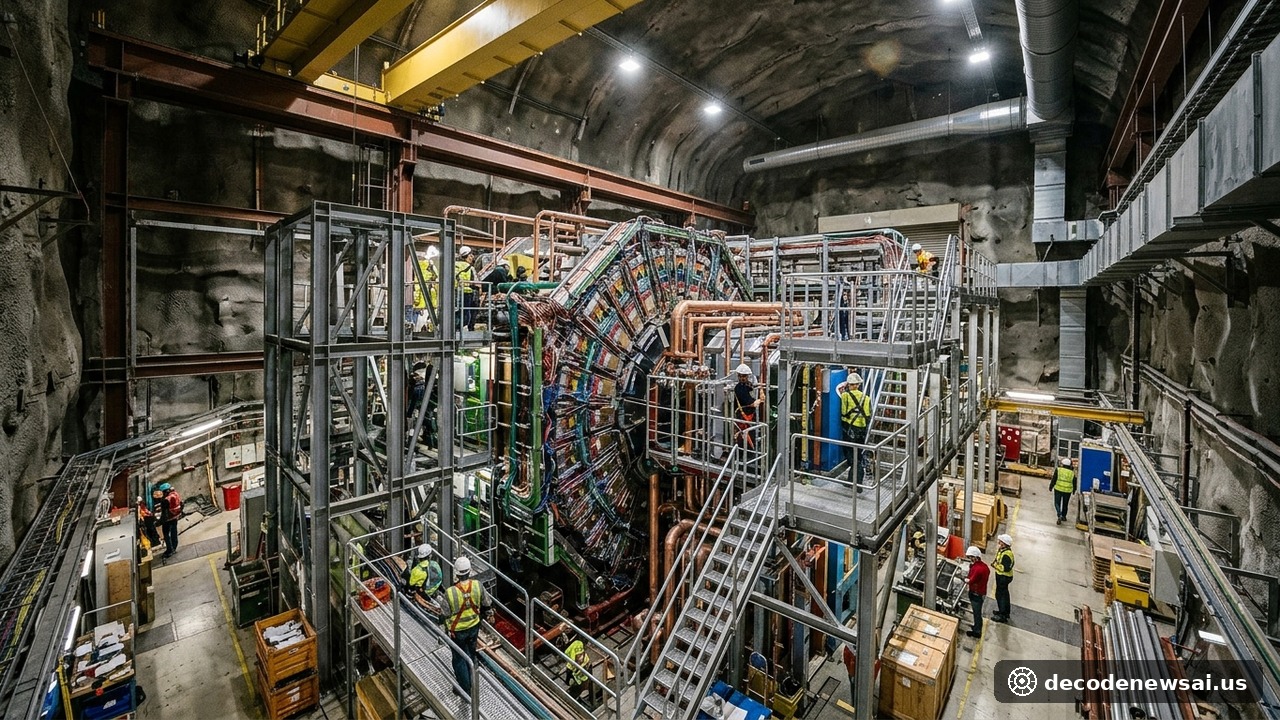
Isolating a handful of muon signals from trillions of proton interactions beneath the Franco-Swiss border pushed particle detection technologies to their absolute limits.
What Are the Implications for Modern Cosmology and Particle Theory?
Editorial reviews across Phys.org and CERN emphasize that confirming this ultra-rare transition validates the predictive precision of Standard Model quantum electrodynamics while restricting theoretical parameter spaces for hypothesized beyond-the-Standard-Model theories.
A foundational mystery in modern cosmology concerns the baryon asymmetry of the universe—the unexplained imbalance between matter and antimatter that permitted physical structures to endure following the Big Bang. While observed B0 branching ratios match existing theoretical boundaries, upcoming High-Luminosity LHC operations will provide sufficient statistical resolution to inspect angular decay distributions and time-dependent asymmetries, driving further investigations into dark matter and the fundamental mechanics of cosmic matter generation. Theoretical physicists anticipate that these empirical constraints will refine precision calculations across international laboratory consortiums, shaping future collider design studies and subatomic research roadmaps.