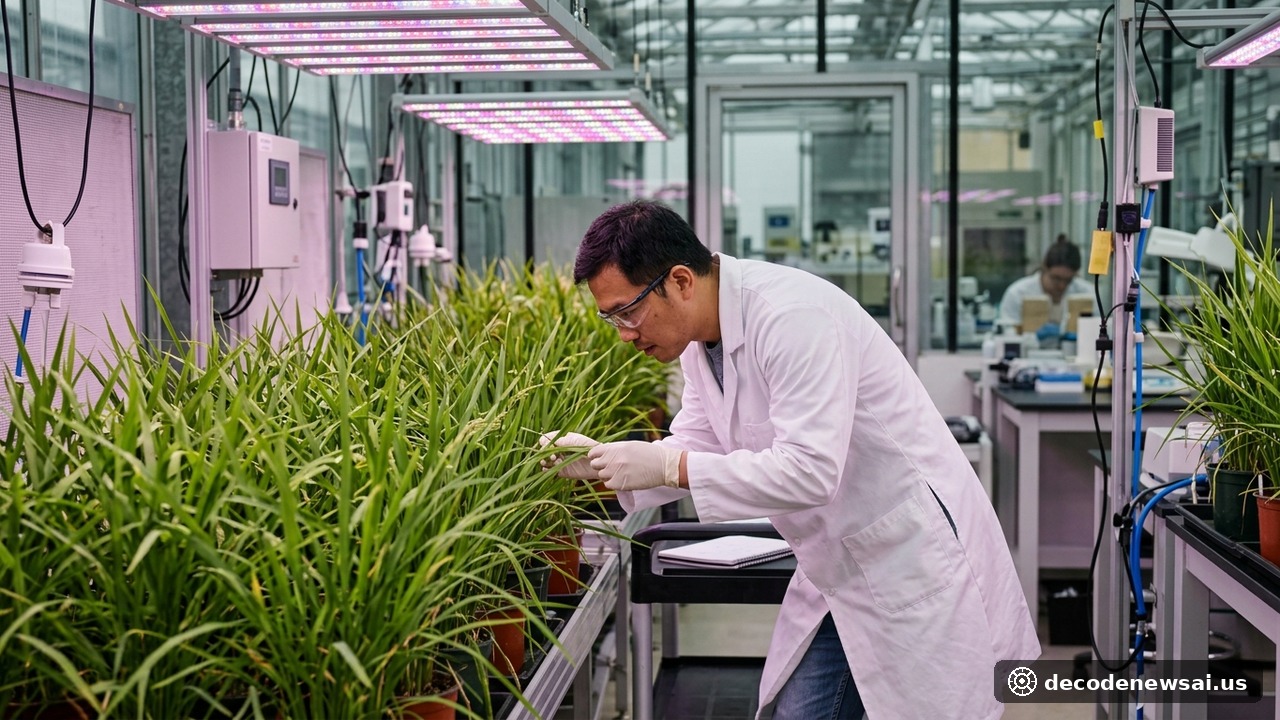
Technical Milestones and Precision Genomic Metrics of OpenCRISPR-1 Rice
- Lead Research Institution & Senior Author: University of Missouri (Prof. Bing Yang Lab)
- Targeted Agricultural Pathogen Species: Bacterial Blight (Xanthomonas oryzae pv. oryzae)
- Targeted Modification Efficiency Benchmark: Exceeding 92% Efficacy (0.05% Off-Target Rate)
- Downstream Agronomic Deployment Targets: Expanding to Climate-Resilient Soybeans & Corn
What Distinguishes AI-Generated OpenCRISPR-1 from Natural Enzymes?
Throughout the initial decade of the CRISPR Revolution, molecular biologists relied almost entirely on naturally occurring endonuclease enzymes mined from wild bacterial immune systems. However, wild Cas enzymes evolved under evolutionary constraints suited to prokaryotic survival, creating persistent limitations in target PAM recognition versatility, molecular size constraints, and compatibility inside complex eukaryotic plant nuclei.
Profluent's OpenCRISPR-1 represents an architectural departure from natural bioprospecting. By training massive generative foundation models on hundreds of millions of natural protein topologies and evolutionary sequence variants, researchers directed the algorithm to engineer completely novel enzymatic catalytic folds from first principles. The resulting de novo endonuclease achieves superior target specificity, improved molecular stability, and tailored catalytic kinetics optimized specifically for plant genomic environments.
How Did University of Missouri Scientists Engineer Bacterial Blight Resistance?
Bacterial blight, caused by the microbial pathogen Xanthomonas oryzae pv. oryzae, represents one of the most devastating infectious threats to global rice production. The bacterium attacks rice crops by secreting transcription activator-like effectors into plant cells, hijacking host SWEET sugar transporter genes to nourish bacterial proliferation and causing severe leaf drying that destroys up to 50% of annual crop yields across Asia and Africa.
Professor Yang's laboratory introduced the OpenCRISPR-1 complex into rice embryonic callus cells, precisely targeting the promoter elements of the SWEET genes that the pathogen exploits. The AI-designed enzyme executed precise micro-mutations that blocked effector binding without altering baseline sugar transport necessary for normal plant development. In comprehensive plant challenge trials, modified rice lines exhibited near-complete phenotypic immunity when inoculated with hypervirulent bacterial strains, showing no observable trade-offs in tiller counts, plant architecture, or mature grain yields compared to unmodified control lines.
How Does Generative Protein Design Secure Agricultural Resilience?
Writing in the journal aBIOTECH, independent peer reviewers highlighted that successfully translating an AI-generated synthetic enzyme into a major monocot food crop establishes a transformative precedent for crop science.
As climate change accelerates agricultural vulnerability through erratic droughts, extreme heat waves, and migrating fungal and bacterial pathogens, traditional cross-breeding and random chemical mutagenesis cycles are too slow to keep pace with environmental degradation. The Missouri team confirmed plans to adapt the OpenCRISPR-1 architecture to engineer environmental stress resistance across soybean and maize germplasms. Deploying computational protein design enables researchers to tailor bespoke genetic countermeasures against emerging agricultural threats, providing vital biotechnological infrastructure to sustain global calorie supplies in the coming decades.