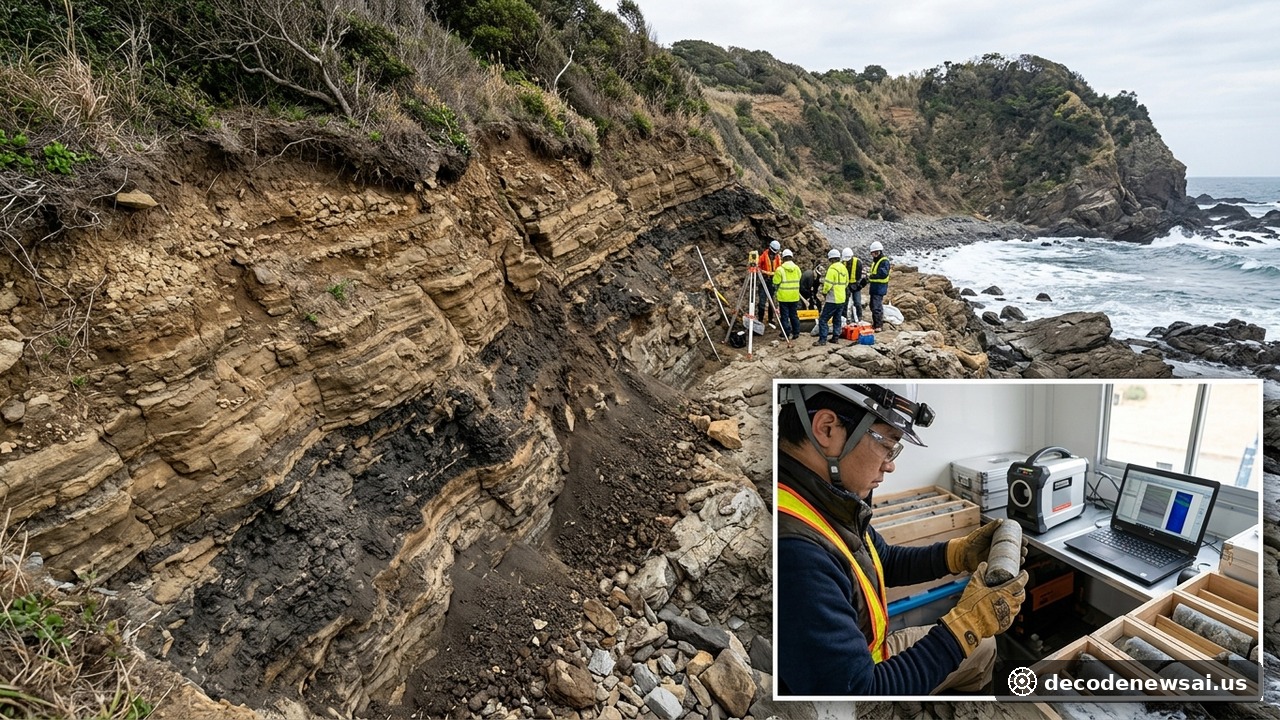
A pioneering international geophysics collaboration led by Professor Tetsuro Hirono from the Department of Earth Sciences at Osaka Metropolitan University published transformative research findings on November 6–7, 2026, elucidating physical mechanisms responsible for catastrophic marine seismic events. Utilizing pristine structural clay fault gouge recovered from exhumed ancient subduction fault exposures across Japan's Boso Peninsula in Chiba Prefecture, the scientists conducted high-speed rotary shear friction simulations replicating dynamic lithospheric rupture pressures. The experimental data established that water-bearing smectite clay layers, when subjected to violent fault shear and rapid frictional heating during megathrust rupture events, undergo instantaneous thermal pressurization of trapped pore fluids, causing solid fault gouge to transition into a fluid-like state. This friction-free liquefaction resolves a foundational geophysical paradox, demonstrating how shallow tectonic boundaries slip dozens of meters to generate catastrophic tsunamis.
Foundational Physical Parameters and Laboratory Metrics of Fault Clay Liquefaction
- Primary Institution & Research Lead: Osaka Metropolitan University; Prof. Tetsuro Hirono
- Geological Field Provenance & Formation: Exhumed Subduction Faults, Southern Boso Peninsula
- Dominant Physical Slip Phenomenon: Thermal Pressurization Liquefaction of Trapped Water
- Dynamic Shear Observation & Outcome: Friction Coefficients Drop to Near Zero at High Velocity
- Disaster Mitigation Framework Revisions: Numerical Recalibration of Nankai Trough Inundation
Why Did Ancient Fault Core Samples from the Boso Peninsula Provide Critical Answers?
For generations, geophysicists investigating destructive megathrust events—most notably the catastrophic 2011 Tohoku-oki earthquake—confronted a fundamental physical paradox regarding fault sliding dynamics: classical Coulomb frictional mechanics dictated that deep confining pressures under thousands of atmospheres should generate enormous resistance, dampening seismic energy and limiting tectonic displacements.
However, ocean-bottom acoustic surveys following the 2011 event documented extreme, counter-intuitive horizontal displacements exceeding 50 meters near the shallow trench axis, displacing millions of tons of ocean water. To isolate the physical properties enabling this extreme behavior, Professor Hirono's team analyzed the Boso Peninsula in Chiba Prefecture. As one of the planet's rare subaerial tectonic outcrops displaying pristine, uplifted megathrust boundary gouge, the site allowed scientists to harvest intact, unweathered smectite-rich clay samples preserving natural pore configurations and trapped interstitial fluid compositions.
How Did Laboratory Shear Tests Recreate the Transition from Solid Rock to Fluid?
Within Osaka Metropolitan University's advanced rotary shear testing facility, engineers subjected the cylindrical Boso fault cores to extreme confining stresses exceeding 30 megapascals while applying rapid rotational velocities exceeding 1 meter per second to simulate real-time earthquake rupture dynamics.
High-resolution thermal sensors recorded a dramatic physical metamorphosis within fractions of a second: friction-induced frictional heating triggered explosive volumetric expansion of interstitial water trapped inside microscopic smectite crystalline networks. Because the impermeable clay matrix prevented fluid migration, fluid pore pressure spiked to match total overburden confining stress. At this critical threshold, effective normal stress between solid mineral grains vanished entirely. The once-rigid geological material transformed into an amorphous fluid suspension, causing kinetic friction coefficients to plunge toward zero and allowing contiguous tectonic plates to slide unimpeded across massive fault planes.
What Are the Global Implications for Tsunami Inundation Warning Models?
Commentaries featured in SciTechDaily and global geophysics forums emphasize that the identification of thermal pressurization liquefaction will force sweeping updates across international tsunami prediction infrastructure.
Historically, seismic hazard agencies modeling future megathrust hazards across the Nankai Trough, the Sagami Bay system, and the Cascadia Subduction Zone relied upon idealized velocity-weakening models that assumed substantial frictional resistance, potentially underpredicting maximum coastal run-up heights. By proving that saturated shallow clay layers eliminate shear resistance during seismic slips, the Osaka Metropolitan University study provides empirical physics parameters to refine hydrodynamic simulations. Japan's National Research Institute for Earth Science and Disaster Resilience has begun incorporating non-linear clay pressurization equations into national civil defense warning grids, substantially improving survival lead times for coastal populations worldwide.