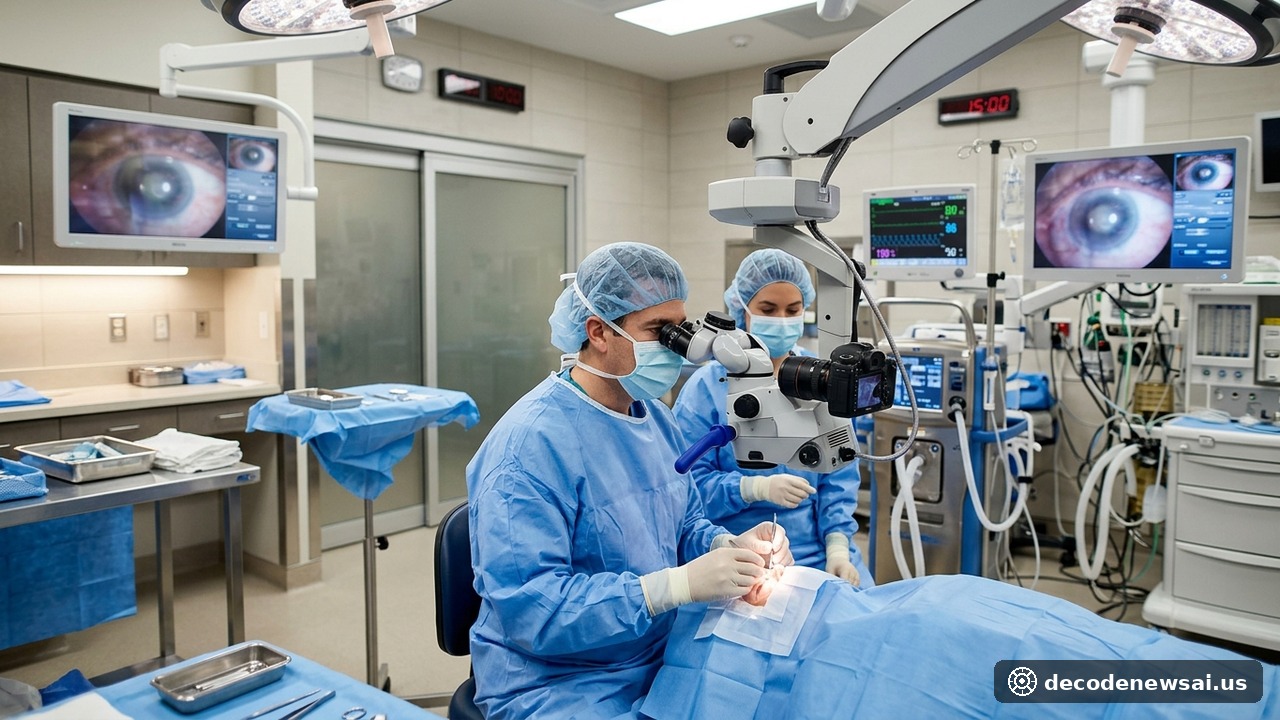
The Centers for Medicare & Medicaid Services (CMS) officially released its final policy changes and payment rates for the Calendar Year (CY) 2027 Medicare Physician Fee Schedule (MPFS) alongside the Hospital Outpatient Prospective Payment System (OPPS) and Ambulatory Surgical Center (ASC) payment system on November 5, 2026. Under the finalized statutory formula, the CY 2027 ASC conversion factor was established at $57.721 for surgical centers meeting federal quality reporting standards. In specialized ophthalmic surgery, the final reimbursement payment for routine cataract surgery via extracapsular phacoemulsification with intraocular lens insertion (CPT code 66984) was finalized at $442.12, representing a 4 percent reduction compared to CY 2026 baseline reimbursement levels.
What Are the Quantifiable Conversion Factors and Fee Schedule Metrics in CMS's Final Rule?
- CY 2027 Quality-Reporting ASC Conversion Factor Rate: Finalized at $57.721 USD ($56.592 for Non-Reporting)
- Qualifying Alternative Payment Model (APM) Conversion Factor: $32.95 USD (Down 1.83% Compared to CY 2026)
The broad downward adjustment in physician fee conversion factors was heavily dictated by the expiration of temporary legislative relief enacted under Public Law 119-21, commonly cited as the Working Families Tax Cut (WFTC) statute. That statutory measure had introduced a temporary, one-year 2.5 percent conversion factor increase across CY 2026 physician services, which statutorily expired heading into CY 2027 without congressional reauthorization. In its formal economic analysis, CMS projected that the combined impact of all statutory and regulatory revisions will decrease total allowed Medicare charges across ophthalmic surgical procedures by approximately 3 percent, forcing outpatient surgical facilities to absorb elevated nursing labor and single-use consumable costs.
How Did CMS Soften Proposed Cuts to Modifier -25 and Practice Expense Indexing?
In response to extensive public comments and clinical advocacy organized by national specialty medical societies, CMS instituted pragmatic concessions mitigating previously proposed payment reductions.
A major flashpoint during notice-and-comment rulemaking centered on proposed cuts to Modifier -25, which physicians utilize when billing a significant, separately identifiable evaluation and management (E/M) service on the same day as a minor surgical intervention. Yielding to clinical feedback, CMS scaled back its proposed reduction: rather than applying across 10-day and 90-day global surgical periods as initially drafted, the policy applies strictly to zero-day global procedures. Furthermore, the agency adjusted the secondary same-day service payment to 80 percent of the standard fee schedule, discarding its aggressive 50 percent penalty. Additionally, CMS adopted a multi-year stabilizing buffer capping annual practice expense adjustments at 5 percent, shielding specialized outpatient surgical suites from precipitous facility overhead cuts.
Healthcare financial analysts noted that the shift toward ambulatory surgical centers has historically generated billions in cumulative Medicare savings by transitioning routine procedures out of expensive acute-care hospital outpatient departments. However, because independent ASCs operate without inpatient cross-subsidization, continued fee schedule erosion threatens the facility margins necessary to recruit specialized ophthalmic surgical nurses and maintain sterile processing standards in community settings.
What Are the Broader Health Economics Consequences for Ambulatory Surgery Centers and Patient Access?
CMS's finalized CY 2027 payment architecture reflects the relentless fiscal pressure confronting federal entitlement trust funds amid demographic graying.
As the post-war baby boom cohort ages into peak incidence of visually debilitating age-related cataracts, federal actuaries routinely target high-volume procedural codes to restrain Medicare Part B expenditures. However, leadership across the American Society of Cataract and Refractive Surgery (ASCRS) caution that cumulative reimbursement reductions threaten the operational solvency of independent community-based surgical suites. Outpatient practices operating in rural and underserved corridors may struggle to replace specialized surgical microscopes and phacoemulsification handpieces, accelerating physician consolidation into health systems and lengthening procedural wait times for elderly beneficiaries seeking vision restoration.