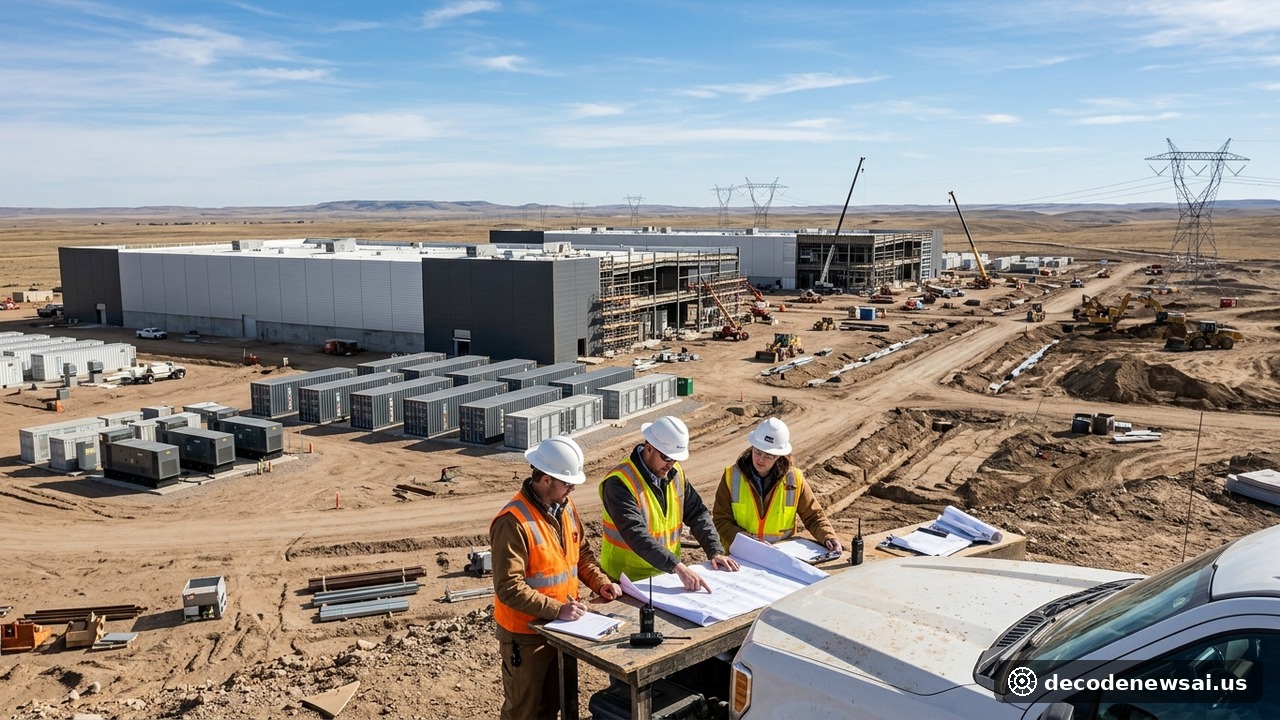
Alphabet subsidiary Google LLC officially announced on November 6, 2026, the strategic acquisition of a pre-developed hyperscale data center campus in southeastern Wyoming from artificial intelligence infrastructure developer Crusoe, confirming a planned capital expenditure commitment of $17 billion. Representing Google's inaugural data center installation in Wyoming, the 716-acre campus is designed to support an advanced 702-megawatt clean energy architecture powered by on-site fuel cells with integrated carbon capture alongside closed-loop, zero-water-consumption air-cooling systems. Google established a dedicated utility development consortium alongside Tallgrass Energy, Black Hills Energy, and American Electric Power (AEP) to provide 24/7 dedicated low-carbon baseload power for training next-generation multi-modal artificial intelligence foundation models and supporting global enterprise cloud infrastructure.
What Are the Core Operational Metrics and Capital Commitments in Google's Wyoming Deal?
- Key Public Utility and Pipeline Energy Partners Formally Named: Tallgrass Energy, Black Hills Energy, and American Electric Power
Addressing infrastructure partners and municipal stakeholders during a technical briefing, Google leadership articulated the strategic rationale underpinning the Mountain West expansion: "Wyoming provides an exceptional operating convergence: a naturally cool climate profile that optimizes aerodynamic thermal dissipation, vast contiguous acreage, and direct access to high-capacity transcontinental fiber and transmission corridors. By acquiring a project where Crusoe successfully secured foundational environmental reviews, land assemblies, and water rights, Google bypasses conventional multi-year interconnection queue delays. In an era where demand for frontier machine learning training is surging exponentially, our $17 billion commitment demonstrates how hyperscale operators can deploy sovereign compute without placing cost or reliability strains on municipal utility ratepayers."
Energy transition economists note that private behind-the-meter generation structures isolate regional transmission authorities from unexpected capacity shocks. By financing dedicated transmission lines directly connecting fuel cell banks to on-site substation switchyards, the project functions as an islanded microgrid during peak load events, enhancing broader regional grid resilience.
Furthermore, state regulatory filings confirm that the development consortium has initiated comprehensive baseline environmental monitoring across Laramie County, ensuring that groundwater quality and ambient air standards remain rigorously protected throughout the phased multi-decade construction timeline.
How Do 702MW Air-Cooled Fuel Cells and Carbon Capture Resolve Water-Power Frictions?
In traditional data center operations, cooling massive arrays of high-density accelerator racks typically mandates evaporative water towers that consume millions of gallons of potable water daily.
In arid and semi-arid geographies across the American West, water-intensive cooling architectures routinely ignite severe regulatory friction with agricultural irrigators and municipal water districts. Google's Wyoming campus resolves this environmental challenge by deploying closed-loop air-cooled heat exchangers, maintaining sub-second thermal equilibrium across thousands of proprietary Tensor Processing Units (TPUs) with virtually zero consumptive water withdrawal. On the power supply side, Google decoupled the campus from regional coal-fired generating grids by partnering with Tallgrass Energy to construct a 702-megawatt natural gas fuel-cell distributed microgrid equipped with point-source carbon capture and deep subterranean sequestration (CCS), achieving regulatory compliance with zero-carbon grid standards.
What Strategic Precedents Does Private Microgrid Development Establish for Hyperscale AI?
Following midterm election ballots where voters across the United States rejected dozens of utility bond measures and tax incentives designed to attract energy-intensive data centers, technology giants face intense community scrutiny over grid resource allocation.
Google's acquisition of the Crusoe project and its explicit covenant to fund 100 percent of all associated generation and transmission infrastructure establishes a sustainable operational template for high-density compute siting. By purchasing a pre-developed asset and underwriting dedicated utility capital expenditures, Google insulates regional residential ratepayer bases from grid upgrade surcharges. Wall Street utility and technology analysts observe that dedicated, fully capitalized microgrid campuses—pairing on-site dispatchable generation with zero-water cooling—will become the mandatory operating blueprint for hyperscalers deploying gigawatt-scale artificial intelligence clusters over the next decade.