Key Financial and Technical Metrics: IonQ Earnings and Nighthawk Architecture
- Real-Time Hardware Error-Correction Latency: Nanosecond Closed-Loop Decoding Feedback
Why Did IonQ's $173 Million Quarter Reshape Capital Market Perceptions?
Historically, publicly traded quantum computing pure-plays were viewed by institutional asset allocators as pre-revenue research ventures characterized by open-ended operational cash burns and speculative commercial timelines. IonQ's quarterly performance of $173.8 million dismantles that skepticism, demonstrating that commercial quantum hardware can generate substantial, recurring revenue at enterprise scale.
Analysis of the revenue composition reveals that enterprise customers are committing capital across high-value verticals. Multi-million-dollar compute agreements from multinational biopharma conglomerates evaluating peptide conformational folding, tier-one global investment banks executing accelerated portfolio risk simulations, and specialized defense aerospace agencies deploying quantum-resistant encryption architectures drove the surge. Supported by an order book extending past 1.2 billion dollars, IonQ has established a self-sustaining commercial cadence, validating the thesis that dedicated quantum advantage is yielding measurable economic returns across targeted computational domains.
What Engineering Breakthrough Did the IBM-Oak Ridge Nighthawk System Achieve?
While IonQ demonstrated commercial revenue momentum in trapped-ion platforms, IBM and Oak Ridge National Laboratory achieved a defining technical milestone in superconducting circuits: addressing the long-standing physical hurdle of real-time quantum error correction. Because fragile quantum superpositions decay rapidly due to ambient thermal noise and material dielectric loss, conventional offline error correction often diagnoses qubit corruption long after quantum coherence has collapsed.
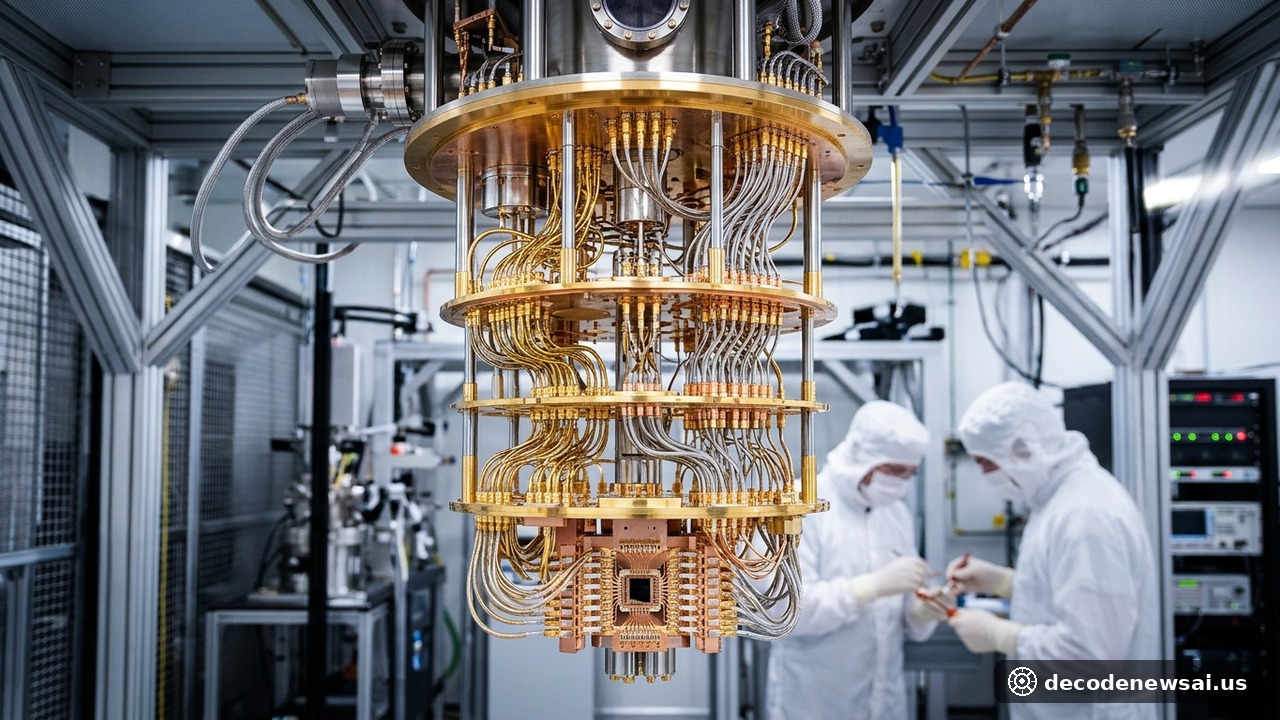
The newly deployed Nighthawk testbed resolves this temporal latency through an innovative heterogeneous co-design architecture. IBM's 120-qubit dilution refrigerator was installed in close physical proximity to Oak Ridge's high-performance computing clusters, interfaced via custom ultra-low-latency PCIe optical interconnects developed in collaboration with AMD. During continuous algorithm execution, dedicated GPU accelerators ingest tens of thousands of syndrome measurement streams per microsecond, performing parallel maximum-likelihood decoding and synthesizing corrective phase-shift pulses in nanoseconds. This closed-loop hardware integration realizes active, runtime fault tolerance, extending the effective logical coherence of computational circuits.
Where Is the Competition Between Trapped-Ion and Superconducting Modalities Headed?
Leading computational physicists emphasize that the future of frontier high-performance computing lies in hybrid quantum-classical computing frameworks. Rather than displacing silicon-based digital infrastructure, quantum processors will operate as specialized accelerators addressing computationally intractable mathematical topologies. With commercial revenues scaling rapidly and active error mitigation transitioning into physical reality, quantum information science is crossing into an era of sustainable industrial transformation.