Key Observational and Astrophysical Metrics: Beta Pictoris b Radio Detection
- Derived Lower Bound Magnetic Field Strength: 1.25 Kilogauss (0.125 Tesla Magnetosphere)
- Heliocentric Orbital Separation & Distance: 9–10 AU from Host Star; 63.4 Light-Years Distance
- MeerKAT Observational Frequency Bandwidth: 0.85 to 3.5 GHz (Coherent Circular Polarization)
- Physical Mechanism Governing Emission: Electron Cyclotron Maser Instability (ECMI)
- Planet Theoretical Dynamo Mass Metric: 9 to 11 Jovian Masses (Young Gas Giant World)
Why Has Direct Exoplanetary Magnetic Field Detection Eluded Astronomers for Decades?
Within our solar system, magnetized worlds like Jupiter, Saturn, and Earth generate planetary magnetospheres through convective dynamos driven by liquid metal and ionic circulating cores. These magnetic bubbles serve as indispensable shields against energetic galactic cosmic rays and ionizing solar winds, while generating intense auroral radio bursts at planetary magnetic poles through the capture of solar wind plasma.
However, translating this observational methodology to extrasolar planetary systems presented profound engineering hurdles. Coherent radio emission emitted by distant exoplanets is exceptionally faint, routinely obscured by orders-of-magnitude stronger thermal and coronal emission from host stars. Historical ground-based radio observatories lacked the spatial angular resolution and baseline sensitivity required to resolve a planet from its parent star, leaving the empirical confirmation of extrasolar magnetic fields as one of the unfulfilled holy grails of observational astrophysics.
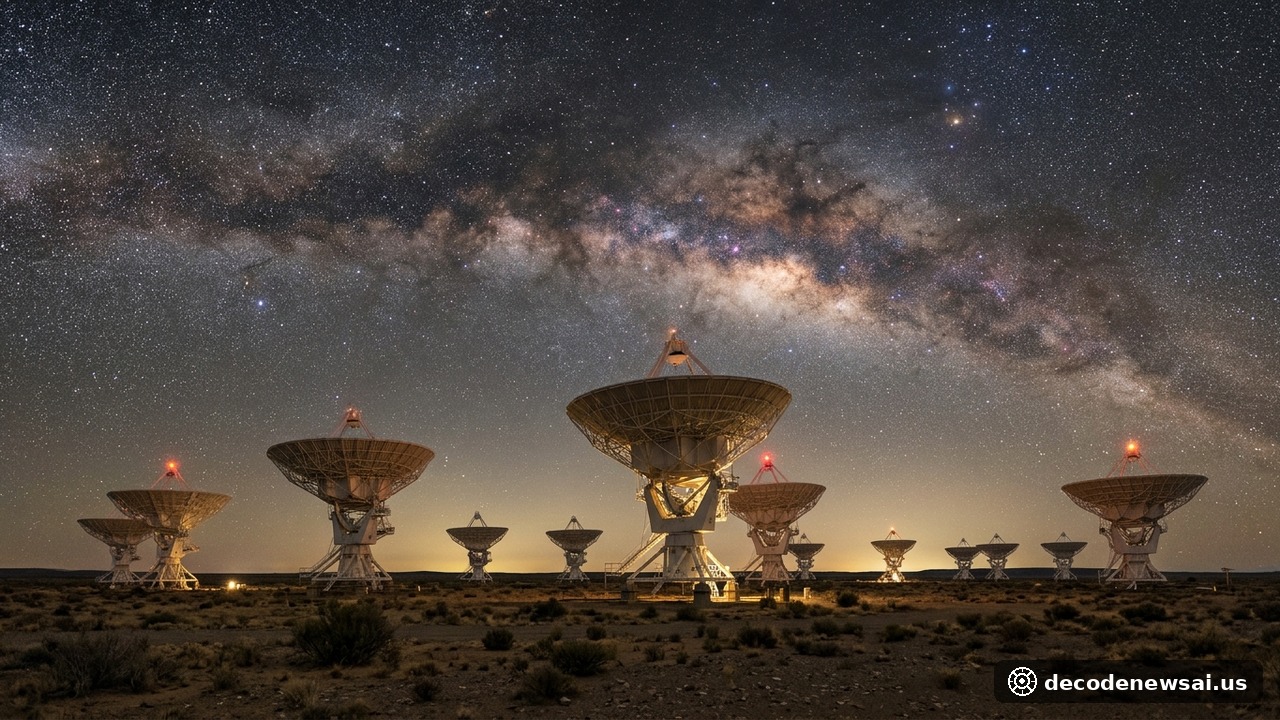
How Did the MeerKAT Array Resolve Magnetospheric Radio Emissions Across 63 Light-Years?
What Are the Implications for Planetary Dynamo Physics and Habitability?
The derived magnetic field threshold of 1.25 kilogauss directly validates dynamo scaling laws that predict young, rapidly rotating super-Jovian worlds generate powerful dipolar magnetic architectures. At an estimated planetary age of approximately 20 million years, Beta Pictoris b retains intense primordial thermal convection within its metallic core, sustaining a magnetic barrier capable of deflecting stellar plasma flows.
Planetary dynamicists and astrobiologists emphasize that magnetic field integrity represents a paramount factor governing atmospheric retention and surface habitability. The validation of radio interferometric polarimetry paves the way for future flagship facilities, including the Square Kilometre Array (SKA) and the European Extremely Large Telescope (ELT), to scan terrestrial exoplanetary targets for protective magnetospheres, providing empirical foundations in the search for habitable worlds beyond the solar system.