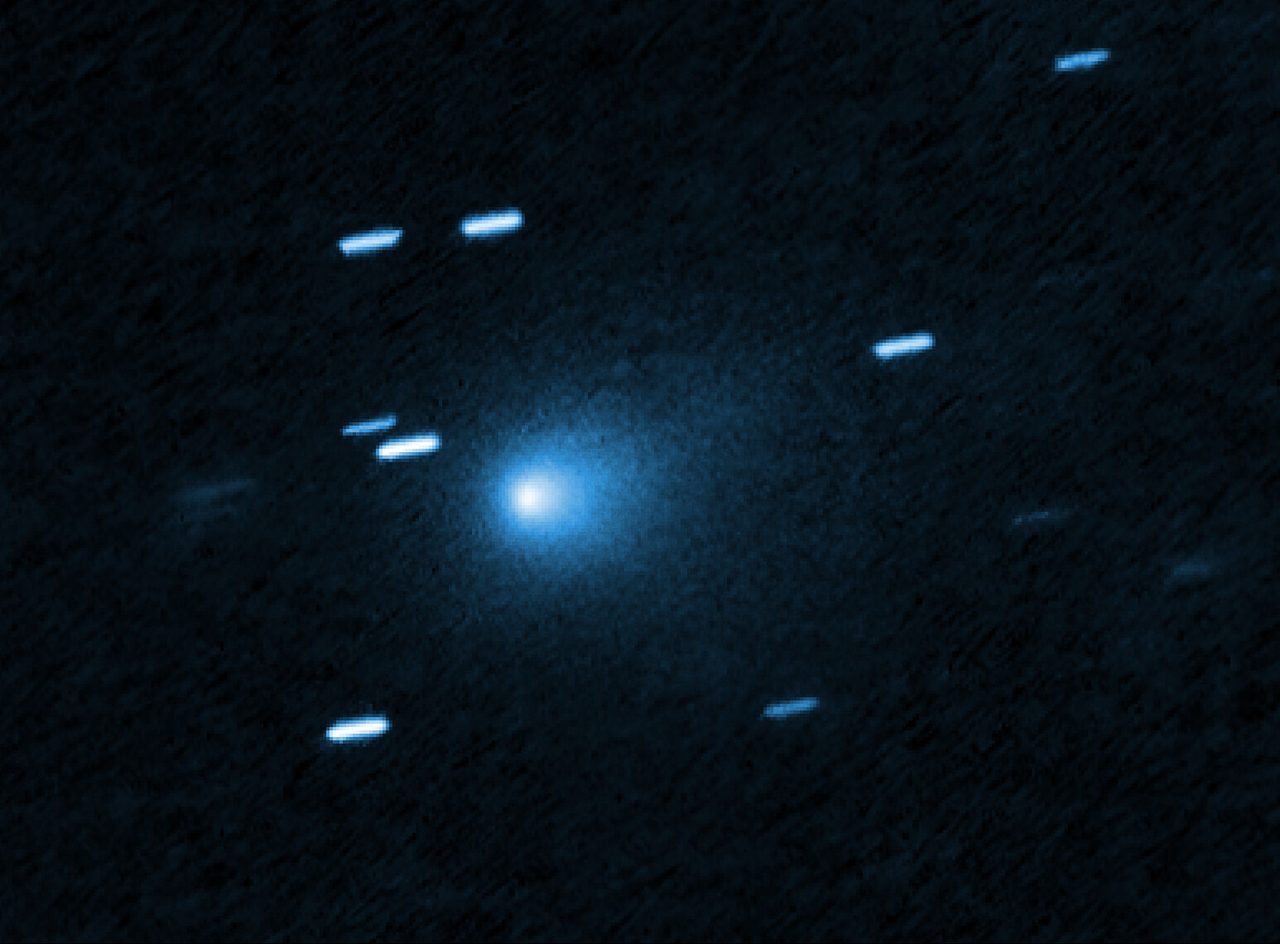
The National Aeronautics and Space Administration (NASA) and the European Space Agency (ESA) jointly revealed groundbreaking spectroscopic findings on November 6, 2026, gathered by the James Webb Space Telescope (JWST) targeting interstellar comet 3I/ATLAS. High-resolution near-infrared observations conducted with Webb's Near-Infrared Spectrograph (NIRSpec) confirmed that the interstellar traveler harbors extensive reservoirs of amorphous water ice crystals encapsulated within a refractory silicate and organic matrix. The unique structural composition and chemical ratio diverge sharply from the vast majority of native comets within the Solar System, matching absorption spectra observed in pristine trans-Neptunian bodies residing in the deep Kuiper Belt and unlocking unprecedented empirical insights into circumstellar disk accretion dynamics across the Milky Way galaxy.
What Are the Core Spectroscopic Parameters and Physical Metrics of Comet 3I/ATLAS?
- Heliocentric Orbital Distance of 3I/ATLAS at Observation: Approximately 3.42 Astronomical Units (AU)
- Mass Ratio of Refractory Silicates to Water Ice in Coma: Approximately 2.8 to 1 (Confirming Dense Protective Crust)
- Estimated Effective Nucleus Diameter and Rotational Period: 1.2 Kilometers in Diameter, 16.8 Hours Rotation Period
Principal investigators coordinating the international observational consortium underlined the profound cosmochemical ramifications of the dataset: "Interstellar interlopers represent pristine cryogenic capsules expelled from fledgling exoplanetary systems during violent epochs of early gravitational scattering. Unlike earlier cataloged travelers such as 1I/'Oumuamua and 2I/Borisov, 3I/ATLAS displays an extraordinary volatiles preservation mechanism. The broad 3.1-micrometer absorption band confirmed by NIRSpec demonstrates that the parent protoplanetary disk possessed extensive volatile reservoirs subjected to chronic interstellar radiation bombardment, which forged a robust outer shell preserving amorphous ice against cosmic ray volatilization over billions of years."
How Do Refractory Protective Mantles Reshape Exoplanetary Formation Hypotheses?
Traditional Solar System cometary formation models postulate that icy planetesimals coalescing beyond the snow line retain highly porous, volatile-rich aggregates of crystalline ice, carbon monoxide, and methane.
However, spatially resolved data from JWST's Integral Field Unit (IFU) reveals that as 3I/ATLAS traversed its hyperbolic trajectory closer to the Sun, it resisted catastrophic fragmentation or hyperactive outgassing typically triggered by thermal shock. Instead, a resilient outer mantle composed of macromolecular tholins, amorphous carbon, and fine-grained iron-magnesium pyroxenes buffered the core against intense solar radiative heating. This protective crust insulating the interior amorphous ice demonstrates that dust grain agglomeration and volatile co-accretion in external circumstellar disks can operate under physical regimes markedly more resilient than previously theorized in standard Solar Nebula simulations.
Astrophysicists analyzing the Webb data noted that the precise isotopic ratios of carbon and oxygen trapped within the ice matrix provide vital clues regarding the parent star's spectral classification. If the volatile composition reflects elevated carbon monoxide to carbon dioxide ratios, the comet likely condensed within an outer protoplanetary envelope orbiting an early-type carbon-rich star or within a dynamically active stellar cluster environment.
Furthermore, these spectroscopic discoveries establish a quantitative framework for future observational campaigns utilizing upcoming survey platforms such as the Vera C. Rubin Observatory. By establishing empirical spectral baseline templates, ground-based and spaceborne telescopes can rapidly categorize incoming interstellar candidates before volatile outgassing obscures their primordial surfaces.
What Strategic Repercussions Does In Situ Interstellar Spectroscopy Hold for Planetary Science?
The precise spectroscopic classification of 3I/ATLAS establishes a transformative paradigm in planetary science, enabling direct chemical interrogation of foreign stellar nurseries without dispatching multi-decade interstellar spaceflight missions.
Historically, determining volatile inventories across exoplanetary systems relied on indirect atmospheric transmission spectra during planetary transits. Natural interstellar objects deliver tangible samples of primordial volatile building blocks straight into the inner Solar System. By correlating JWST spectroscopic metrics with submillimeter imaging surveys of protoplanetary disks conducted by the Atacama Large Millimeter/submillimeter Array (ALMA), astrophysicists can quantify the chemical pathways through which prebiotic water and complex organic compounds migrate into terrestrial planet accretion zones, providing robust empirical calibration for future robotic intercept and sample return missions.