GREENBELT, Md. — Astronomers have found a hidden giant exoplanet in the young Beta Pictoris system. They used NASA's James Webb Space Telescope. The team detected the planet's atmospheric chemical fingerprint. The find expands one of astronomy's most studied multi-planet architectures. The observation confirms Beta Pictoris d inside dense circumstellar debris.
大气光谱指纹揭示隐藏的巨行星
Beta Pictoris sits roughly 63 light-years from Earth. It is a benchmark for watching active planet formation. A dense circumstellar disk of dust and colliding debris surrounds the star.
The system was already known for two massive gas giants. Direct imaging established both worlds. Beta Pictoris b was among the first exoplanets ever imaged directly by ground telescopes. Beta Pictoris c was found through precision radial velocity measurements.
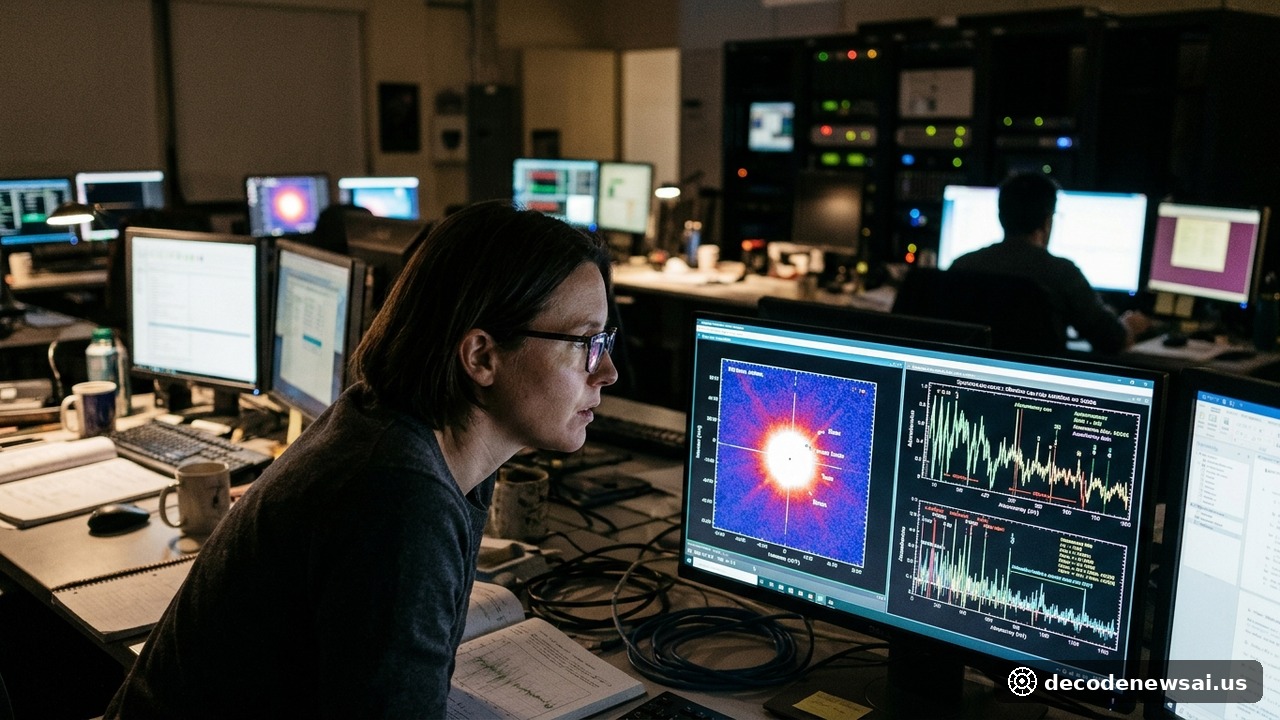
The team used a new detection method for Beta Pictoris d. Traditional direct imaging faces optical limits. The new planet is about 100 times fainter than Beta Pictoris b in optical wavelengths. Researchers did not look for an isolated point of visible light. They extracted spectral signatures of atmospheric carbon monoxide using Webb's Near-Infrared Camera (NIRCam).
多行星成像系统的扩展与比较实验室
The confirmation makes Beta Pictoris only the second known system with three directly imaged exoplanets. Such system benchmarks are very scarce. The three-planet architecture gives astrophysicists a comparative laboratory. They can study how giant planets shape dust disks in early evolutionary phases.
Aidan Gibbs led the investigation. He is a postdoctoral researcher at the University of California, San Diego. The findings were published in The Astrophysical Journal Letters. Independent optical observations from the European Southern Observatory's Very Large Telescope in Chile confirmed the planet's physical coordinates.
Gibbs described the work in an official NASA science announcement. Gibbs stated: "This discovery adds another piece to an already fascinating planetary system. Beta Pictoris has long served as a laboratory for understanding how planetary systems form and evolve, and now we have another planet helping us tell that story."
光谱特征为暗弱行星搜索确立新方法
Astrophysicists stress that spectral identification bypasses classical direct imaging limits. Observation capabilities are expanding. In young circumstellar systems, intense stellar glare and reflective dust disks often hide faint planets from conventional coronagraphic imaging.
Webb's high-resolution infrared spectrographs show a viable path to finding deeply concealed exoplanets. The method tracks distinct atmospheric molecular bands. Molecular analysis penetrates optical dust veils. Researchers register specific chemical wavelengths tied to carbon monoxide. That lets them separate planetary emissions from surrounding circumstellar dust.
Astronomers plan follow-up spectroscopic exposures with Webb's Mid-Infrared Instrument. Orbital constraints will be mapped more precisely. The discovery validates spectroscopic direct imaging as an essential tool. It can identify unseen giant worlds across the Milky Way.
跨天文台数据More与理论意义
The confirmation of Beta Pictoris d shows the growing power of multi-observatory data synthesis. Synergistic analyses proved decisive. Astronomers combined high-resolution infrared spectroscopy from orbit with adaptive optics observations from ground observatories. They isolated the planet's atmospheric emission profile from stellar diffraction patterns.
Astrophysicists stress that studying multiple planets in one young system gives unmatched constraints on planetary migration models. Protoplanetary dynamics remain complex. Orbital interactions continue to shape the architecture of Beta Pictoris. Comparative chemical profiling across all three giant planets will provide fundamental empirical benchmarks. These benchmarks will help understand chemical diversity and atmospheric evolution of planetary systems across the galaxy. They also expand frontiers for future space telescope exploration.