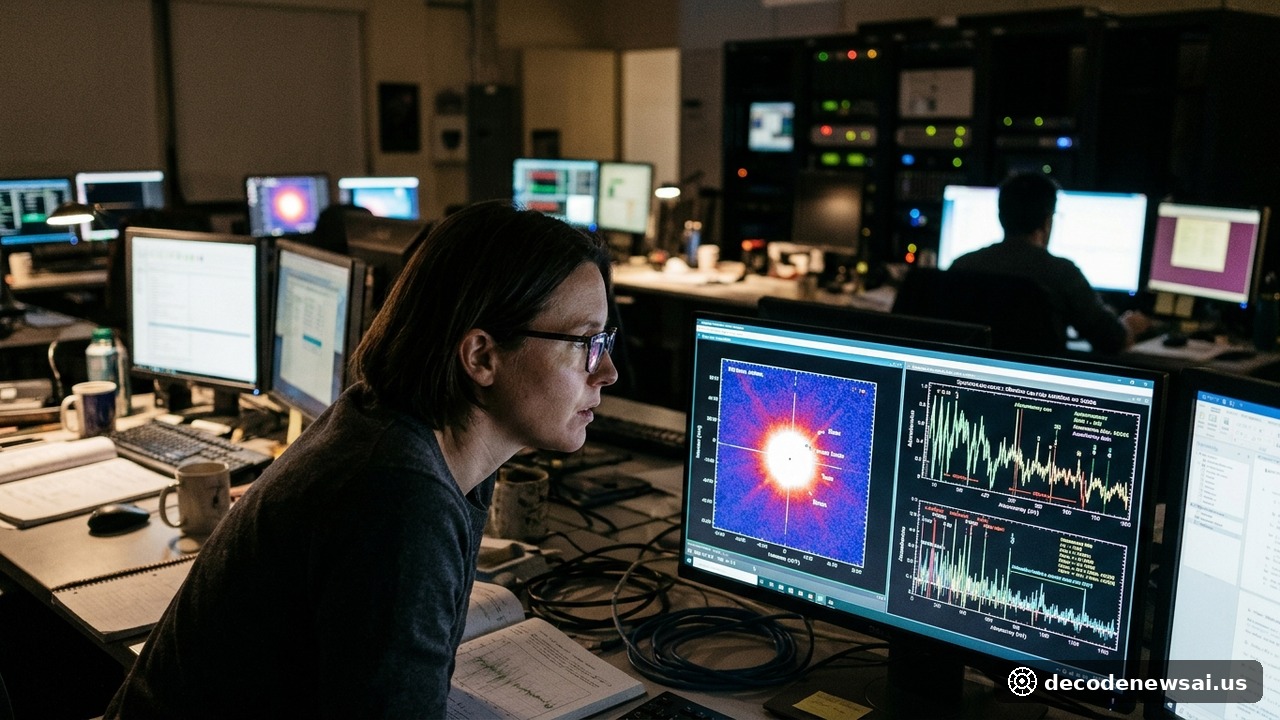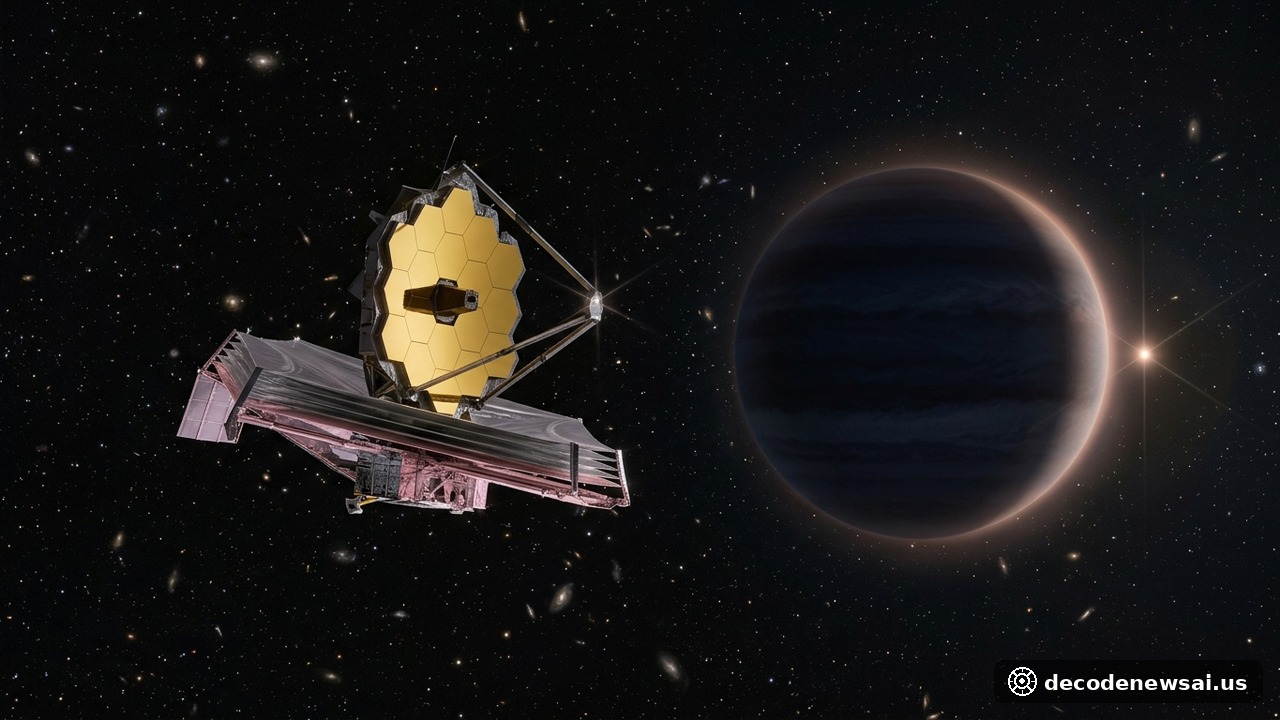
NASA, the European Space Agency, and international research universities unveiled benchmark exoplanetary observations in early November 2026, demonstrating that the James Webb Space Telescope (JWST) successfully captured the direct image and atmospheric spectral profile of a cold giant exoplanet concealed behind intense host star glare; utilizing a hybrid coronagraphic technique that subtracts optical diffraction patterns in real time, astronomers isolated the distant gas giant's thermal infrared emission and confirmed atmospheric sulfur dioxide, methane, and water vapor absorption lines.
What Observational Benchmarks Distinguish JWST's Direct Exoplanet Discovery?
- Core Optical Innovation Architecture: Reference Differential Imaging + High-Contrast Coronagraph
- Target Planetary Physical Classification: Cold wide-orbit gas giant companion
- Atmospheric Absorption Molecular Detections: Photochemical Sulfur Dioxide (SO2) & Methane
- Primary Peer-Reviewed Publication Venue: Nature Astronomy Scientific Submission
Why Does Extreme Stellar Glare Obstruct Direct Imaging of Outer Planets?
Throughout decades of exoplanetary discovery, the vast majority of cataloged worlds were detected indirectly via transit photometry—recording microscopic dips in host star brightness—or radial velocity doppler shifts. While effective for close-in orbits, transit techniques cannot resolve the physical spatial orientation or unperturbed thermal structure of distant outer planets.
Direct imaging represents an immense technological hurdle because stars outshine their orbiting planets by factors exceeding several billions in visual and near-infrared spectra. Attempting to photograph a cold Jovian world alongside its luminary is analogous to resolving a bioluminescent firefly hovering millimeters from a high-intensity lighthouse searchlight kilometers away. Even JWST's segmented gold-coated beryllium mirror array suffers from internal diffraction spikes that saturate hypersensitive infrared detector arrays.
How Did Reference Differential Imaging Filter Out Overwhelming Stellar Glare?
To overcome optical saturation, astronomers developed a complementary pipeline combining onboard physical starlight suppression with algorithmic differential subtraction. While JWST's micro-machined coronagraph masks block the direct starlight cone, residual light bleeds through secondary mirror supports.
The team recorded comparative point-spread functions across designated reference stars lacking orbiting companions. Advanced post-processing algorithms reconstructed internal scattering aberrations with nanometer-level fidelity, systematically subtracting the star's glare from raw observational matrices. With optical noise suppressed beneath physical limits, the cold giant planet emerged from the background dark, enabling scientists to measure its unadulterated thermal flux and orbital radius without contamination.
What Are the Scientific Implications for Detecting Atmospheric Biosignatures?
Following direct optical confirmation, the telescope engaged its Near-Infrared Spectrograph (NIRSpec) to harvest multi-wavelength transmission and emission data, generating pristine continuous spectral absorption curves.
The data revealed conclusive signatures of atmospheric water vapor, dense methane clouds, and photochemical sulfur dioxide created as high-energy ultraviolet radiation drives disequilibrium chemistry across upper planetary stratospheres. Successfully imaging cold gas giants on decadal orbits proves that JWST's coronagraphic pipelines can isolate pristine planetary atmospheres, establishing foundational observational methodologies necessary to directly detect atmospheric biosignatures on temperate terrestrial worlds throughout coming observation cycles.
What Next-Generation Technologies Will Follow the Direct Exoplanet Breakthrough?
Building upon the coronagraphic starlight suppression demonstrated by the James Webb Space Telescope, astronomical consortiums are refining coronagraphic masks for future flagship missions, including the Nancy Grace Roman Space Telescope and the Habitable Worlds Observatory. These future observatories will deploy advanced starshades to suppress host star glare by factors exceeding ten billion.
Astrophysicists emphasize that mastering differential starlight subtraction is the foundational technical bridge toward characterizing Earth-sized terrestrial planets in habitable zones. By proving that high-contrast algorithms can isolate faint atmospheric signatures, the astronomical community is rapidly advancing humanity's empirical capability to search for atmospheric oxygen, ozone, and biological indicators across nearby star systems.