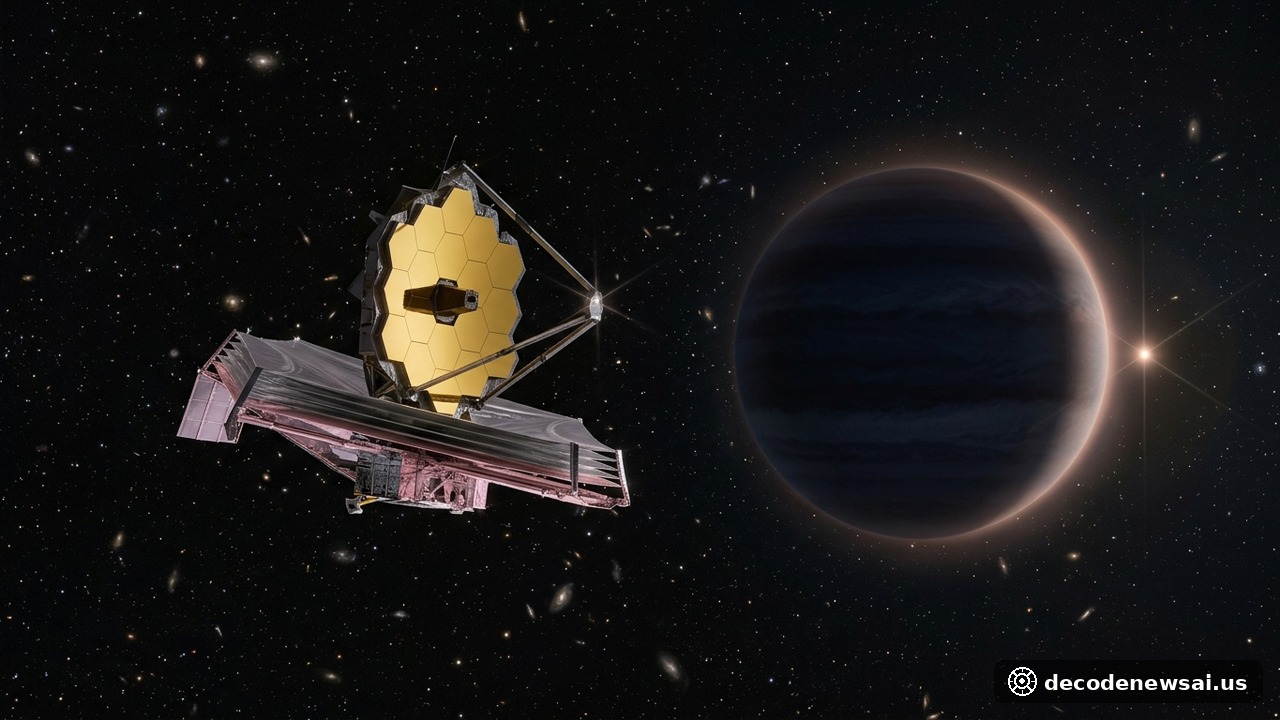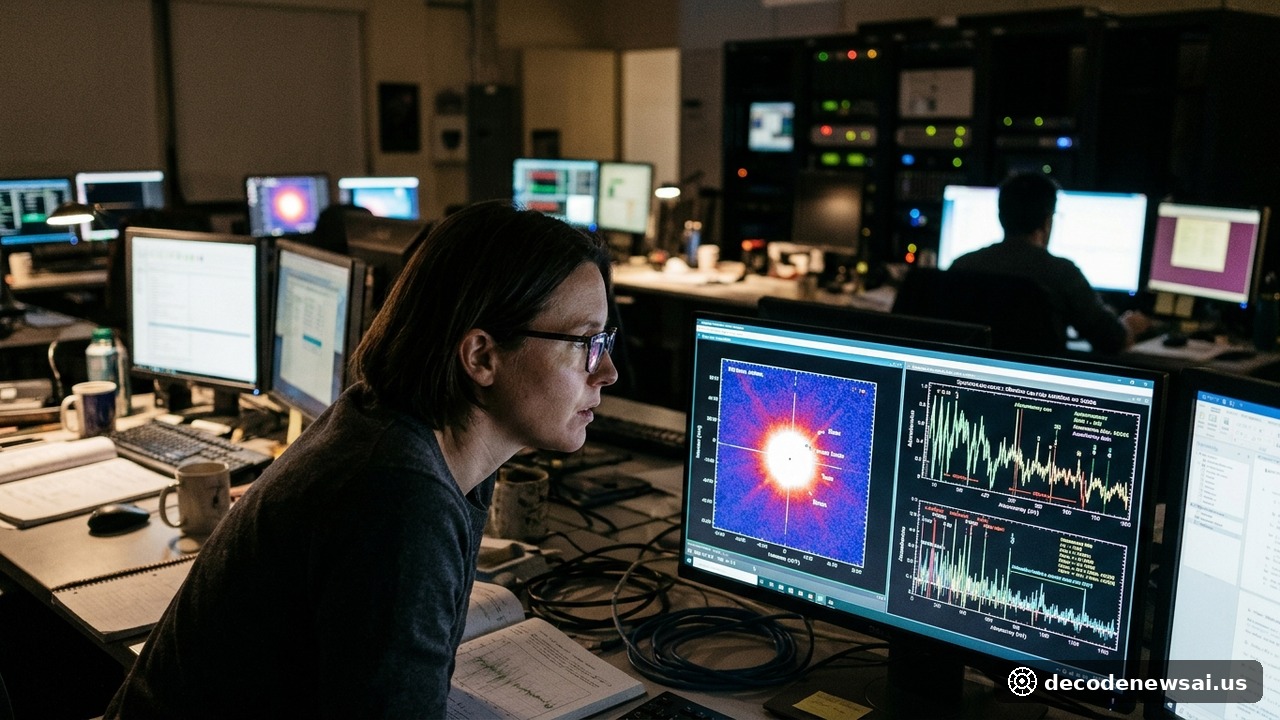
Astronomers operating the NASA, ESA, and CSA James Webb Space Telescope (JWST) in collaboration with astrophysicists at Northwestern University revealed a breakthrough observational achievement on November 6, 2026. Deploying an innovative physics-grounded post-processing algorithm designated FLIP (Forward-model Linear Inversion of Point Spread Function), researchers recovered direct images of the young gas-giant exoplanet 51 Eridani b at 4.3 microns from archival Near-Infrared Camera (NIRCam) data. The Jupiter-analog world, situated approximately 96 light-years from Earth and orbiting its bright host star at an orbital separation comparable to Saturn, had previously remained entirely obscured by overwhelming stellar diffraction halos in standard coronagraphic reductions.
Observational Specifications and Direct Imaging Breakthrough Metrics
- Extreme Planet-to-Star Optical Contrast Ratio: Roughly One-Millionth the Flux of the Host Star
- Algorithmic Signal-to-Noise Gain Metric: Up to 15x Sensitivity Lift Over Standard PCA
The Physical Obstacles Governing Direct Imaging of Exoplanetary Systems
Direct imaging of extrasolar worlds represents one of the most formidable technical hurdles in modern observational astrophysics.
Metaphorically, attempting to photograph an exoplanet is equivalent to resolving a tiny, flickering firefly hovering inches away from a high-intensity coastal lighthouse beacon located miles away. In the 51 Eridani system, the twenty-million-year-old host star shines with intense stellar luminosity, while the planet 51 Eridani b—despite possessing twice the mass of Jupiter—emits infrared flux that is more than one million times fainter than its primary star. Although the James Webb Space Telescope incorporates high-precision coronagraphic masks, microscopic mirror edge diffraction and thermal distortions produce quasi-static optical speckles. In the crucial 4.3-micron mid-infrared filter, standard high-pass filtering and principal component analysis (PCA) algorithms could not differentiate stellar speckles from authentic planetary signals, causing earlier reduction pipelines to yield null detections.
Reconstructing Deterministic Point Spread Functions via Forward Linear Inversion
Astrophysicists at Northwestern University resolved this observational dilemma by abandoning purely empirical statistical subtraction models.
Pioneering Atmospheric Characterization for Giant Planets and Future Habitable Worlds
The unmasking of 51 Eridani b across mid-infrared channels marks a monumental milestone for exoplanetary atmospheric chemistry and planetary evolution studies.
The 4.3-micron spectral window occupies a critical diagnostic band where key volatile compounds—including carbon dioxide, carbon monoxide, and methane—exhibit intense molecular absorption signatures. Comparing the pristine infrared photometry isolated by FLIP against synthetic atmospheric evolutionary models, astronomers confirmed intense methane disequilibrium and vigorous vertical convective mixing within the young planet's gaseous envelope. Crucially, the FLIP pipeline is completely open-source and software-based, requiring no hardware modifications to existing telescopes. It can be immediately executed across vast existing JWST survey archives and adapted for the Nancy Grace Roman Space Telescope, equipping astronomers with a definitive mathematical tool to extract habitable terrestrial planets from blinding stellar glare.