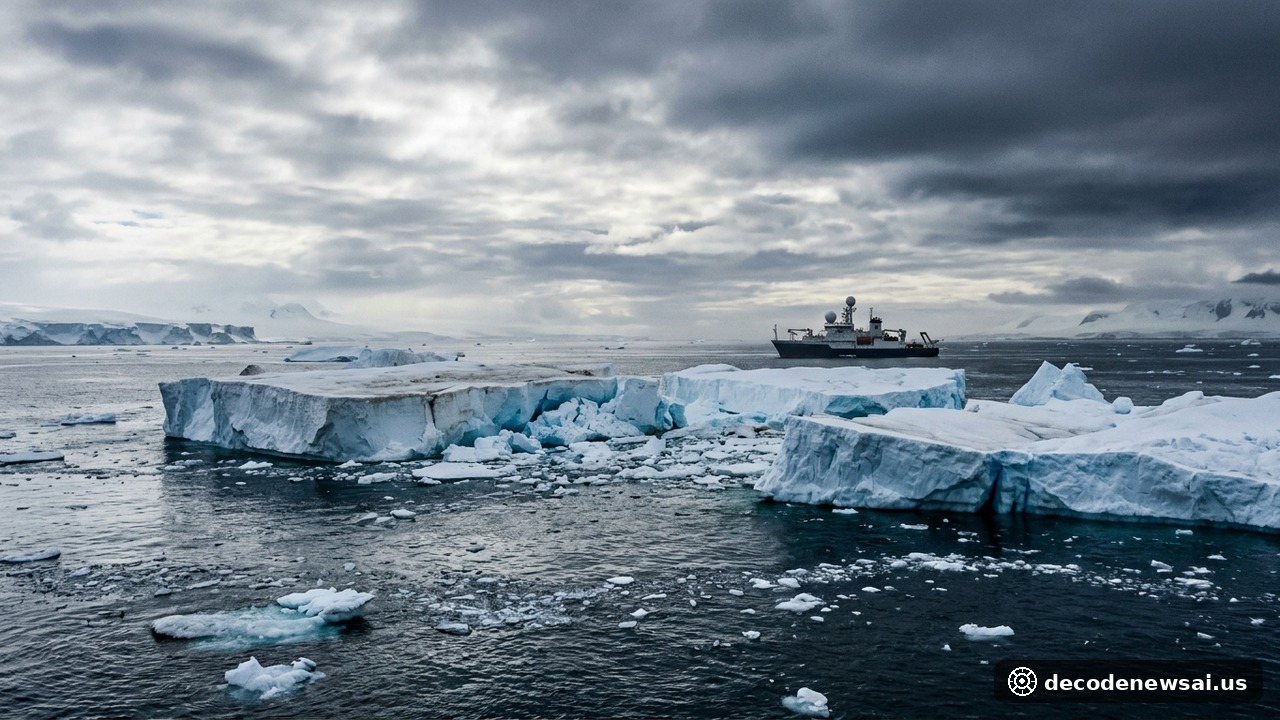
The British Antarctic Survey (BAS) alongside international polar research oceanographers published comprehensive climate telemetry in early November 2026, confirming that historically unprecedented El Niño atmospheric patterns paired with upwelling Circumpolar Deep Water drove Antarctic sea ice coverage down to absolute historical lows for early spring; concurrently, geophysical analyses published in Nature Communications by Max Planck researchers demonstrate that massive glacial meltwater pulses entering the Southern Ocean are driving severe stratification across Antarctic Bottom Water (AABW) convective pumps, threatening to decelerate the global thermohaline overturning circulation.
What Core Observational Metrics Document the 2026 Antarctic Sea Ice Collapse?
- Early Spring Sea Ice Extent Deficit: Fell beneath absolute satellite record;Lowest October–November ice extent;British Antarctic Survey (BAS)
- Antarctic Winter Maximum Peak: Third-smallest winter maximum on record;Structural departure from historical mean;European Geosciences Union (EGU)
- Antarctic Bottom Water (AABW) Flow: Deep convective renewal declined by >30%;Weakening deep-sea oxygenation vectors
- Atmospheric Circulation Perturbation: Historic atmospheric pressure anomalies;Tropical Pacific El Niño teleconnections
- Primary Peer-Reviewed Empirical Study: Published in Nature Communications;Links subsurface thermal flux to ice loss;Springer Nature Publishing Group
Why Did the Historic Antarctic Sea Ice Equilibrium Collapse Into Rapid Retreat?
Throughout prior decades of anthropogenic climate warming, Antarctic sea ice maintained relative geographic stability, insulated by vigorous Southern Ocean westerly wind rings and deep circumpolar vortex structures that occasionally produced record-high winter extents even as Arctic sea ice experienced continuous linear decline.
However, polar oceanographers led by Dr. Tom Bracegirdle at the British Antarctic Survey demonstrate that the protective Antarctic buffer broke down permanently after 2016, entering an irreversible phase shift between 2023 and 2026. High-resolution synthetic aperture radar satellites show that across the Weddell, Bellingshausen, and Amundsen seas, spring melt acceleration diverged sharply from decadal climate model simulations, collapsing structural margins and tracking well beneath historical floors.
How Do El Niño Teleconnections and Circumpolar Deep Water Form Feedback Loops?
Deploying hundreds of autonomous deep-diving Argo profilers alongside autonomous underwater gliders, researchers isolated the coupled thermodynamic mechanisms accelerating ice disintegration.
A record-strength El Niño phase across the equatorial Pacific induced sweeping atmospheric pressure waves across the southern hemisphere, channeling humid subtropical air masses directly over the Antarctic Peninsula. Concurrently, accumulating global ocean heat accelerated the shelfward intrusion of warm, saline Circumpolar Deep Water (CDW). This subsurface thermal assault melts the grounding zones of marine-terminating ice shelves from below, calving floating glacial tongues and destabilizing thousands of square kilometers of sea ice into warmer northern latitudes.
What Are the Global Ecological Ramifications of a Stalling Deep Ocean Conveyor?
The peer-reviewed synthesis in Nature Communications warns that rapid cryospheric melting discharges trillions of metric tons of low-density freshwater into pristine Southern Ocean surface layers.
This buoyant freshwater layer forms a permanent physical barrier preventing dense, cold surface brines from sinking, paralyzing the formation of Antarctic Bottom Water. As the primary engine driving global thermohaline conveyor belts, AABW transports cold, oxygenated water across abyssal trenches throughout the Atlantic, Pacific, and Indian basins. Decelerating this oceanic pump threatens to expand deep-sea anoxic dead zones, compromise pelagic fisheries, and weaken the deep ocean's structural capacity to sequester planetary carbon emissions.
How Does Southern Ocean Meltwater Feedback Impact Antarctic Marine Ecosystems?
Beyond driving ocean circulation slowdowns, the rapid accumulation of low-salinity glacial meltwater fundamentally alters Southern Ocean marine biogeochemistry. Cold surface meltwater layers reduce sunlight penetration and disrupt seasonal phytoplankton blooms that anchor the Antarctic food web.
Marine biologists caution that collapsing sea ice platforms threaten crucial breeding and foraging habitats for krill, Adélie penguins, and crabeater seals. Because Antarctic krill represent the keystone nutrient source supporting baleen whales and seabirds, sustained cryospheric breakdown initiates cascading ecological disruptions that threaten biodiversity across fragile polar marine reserves.