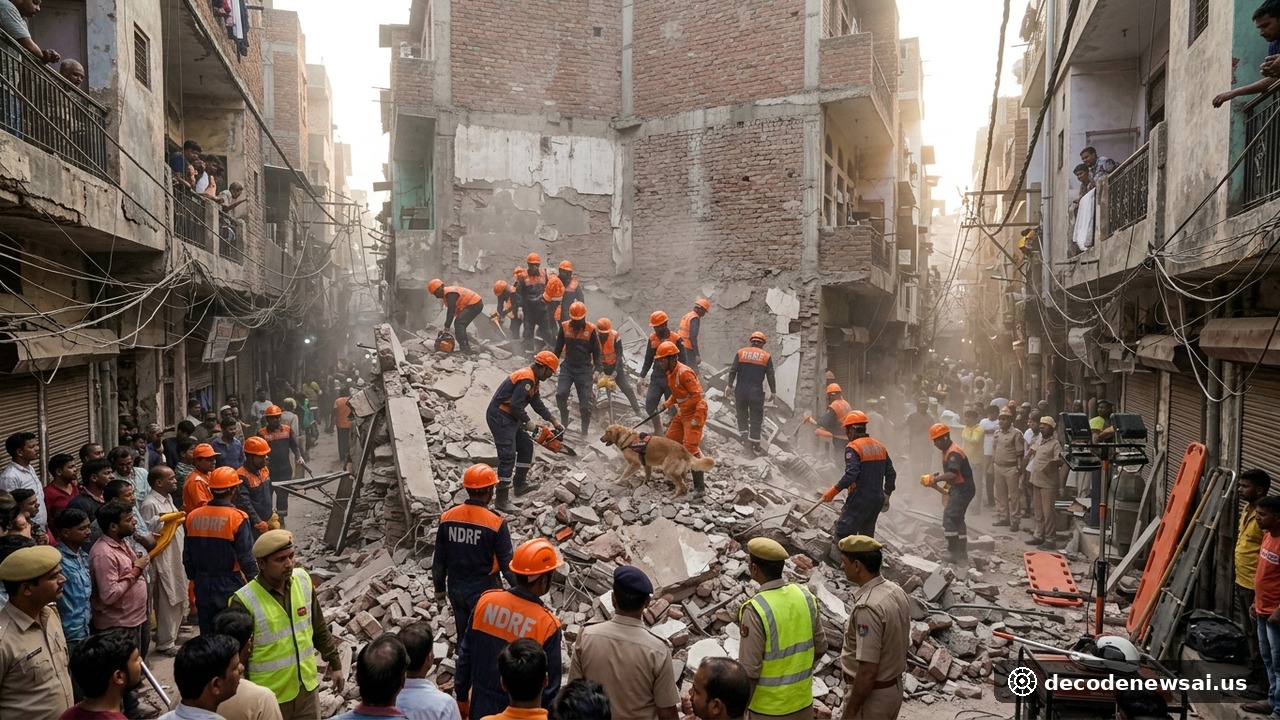
The confirmed death toll resulting from the catastrophic collapse of a three-storey commercial-residential building in central Delhi's historic Hauz Qazi quarter rose to seven on the morning of November 8, 2026. The grim milestone was reached as search and rescue teams from the National Disaster Response Force (NDRF) and the Delhi Fire Service recovered the body of a 66-year-old resident from deep within the rubble pile, marking more than seventy hours of continuous emergency operations. Delhi Police confirmed the formal arrest of the commercial property owner and three independent construction contractors on charges of culpable homicide not amounting to murder. Municipal authorities revealed that structural remodeling that compromised ground-floor load-bearing masonry walls was executed without approved architectural permits, igniting intense civic outrage across the Indian capital.
Casualty Metrics and Judicial Investigation Parameters in Hauz Qazi Disaster
- Confirmed Fatality Count & Operation Span: 7 Fatalities Recovered; Ops Exceeding 70 Hours
- Indicted Corporate and Construction Principals: 4 Arrests (Property Owner and 3 Contractors)
- Geographic Location & Collapsed Structure: Hauz Qazi Commercial Hub Near Chawri Bazar;NDTV National Broadcast Operations
- Regulatory Permitting & Building Integrity: MCD Confirms Zero Sanctioned Structural Plans;Press Trust of India Wire Service
Formidable Physical Hazards Hampering Prolonged Subterranean Rescue Operations
Situated adjacent to the historic Chawri Bazar wholesale corridor, Hauz Qazi represents one of Old Delhi's most densely populated and architecturally fragile urban sectors.
The collapse occurred without advance structural warning on November 5, causing the aging masonry structure to pancake entirely within seconds and trapping morning store employees and residential tenants beneath reinforced concrete slabs. Because the surrounding access alleys measure barely a few meters across, heavy mechanical excavators and crane transports could not navigate to the central collapse zone. Consequently, hundreds of NDRF rescue personnel were compelled to utilize hydraulic spreaders, acoustic listening probes, and trained canine teams to lift debris manually. Complicating operations significantly, seasonal atmospheric inversions following the Diwali holiday caused regional Air Quality Index readings to spike past 384 into the severe hazard zone, forcing tactical teams to operate through suffocating particulate smog that compromised pulmonary stamina.
Criminal Culpability and Municipal Governance Failures in Unsanctioned Alterations
As recovery operations neared conclusion, the Delhi Police Crime Branch executed comprehensive enforcement operations targeting the commercial entities responsible for the collapse.
Preliminary structural engineering reports indicate that the primary trigger of the building failure was the reckless demolition of central ground-floor load-bearing brick columns, executed to expand floor space for a wholesale hardware logistics warehouse. In formal affidavits submitted to the Delhi High Court, the Municipal Corporation of Delhi admitted that the structure possessed zero approved renovation permits, constituting an illegal and uninspected structural modification. However, local merchant associations and victims' families rejected administrative explanations, staging demonstrations outside local police facilities alleging that municipal inspectors routinely accept financial bribes to ignore pervasive building code violations throughout the historic precinct.
The Urban Renewal Dilemma Across Historic Megacity Architectural Precincts
The fatal collapse in central Delhi has reignited urgent national debates regarding urban safety standards and historical district preservation across developing South Asian metropolises.
Urban planning institutes estimate that within Old Delhi alone, tens of thousands of structures surpassing sixty years in service life remain in advanced states of structural fatigue. These aging buildings house millions of low-income tradespeople, but complicated joint family ownership titles and inadequate resettlement funds lead property owners to resist condemnation orders, frequently adding unauthorized vertical floors to maximize rental yield. India's Ministry of Housing and Urban Affairs acknowledged Supreme Court mandates directing metropolitan governments to enforce dynamic structural audit classifications. Nevertheless, without subsidized urban renewal financing, Indian city administrators face profound challenges balancing working-class tenancy rights against the urgent necessity of removing death-trap structures.