A research team led by North Carolina State University has solved a perplexing mystery that has challenged the region's blueberry industry for over a decade. In a landmark study published in the Journal of Integrated Pest Management, researchers utilized DNA barcoding techniques to definitively identify the destructive subterranean pest attacking commercial blueberry root systems: Prionus imbricornis, a native wood-boring longhorn beetle known colloquially as the tile-horned prionus. Capable of growing up to five inches (12.7 centimeters) in length, the massive larvae feed undetected below ground, hollowing out roots and causing mature blueberry bushes to decline and die. The discovery establishes North Carolina as the first state in the nation to document Prionus imbricornis actively infesting and destroying cultivated blueberry bushes. Solving a Decade-Old Agricultural Mystery Beneath North Carolina Blueberry Farms Reports of unidentified, giant insect larvae feeding on and causing severe destruction to blueberry root systems in southeastern North Carolina date back to 2010. For more than ten years, commercial fruit growers and entomologists struggled to identify the exact insect species responsible for the damage. Identifying the subterranean pest was complicated because the larvae live hidden deep within the soil and root crowns of host plants, making direct field observation and tracking exceptionally challenging. Furthermore, larvae belonging to different longhorn beetle species exhibit very similar morphological features, rendering visual identification through traditional morphological criteria unreliable.
Five-Inch Prionus Larvae Feed Hidden Underground on Blueberry Roots
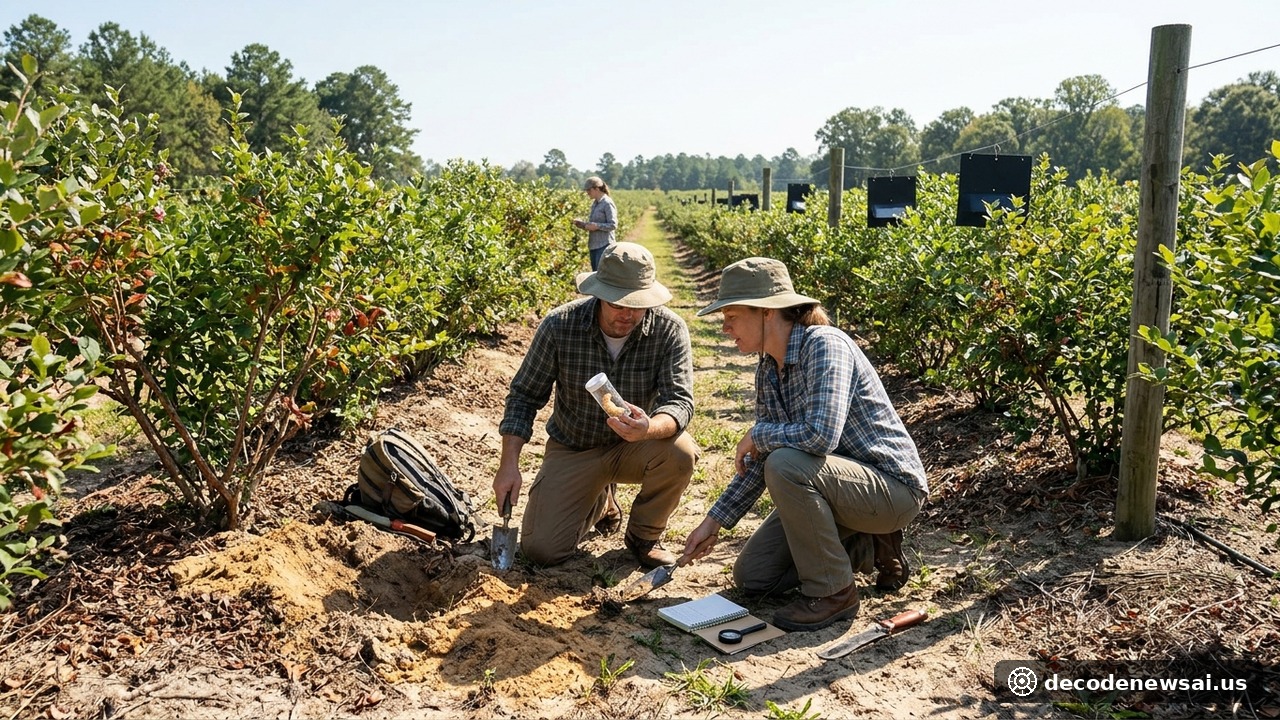
To uncover the true identity of the pest, the research team conducted comprehensive field investigations across six commercial blueberry farms located in Pender, Sampson, Bladen, and New Hanover counties. The scientists deployed a series of black panel traps baited with synthetic sex pheromones, using specific chemical scent signals to capture adult beetles emerging in the area. The researchers then collected multiple unknown larvae actively infesting blueberry fields and applied genetic barcoding, a high-precision molecular diagnostic method that analyzes standardized DNA segments. By comparing the larval DNA sequences with genetic reference material extracted from known adult Prionus specimens, the scientists achieved a definitive match. The genetic barcoding results matched Prionus imbricornis with 98 to 99 percent accuracy, confirming the species responsible for the subterranean root damage.
Lead author Kenneth Geisert, a graduate student in NC State's College of Agriculture and Life Sciences, explained that the lack of precise species identification previously undermined control efforts: "Before now, researchers often just assumed the species of Prionus on their commodities based on adult identification. If that guess was incorrect, it could mean using a treatment strategy that did not line up with the problem and incorrectly associating species and their hosts. For instance, while P. imbricornis attacks roots, another type of longhorn beetle might attack the trunk of a tree, or dead branches. Without knowing which species of beetle you're dealing with and their ecology, incorrect management can cause adverse effects on non-target insects." Hidden Underground Feeding: Five-Inch Larvae Threaten Plant Root Systems Prionus imbricornis is native to the eastern United States and is typically associated with hardwood tree hosts. Adult beetles are characterized by their prominent antennae, and they do not feed during their adult stage. Female beetles deposit their eggs directly into the soil near the base of host plants. Once hatched, the larvae bore into woody root tissues, where they feed extensively and can reach up to five inches in length before pupation. While the beetle has long been known to kill forest trees by excavating extensive underground root networks, its shift to commercial highbush blueberries represents a newly recognized agricultural threat.
No Labeled Insecticides for Prionus in North Carolina Blueberries
Unlike foliar, stem, or fruit pests whose damage can be easily monitored from above ground, root-boring pests operate completely out of sight. A robust root system is essential for blueberry bushes to absorb moisture and vital soil nutrients. As the five-inch larvae tunnel through subterranean root crowns, they hollow out the woody core, compromising structural stability and halting vascular transport. Because this damage occurs beneath the soil line, growers often observe no warning signs until bushes display sudden branch dieback, severe wilting, or complete plant collapse, at which point excavation reveals massive grubs lodged inside the ruined root systems. The Challenge of No Approved Insecticides and Moving Toward Targeted Management While identifying the specific beetle marks a pivotal scientific milestone, it also underscores significant operational hurdles for commercial blueberry producers. Co-author Lorena Lopez, an assistant extension professor in NC State's Department of Entomology and Plant Pathology, highlighted the dual reality of the discovery: "On one hand, it's very important that we know which species we're dealing with. On the other, North Carolina was the first state to ever report Prionus infestation in blueberries, and there are no insecticides currently labeled against this pest in blueberries."
To address this chemical regulatory deficit, Lopez and her research group have initiated rigorous insecticide evaluation trials to identify candidate compounds capable of controlling the pest. Researchers emphasize that effective management hinges on synchronizing chemical or biological applications with the reproductive phenology of Prionus imbricornis. By timing treatment regimens with egg hatch and early larval emergence, growers can suppress populations before larvae penetrate deep into the woody root crown and inflict irreversible structural damage. Co-authored by Gareth Powell, assistant professor at NC State and director of the NCSU Insect Museum, the study provides a critical scientific baseline enabling agricultural extension agents and blueberry growers to establish targeted integrated pest management strategies.