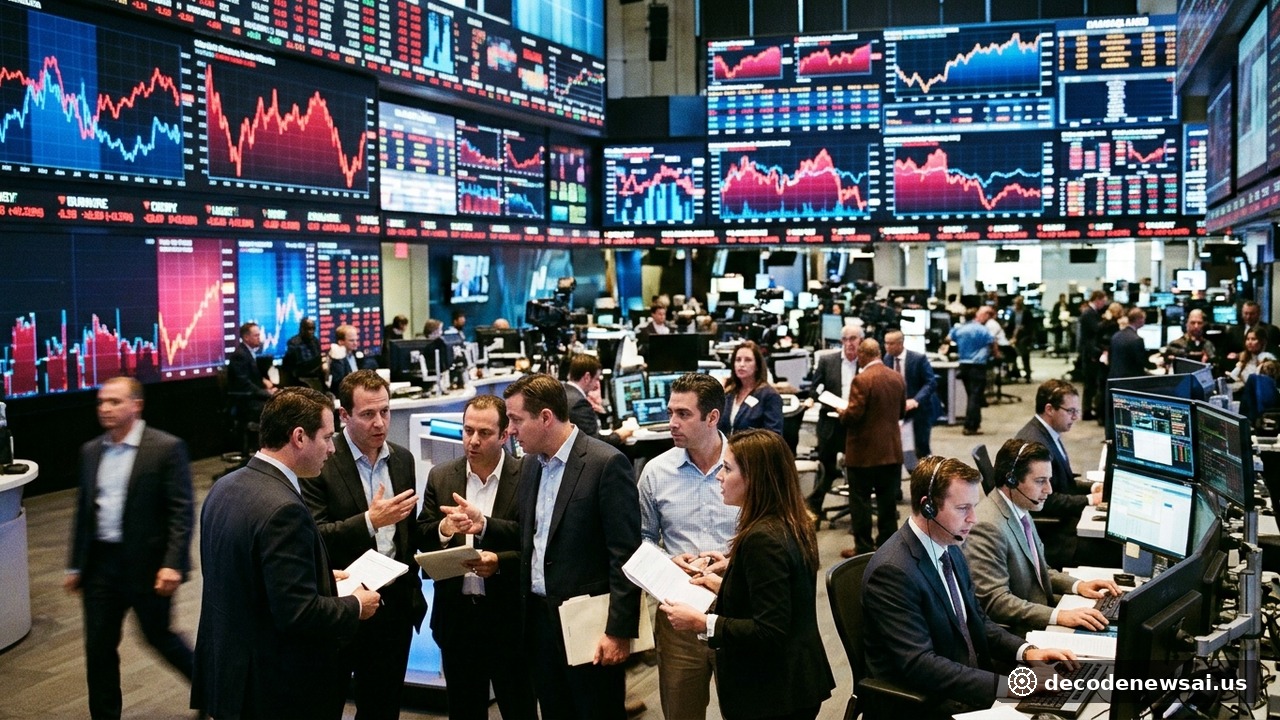
Wall Street technology shares faced widespread revaluation pressures on Sunday following one of the steepest market retrenchments of the year. The Nasdaq Composite index plunged 5.52 percent in a single trading session, settling at 24,315.00 points. The decline placed the technology-heavy benchmark more than 10 percent beneath its all-time high recorded in October. A formal technical correction was officially confirmed. Risk aversion accelerated across institutional trading desks.
S&P 500 and Dow fall as Nvidia drops over 7 percent
The broader S&P 500 index alongside the Dow Jones Industrial Average experienced companion declines during the turbulent trading session. The S&P 500 declined 4.36 percent to conclude at 7,353.73, while the industrial average fell 3.44 percent. Financial analysts verified that the session represented the steepest single-day percentage decline on Wall Street since tariff disruptions in 2025. Institutional portfolios executed widespread profit-taking.
Semiconductor manufacturing bellwethers absorbed the brunt of the market retreat. Shares of Nvidia fell more than 7 percent within the session, while Qualcomm and Applied Materials experienced concurrent declines. Equities responded with acute sensitivity to shifting regulatory postures in Washington following midterm congressional races. Concerns surrounding prospective antitrust scrutiny of artificial intelligence data center construction triggered selling.
Richard Perry, senior equity market strategist at StoneX Financial, evaluated the market correction in a client research briefing. Perry documented: "Extended valuations across technology mega-caps were calibrated for uninterrupted capital expansion, and any indication of regulatory resistance prompts institutional capital to harvest profits immediately." Market sentiment across Wall Street cooled perceptibly.
Europe and Asia futures decline more than 1.5 percent
Equity markets across Europe and the Asia-Pacific region experienced sympathetic downward pressure ahead of Monday openings. Futures contracts tracking Tokyo's Nikkei 225 and Frankfurt's DAX declined by more than 1.5 percent during weekend electronic trading. International safe-haven capital rotated into short-dated United States Treasury paper. Benchmark 10-year Treasury yields declined in response to flight-to-safety flows.
The Cboe Volatility Index surged more than 28 percent within the session to trade above the 22 resistance benchmark. Institutional options desks acquired protective index puts to hedge long equity books against further volatility following upcoming corporate earnings releases. Hedging expenditures rose noticeably across derivative venues. Quantitative funds trimmed net long exposures across active strategies.
Despite the technical correction, the Nasdaq Composite and S&P 500 maintain year-to-date appreciation rates of 4.6 percent and 7.4 percent respectively. Long-horizon value-oriented asset managers began assessing prospective opportunities to accumulate high-quality balance sheets at discounted multiples. However, macro headwinds remain prominent across global markets. Institutional consensus remains deeply fractured regarding market trajectories.
Fed rate futures and upcoming labor data test earnings
Federal Reserve interest rate projections introduced additional uncertainty into broader financial market valuations. Interest rate futures indicate that traders overwhelmingly expect the Federal Open Market Committee to keep borrowing benchmarks unchanged next month. Persistent service-sector inflation continues to encourage policy caution. Deferred interest rate cuts weigh heavily on discounted cash flow valuations for growth assets.
Market attention is turning toward upcoming releases of national labor market reports and consumer expenditure data. Macroeconomic resilience across consumer sectors will test the durability of corporate earnings projections among large-cap technology platforms. Institutional allocators demand higher returns on capital deployments. Growth technology equities face rigorous performance examinations.
Equity strategists at primary brokerages recommended that clients adopt balanced asset allocations across multi-asset portfolios. Capital flows are rotating from mega-cap tech into defensive sectors including utilities and consumer staples. Market volatility cycles are lengthening across global exchanges. Investors must navigate heightened market turbulence.
Volatility funds adjust stop-loss triggers on semiconductor portfolios
Quantitative volatility funds adjusted trailing stop-loss triggers to prevent cascading margin calls across leveraged semiconductor portfolios. Senior asset allocators noted that while technology valuations remain vulnerable to regulatory rhetoric, underlying secular demand for cloud computing infrastructure will continue supporting long-term capital formation.