The Pennsylvania Department of State officially certified the final county-by-county ballot tallies on Sunday, confirming that incumbent Democratic Governor Josh Shapiro secured a decisive second term with 60.4% of the statewide vote. Shapiro defeated Republican nominee and current State Treasurer Stacy Garrity by 22.1 percentage points, establishing the largest gubernatorial margin of victory in the Commonwealth of Pennsylvania in more than three decades. The certified returns cemented Shapiro's broad electoral coalition across crucial suburban and industrial working-class jurisdictions.
Shapiro won over 3.1 million votes and rebuilt I-95 in 12 days
Certified vote totals verified that Shapiro amassed more than 3.1 million votes statewide, turning out robust majorities across historic urban strongholds in Philadelphia and Allegheny County. Crucially, the incumbent governor achieved significant breakthroughs in traditionally conservative suburban and rural battlegrounds, carrying critical counties such as Centre, Erie, and Northampton. Political strategists highlighted that Shapiro outperformed traditional party baselines across nearly every demographic category.
Throughout his initial four-year tenure, Shapiro emphasized pragmatic administrative governance centered on core economic investments and rapid disaster mitigation. His administration earned widespread bipartisan commendation for coordinating the reconstruction of a collapsed elevated section of Interstate 95 in Philadelphia within just 12 days. Furthermore, the administration enacted the largest expansion of senior property tax and rent rebates in state history, effectively insulating elderly homeowners from residential cost pressures.
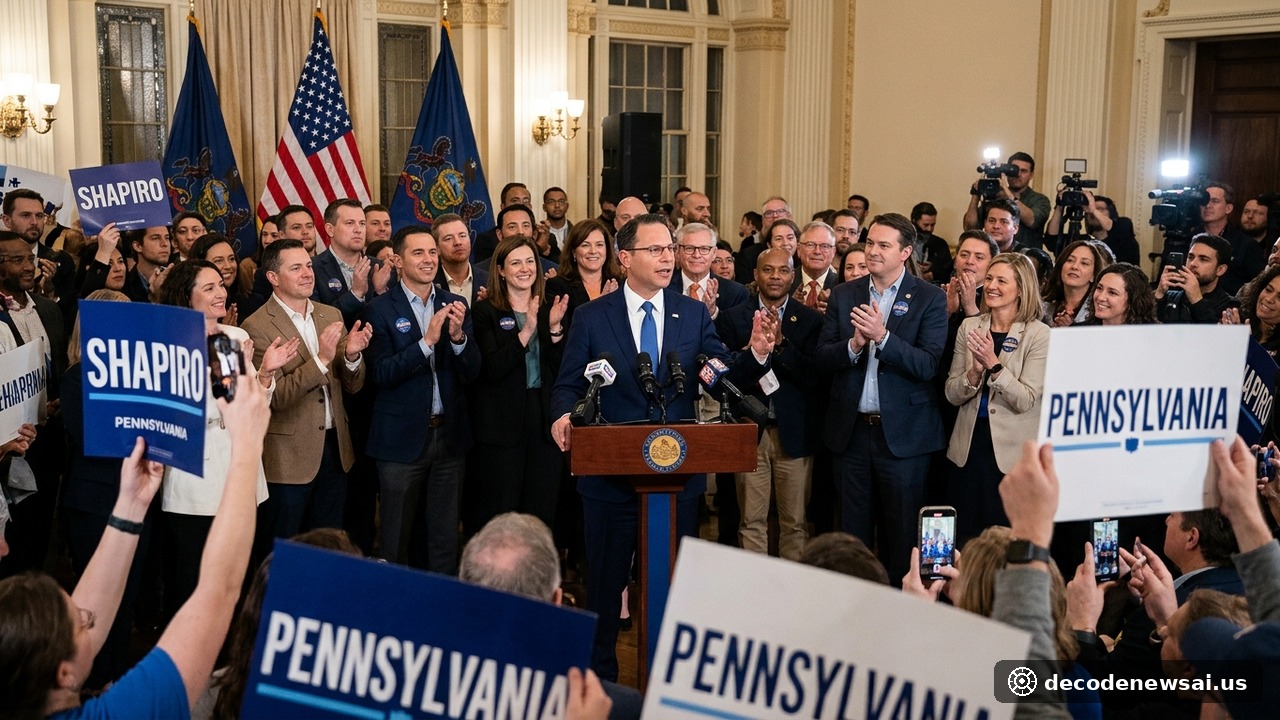
Governor Josh Shapiro addressed thousands of celebrating supporters at his campaign headquarters in Harrisburg, declaring: "The good people of Pennsylvania sent a clear, unmistakable message: getting things done, solving real problems, and rejecting ideological division is what real leadership looks like. We will continue building an economy that works for every family across our commonwealth." Campaign officials reaffirmed an ambitious agenda focused on vocational education and industrial infrastructure.
Garrity conceded as Shapiro won crossover suburban Republicans
Treasurer Stacy Garrity issued a gracious concession statement and telephoned the governor to offer formal congratulations. Garrity's platform centered on corporate net income tax reductions and tighter oversight of state administrative agencies. However, Shapiro's record of maintaining balanced state finances while building emergency reserves exceeding $7 billion blunted conservative fiscal critiques among independent voters.
Electoral data analysts noted that Shapiro's crossover support among moderate Republicans in suburban Philadelphia counties provided an insurmountable mathematical barrier for challengers. Independent voter participation surged in key municipal centers, affirming strong public alignment with bipartisan infrastructure initiatives and pragmatic public safety policies.
National political analysts observed that Shapiro's landslide provides a compelling governing playbook for Democrats competing in battleground Rust Belt states. By prioritizing tangible constituent services, fiscal responsibility, and public safety investments over divisive cultural controversies, pragmatic centrists retain formidable appeal among blue-collar working families. The decisive victory immediately positions Shapiro as a foremost contender within national political discussions heading toward the 2028 presidential campaign.
Shapiro model touted for rural broadband and moderate governance
Political scientists across Pennsylvania universities noted that Shapiro's disciplined governing focus on core physical infrastructure and regulatory predictability resonated deeply across rural working-class townships. By modernizing regional commercial corridors and accelerating permitting workflows for advanced industrial facilities, the administration demonstrated that pragmatic state-level governance delivers tangible economic dividends.
Municipal planning commissions statewide announced expedited timelines for high-speed fiber broadband expansion across underserved Appalachian communities. State matching grants will facilitate private-public telecommunication partnerships to connect rural schools, family agricultural operations, and regional healthcare centers. Bipartisan administrative coordination reinforces long-term economic resilience across the commonwealth.
Furthermore, analysts from nonpartisan policy institutes pointed out that Shapiro's commanding win provides a structural model for moderate governance within key competitive states. By maintaining a disciplined policy cadence, balancing rigorous fiscal management with strategic public investments, and refusing to engage in polarizing political grandstanding, the administration effectively broadened its coalition beyond traditional demographic boundaries. Local civic organizations reported that voter participation across suburban townships reached unprecedented midterm benchmarks, reflecting renewed civic trust in accountable leadership. As state agencies prepare for the upcoming legislative calendar, executive officials reaffirmed their commitment to delivering timely public services, bolstering regional infrastructure resilience, and expanding workforce apprenticeships across vital regional manufacturing sectors.