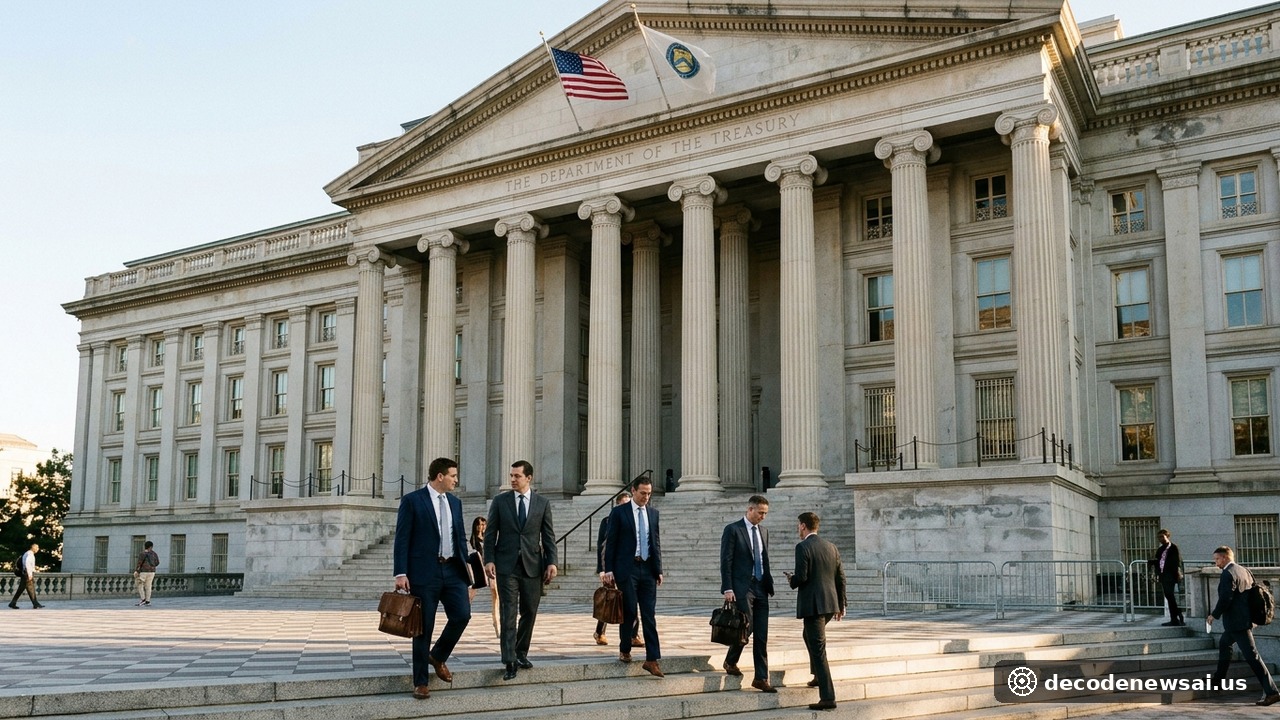
WASHINGTON — The U.S. Department of the Treasury's Office of Foreign Assets Control imposed sweeping financial sanctions on eight Canada-based money services businesses for facilitating illicit transactions on behalf of the Iranian regime. Federal authorities announced the designations under an ongoing cross-border enforcement campaign. The targeted entities systematically converted Iranian rials into digital assets to evade multilateral sanctions. Expansion of Operation Economic Outcast Against Cross-Border Networks The coordinated action represents a major phase of Operation Economic Outcast, an enforcement initiative inaugurated by the Treasury Department in August 2026. Financial scrutiny is tightening. The designated exchange houses maintain storefronts and commercial registrations across Toronto, Vancouver, and Montreal.
Links to Nobitex, Wallex and Ryan Wedding
The sanctions target eight distinct commercial operations. Federal authorities published specific corporate identities. The list includes Vancouver-based 1380079 BC Ltd., operating commercially as Amin Exchange Vancouver and Sarafi Amin. It also includes Toronto-based Nia Nations Currency Exchange, widely known as Nia Exchange. Additional designated entities include Farah Exchange, C Exchange, Cryptoyal, Darvish Exchange, Million Exchange, and Toronto-based Amin Exchange.
These storefront operations provided cross-border money transfer services between Canada and Iran through informal settlement channels. Fund tracing proved difficult. Federal investigators found the businesses regularly facilitated conversions of Iranian rials into Canadian dollars, U.S. dollars, and cryptocurrency tokens while disguising the underlying source of funds. Connections to Iranian Crypto Platforms and Transnational Cartels The Treasury's investigation established direct technical links between the Canadian exchange firms and sanctioned Iranian digital asset infrastructure. The firms routed digital capital through Iranian domestic exchanges. Intermediary platforms included Nobitex and Wallex. Cryptocurrencies formed an integral conduit. Treasury analysts also documented transaction flows directly into digital wallet addresses operated by Iran's Islamic Revolutionary Guard Corps.
The financial network intersected with major international narcotics trafficking investigations. Cartel links surfaced. Federal authorities disclosed that currency exchange locations in Vancouver and Toronto processed illicit funds tied to former Canadian Olympic snowboarder Ryan Wedding. Wedding is currently a fugitive indicted in the United States for running a violent transnational cocaine trafficking ring. Cash revenues from drug trafficking were converted into digital assets and funneled through the Iranian-linked settlement loop.
Bessent Warns Canada Against Harbouring Evasion Nodes
The sanctions block all property and interests in property of the eight businesses within the United States or in possession of U.S. persons. Dollar clearing is entirely barred. Bank accounts are frozen. Financial institutions worldwide are warned that engaging in transactions with these designated entities exposes them to secondary sanctions risk. Secretary Bessent Warns Canada Against Harbouring Evasion Nodes Treasury Secretary Scott Bessent issued a forceful directive alongside the designation package, underscoring the necessity of close bilateral financial cooperation. Regulatory expectations are clear. Bessent stated: "Canada cannot be a safe haven for illicit financial facilitators that provide sanctions evasion services to the Iranian regime and its proxies."
Bessent emphasized that the United States will pursue and dismantle clandestine Iranian financial conduits regardless of geographic jurisdiction. Cross-border regulatory scrutiny is accelerating. American authorities are coordinating with Canadian law enforcement, including the Royal Canadian Mounted Police and the Financial Transactions and Reports Analysis Centre of Canada. They seek to dismantle unlicensed remittance corridors. Heightened Oversight Across Informal Cross-Border Settlement Corridors The enforcement sweep highlights the persistent vulnerabilities within informal cross-border payment circuits. Regulatory agencies are heightening operational oversight. The Financial Crimes Enforcement Network and international compliance partners have repeatedly alerted financial institutions to the risks associated with multi-layered money laundering schemes that blend cash-intensive retail exchanges with decentralized blockchain transactions.
By moving funds through Canadian currency exchanges, illicit networks sought to exploit perceived jurisdictional seams between North American financial regulators. That enforcement gap is narrowing rapidly. American officials emphasized that foreign entities facilitating sanctions evasion face identical legal consequences as domestic operators. Future compliance audits will focus aggressively on identifying nominee corporate directors and unregistered digital asset settlement channels linked to Iranian state enterprises.
Firms Face Immediate Canadian Regulatory Inquiries
The targeted firms now face immediate regulatory inquiries from Canadian provincial and federal authorities. Corporate registries are under review. Financial compliance officers across North America are freezing corresponding bank accounts. The enforcement action signals an aggressive campaign to eliminate unlicensed remittance channels and unauthorized crypto settlement pipelines across the continent.