A comprehensive academic research review published on Saturday by the Harvard Science Review in collaboration with international solid-state battery researchers outlines substantial experimental progress in integrating artificial intelligence workflows with automated chemical synthesis planning. By coupling thermodynamic crystal prediction algorithms directly with kinetic reaction-pathway models, materials scientists achieved unprecedented accuracy in predicting intermediate phase transitions and minimizing synthesis impurities during the fabrication of solid-state electrolytes. The development addresses longstanding kinetic barriers that have historically impeded the commercial development of high-density all-solid-state lithium batteries.
Transition from Theoretical Crystal Predictions to Kinetic Phase Synthesis
The scientific review was officially published on November 7, 2026, marking an essential methodological evolution in computational materials discovery. Historically, generative machine learning applications in inorganic chemistry focused primarily on calculating static thermodynamic ground states for theoretical target compounds, often neglecting real-world kinetic limitations encountered during furnace heating cycles.
Solid-state reaction pathways introduce complex synthesis challenges. A proposed crystalline compound may be thermodynamically stable on paper yet remain practically unfeasible to synthesize due to sluggish solid-state diffusion, competitive intermediate phases, or unfavorable chemical selectivity.
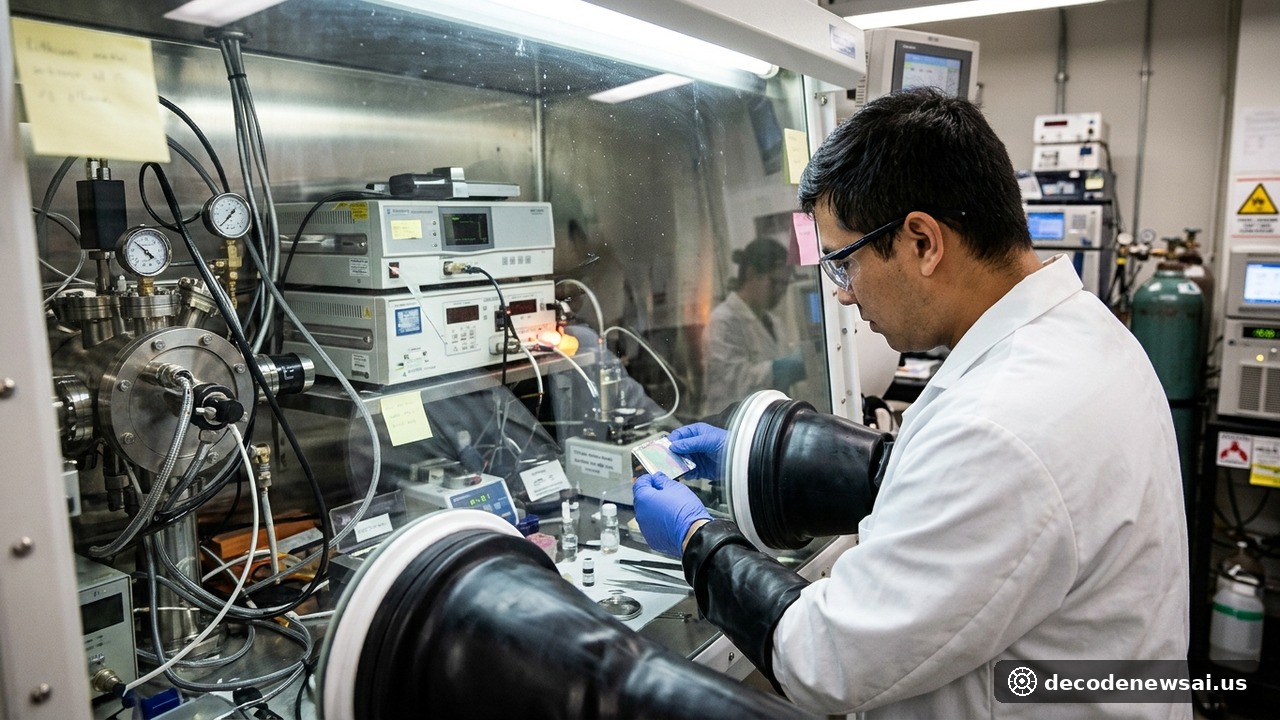
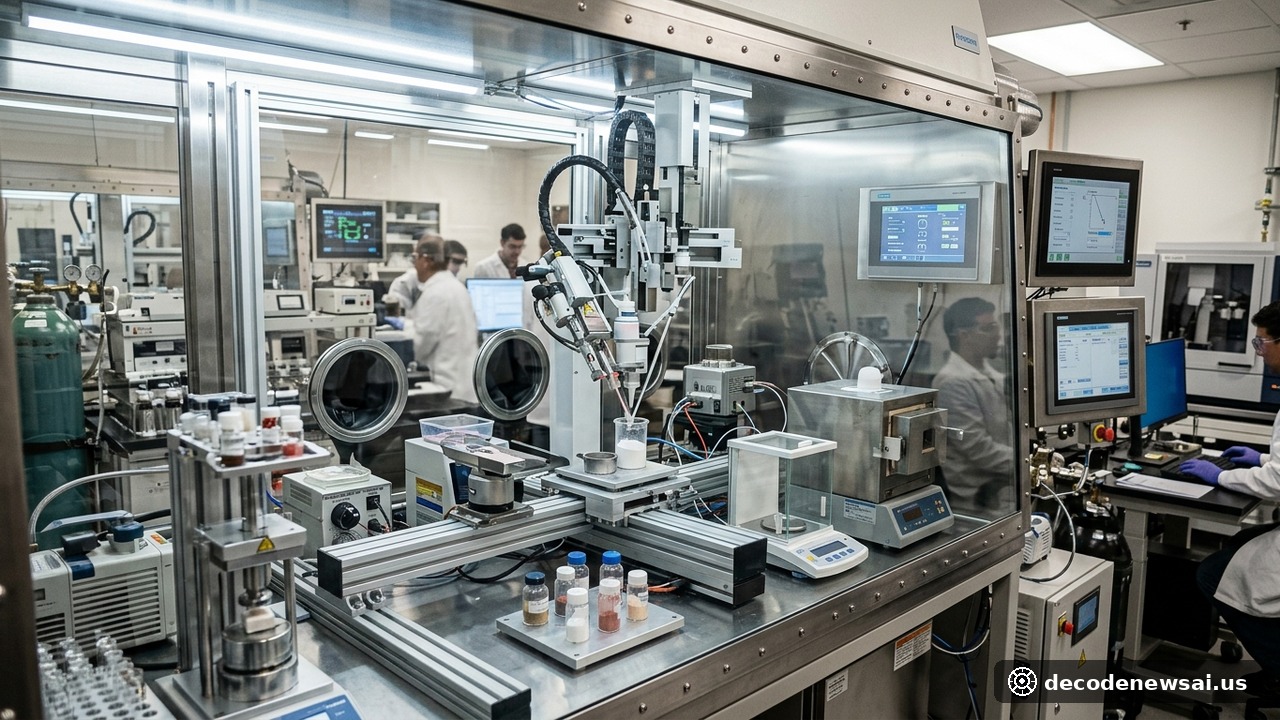
The computational framework integrates literature-derived precursor formulations, graph neural networks, and automated closed-loop synthesis hardware. The system autonomously evaluates energetic migration barriers and predicts whether heated chemical mixtures will yield phase-pure electrolytes or degrade into non-conductive parasitic phases, accelerating laboratory synthesis workflows from years into weeks.
Resolving Critical Interfacial Resistance in High-Energy Solid Electrolytes
Solid-state battery commercialization faces persistent engineering hurdles at the solid-solid electrode boundary. High-voltage lithium metal anodes frequently undergo chemical degradation and mechanical delamination during cycling, forming microscopic lithium dendrites that short-circuit internal cells.
The AI-guided kinetic platform identified several novel composite sulfide and oxide solid-state electrolyte formulations exhibiting remarkable electrochemical stability. Laboratory electrochemical impedance spectroscopy confirmed that the optimized crystalline structures achieved bulk ionic conductivity surpassing 15 millisiemens per centimeter while reducing interfacial charge-transfer resistance by approximately 60 percent.
Principal investigators emphasized the transformative industrial utility of predictive kinetic modeling. In a keynote address delivered during the materials symposium, Dr. Elena Rostova, Lead Researcher for the Advanced Energy Materials Initiative, stated, "Incorporating kinetic reaction pathway modeling directly into AI materials platforms enables researchers to bypass experimental dead ends, dramatically expediting the synthesis of commercially viable solid-state electrolytes."
Commercialization timelines and energy transition implications
Commercialization Timelines and Energy Transition Implications
Automotive manufacturing conglomerates view all-solid-state batteries as a critical technological milestone for electric mobility. Compared to conventional liquid lithium-ion cells, all-solid-state architectures can deliver gravimetric energy densities exceeding 500 watt-hours per kilogram while inherently eliminating thermal runaway risks associated with flammable liquid organic solvents.
Global automotive manufacturers and battery cell suppliers are constructing pilot manufacturing facilities to validate scalable production methodologies. Industrial developers are securing intellectual property rights around novel AI-discovered crystalline compositions to establish competitive market positions ahead of projected commercial rollouts.
Subsequent research will concentrate on addressing scalable powder densification and thin-film separator fabrication under industrial manufacturing tolerances. Collaborative research networks are expanding algorithmic training repositories to include non-lithium conductors, fostering the development of sodium-ion and multivalent solid-state storage technologies. Materials scientists emphasize that data-driven synthesis protocols will dramatically accelerate commercial timelines across the renewable energy economy. Developing robust solid-state architectures remains essential for achieving decarbonization goals across global heavy transport sectors, offering long-term reliability and exceptional energy density for grid-scale power installations, ensuring resilient, continuous clean energy delivery across industrial regions.
Continuous refinements across active learning loops
Computational electrochemists emphasize that continuous refinements across active learning loops will bridge the historical gap between atomic-scale theoretical modeling and scalable industrial manufacturing. As autonomous synthesis planning gains operational adoption across specialized research institutes, next-generation energy storage platforms will achieve commercial viability at accelerated deployment timelines.