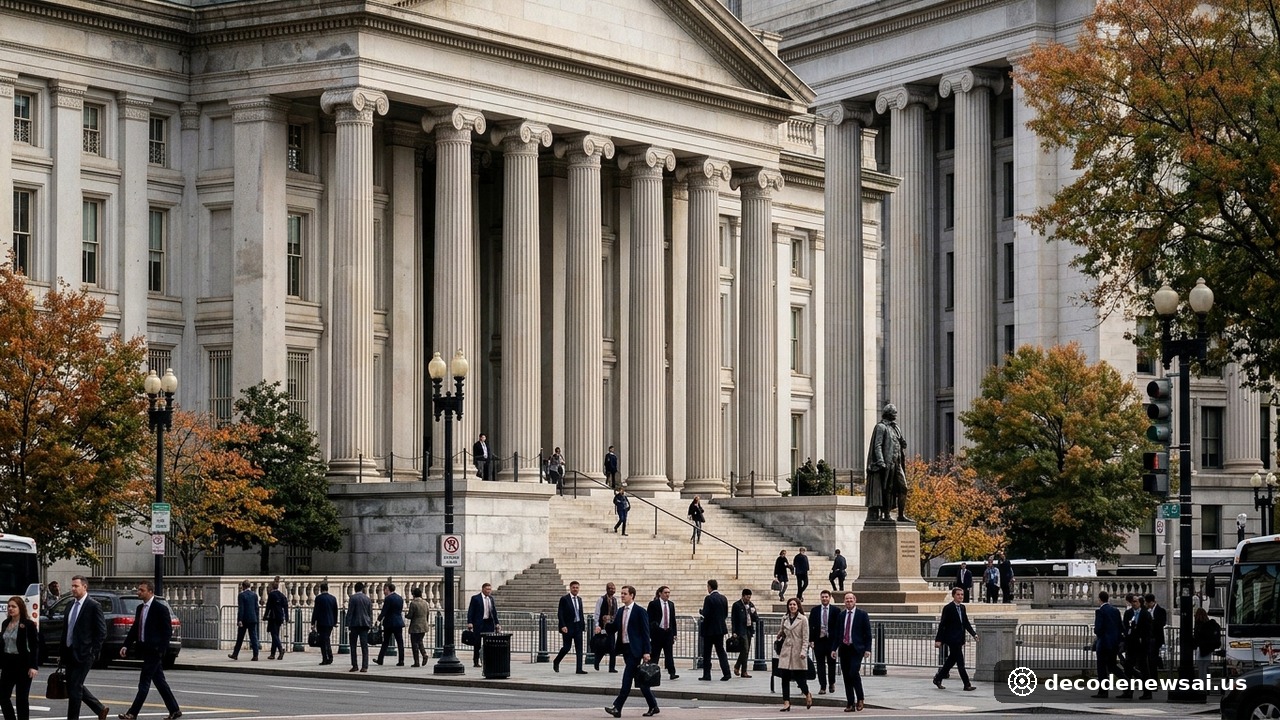
The Congressional Budget Office (CBO) published its Monthly Budget Review on November 10, 2026, confirming that the federal government recorded a budget deficit of $409 billion in October 2026, the opening month of fiscal year 2027. The sharp expansion in red ink represents a substantial acceleration compared to prior-year periods, reflecting a weekly borrowing pace approaching $100 billion. Escalating debt financing costs alongside mandatory entitlements and veterans' health programs drove the monthly shortfall.
Net interest payments rank third in federal budget
The budgetary figures illustrate intensifying fiscal strains confronting the federal government amidst prolonged elevated borrowing rates.
According to preliminary Treasury ledger data, net interest payments on public debt ranked as the third largest federal budgetary outskirt for the month. Testifying before congressional budget panels in Washington, senior budget analysts stated: "Sustained high benchmark interest rates combined with expanding debt stocks generate severe structural compounding pressures. Without comprehensive statutory fiscal adjustments, mandatory debt service will increasingly crowd out vital domestic appropriations."
Beyond debt servicing expenditures, mandatory spending across Social Security, Medicare, and expanded Department of Veterans Affairs clinical benefits expanded significantly during the period.
Lame-duck Congress battles over debt and taxes
The grim fiscal trajectory establishes the battleground for congressional negotiations as lawmakers convene for the post-midterm lame-duck legislative session. Incoming Democratic congressional leadership affirmed plans to target corporate tax loopholes to restore federal revenue streams.
Conversely, Republican fiscal conservatives pledged to resist all revenue-raising measures, demanding enforceable caps on non-defense discretionary appropriations and structural entitlement reforms ahead of looming federal statutory debt limit deadlines. Fixed-income asset managers observed that issuing nearly $100 billion weekly in federal debt obligations continues to test dealer liquidity across domestic Treasury auctions, contributing to upward pressure on benchmark ten-year bond yields. Sovereign credit analysts warned that chronic fiscal deficits exceeding 6% of gross domestic product diminish countercyclical fiscal flexibility during economic downturns, urging bipartisan consensus on long-term fiscal stabilization.
Fiscal policy researchers and macroeconomic budget analysts emphasized that structural interest rate increases compound long-term national debt trajectories, requiring measured fiscal coordination across legislative sessions. Because mandatory debt servicing obligations represent non-discretionary contractual commitments, rapid growth in federal interest payments can constrain future discretionary funding for critical infrastructure and educational initiatives. Independent economic policy institutes encouraged lawmakers to pursue bipartisan fiscal consensus that balances economic growth with sustainable long-term budget baselines. Financial market participants affirmed that maintaining credible fiscal governance remains essential for supporting global confidence in sovereign debt securities.
Economists urge disciplined fiscal planning for stability
Sovereign debt strategists and public finance economists underscored that structural deficit stabilization requires disciplined, forward-looking fiscal planning across legislative majorities. Because escalating national debt financing requirements compete directly with private capital investment, establishing predictable fiscal baselines ensures long-term macroeconomic stability and low borrowing costs. Independent budget watchdogs urged congressional leaders to advance transparent statutory spending reviews to preserve national fiscal strength ahead of upcoming statutory budget negotiations.
In addition, fiscal watchdogs reiterated that comprehensive statutory budget reviews provide essential benchmarks for evaluating structural borrowing trends. Financial market participants anticipate constructive legislative negotiations to support sustainable national economic growth.
Furthermore, macroeconomic policy researchers observed that disciplined fiscal stewardship preserves national creditworthiness during global financial transitions. Economists look forward to balanced statutory solutions that ensure sustainable public finances.
Bipartisan working groups to meet on debt ceiling
Fiscal policy experts reiterated that transparent budget oversight and accountable governance protect national financial stability across economic cycles. Legislators from both political parties confirmed that bipartisan working groups will meet regularly to address ongoing debt ceiling negotiations.
Fiscal researchers emphasized that continuous bipartisan engagement remains indispensable for addressing long-term debt sustainability challenges. Financial market participants anticipate measured policy discussions as legislative committees resume their work.
Federal budget analysts and legislative leaders look forward to constructive bipartisan cooperation on fiscal policy.