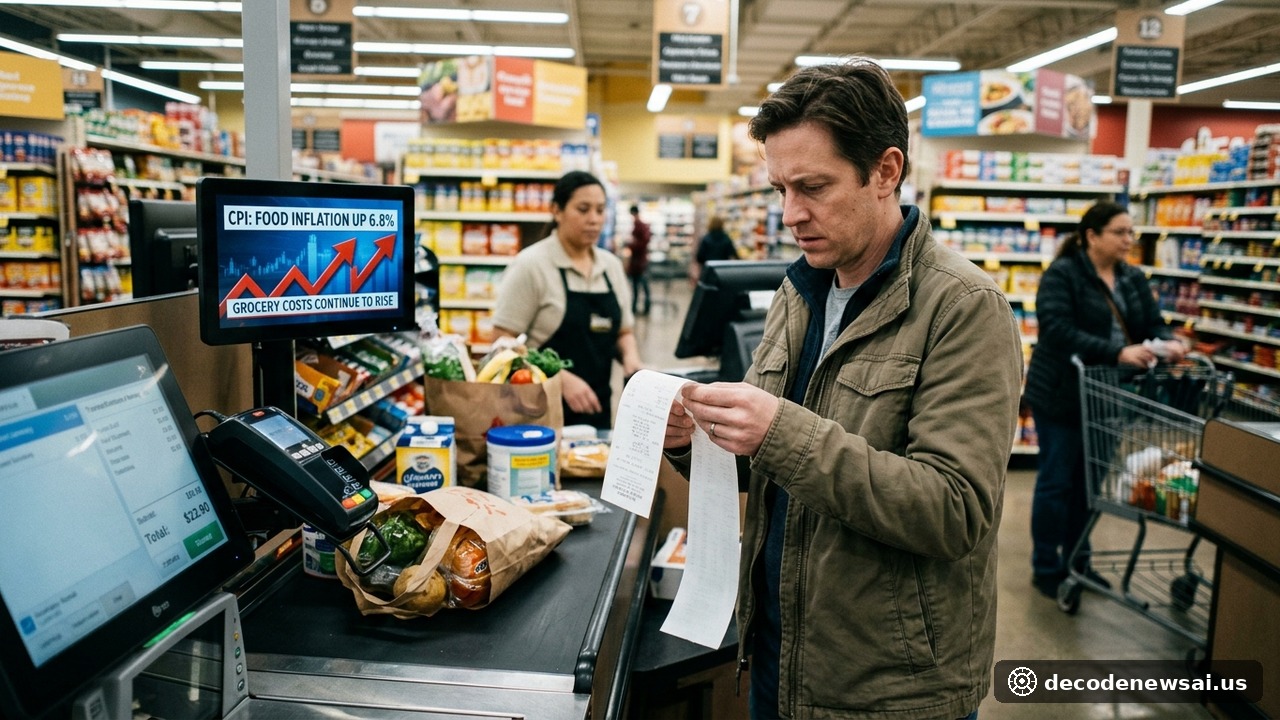
The United States Bureau of Labor Statistics (BLS) officially issued its technical macroeconomic consumer price news release (USDL-26-1685) on November 10, 2026, detailing divergent pricing trajectories across core goods, household energy, and personal service categories. According to the federal statistical report, average monthly consumer expenditures for essential household basket items edged higher by 0.2% on a seasonally adjusted basis. While durable consumer appliances and pre-owned motor vehicle valuations experienced mild disinflationary contractions, persistent structural shelter costs and outpatient healthcare fees maintained solid upward momentum.
Gasoline falls 1.8% while core holds at 2.8%
Federal sub-index accounting demonstrated that domestic retail gasoline prices declined by 1.8% during the reporting window, providing measurable budgetary relief for commuting households.
However, energy savings were largely offset by persistent inflation across residential shelter accounts and commercial utility services. Commenting on the statistical findings during a Department of Labor economic briefing, a senior BLS analytical director stated: "Disaggregated consumer expenditure data reveals structural divergence across domestic consumption pillars. While supply chain clearing has restored stability to manufactured durable goods, elevated services labor expenses and structural lease cycles continue to slow aggregate core disinflation."
Core consumer metrics, which exclude volatile food and energy products, held steady at a 2.8% annualized rate, indicating that baseline household living expenditures remain firm.
Holiday shoppers shift to private label and buy-now-pay-later
Consumer behavior metrics compiled ahead of the upcoming winter holiday shopping season suggest that American households are exercising heightened budget discipline regarding discretionary non-essential purchases. National retail federations reported expanding consumer migration toward private-label grocery items and promotional department store clearances. Concurrently, usage volumes across buy-now-pay-later digital micro-financing platforms reached record seasonal peaks, highlighting liquidity preservation among working-class demographics.
Macroeconomic policy analysts and fixed-income portfolio managers noted that the finalized price metrics support expectations for continued measured monetary policy adjustments by the Federal Reserve. Interest rate swap contracts continue to discount an approximate 70% probability of an additional 25-basis-point federal funds rate reduction during the Federal Open Market Committee's upcoming December policy meeting.
Macroeconomic forecasting researchers and consumer finance analysts emphasized that persistent price growth across housing and healthcare services necessitates disciplined household expenditure planning ahead of seasonal retail cycles. Because non-discretionary shelter and medical commitments represent mandatory living expenses, elevated service price trends constrain discretionary purchasing power across middle-income demographics. Financial market strategists noted that steady core inflation readings reinforce expectations for measured monetary policy easing, allowing central bankers to assess incoming economic indicators before calibrating benchmark interest rate paths.
Balanced spending supports growth as wage gains stay predictable
Furthermore, retail commerce associations noted that consumer purchasing patterns reflect disciplined budgeting amidst evolving employment and wage trends. Market analysts expect balanced household spending to support sustainable economic growth throughout the upcoming fiscal quarter.
In addition, retail trade associations and macroeconomic researchers observed that shifting expenditure trends reflect disciplined budgeting decisions by consumers facing selective price pressures across essential daily services. While expenditure growth in non-discretionary sectors like healthcare and shelter remains elevated, price moderation in core durable goods and energy services provides tangible relief for everyday households. Furthermore, financial market economists noted that balanced consumer spending patterns support a gradual economic transition toward sustainable long-term expansion, providing central banking authorities with valuable room to navigate ongoing monetary policy adjustments.
Furthermore, employment economists and monetary policy researchers emphasized that balanced labor market conditions continue to support predictable aggregate wage gains without exacerbating systemic inflationary pressures. Municipal economic development councils noted that resilient local commerce and healthy consumer balance sheets provide a stable foundation for small business investment heading into the new fiscal year.
In conclusion, macroeconomic commentators emphasized that transparent statistical reporting enables households and enterprises to make informed financial plans. Economic policy institutes look forward to stable financial conditions supporting broad-based consumer confidence.