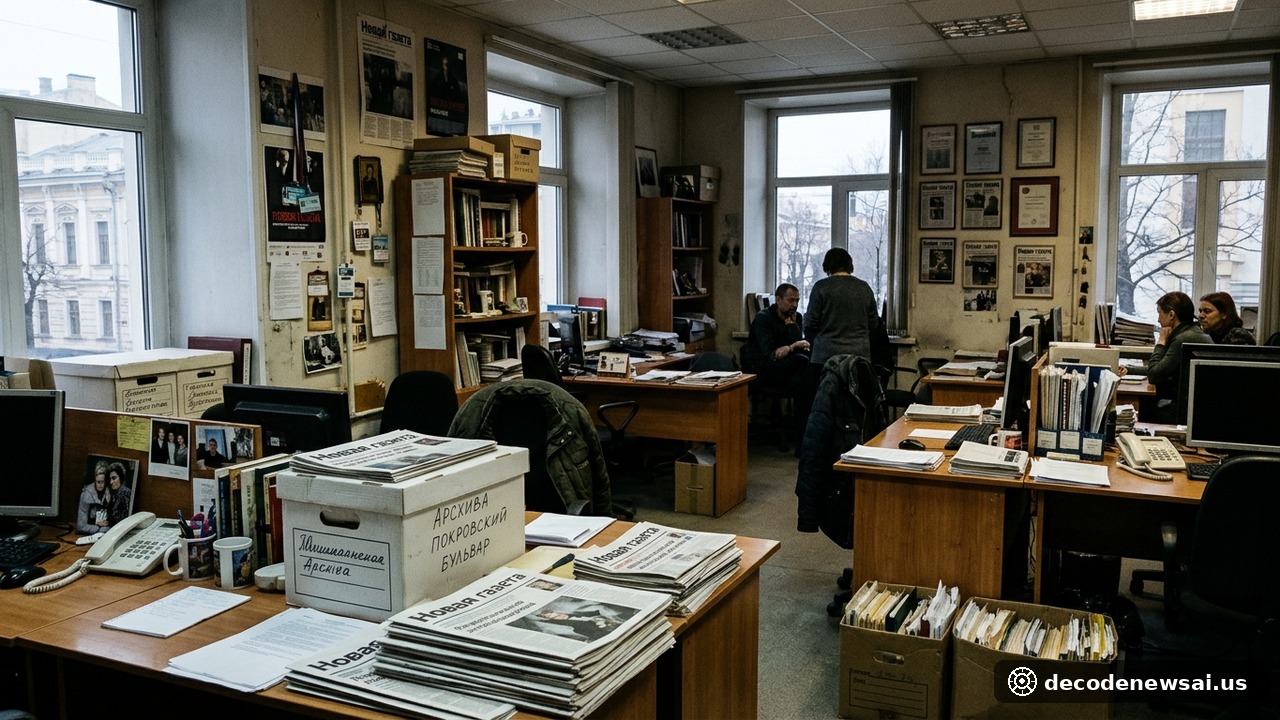
Russia's most celebrated independent newspaper Novaya Gazeta officially closed its Moscow newsroom on Monday, terminating its physical presence following decades of relentless government pressure and administrative crackdowns. After thirty-three years of investigative journalism during which six of its reporters were murdered, staff cleared out the landmark editorial offices. The closure marks the operational silencing of the final domestic news organization consistently critical of the Kremlin. Journalists gathered outside the building in quiet solidarity. International press freedom monitors condemned the forced exit.
Thirty-Three Years of Courageous Reporting and Sacrifices for Independent Truth
Founded in 1993 with financial assistance from former Soviet President Mikhail Gorbachev, Novaya Gazeta established a global reputation for investigative exposes detailing state corruption, military human rights abuses in Chechnya, and bureaucratic miscarriages of justice. Its longtime editor-in-chief Dmitry Muratov was co-awarded the Nobel Peace Prize in 2021 in recognition of his defense of press freedom. Over the decades, six of its investigative reporters and contributors, including Anna Politkovskaya, were murdered in targeted assassinations. Investigative work exacted an unbearable human toll. Its editorial team remained steadfast.
Since the escalation of military conflict in Ukraine in 2022, state regulators systematically targeted Novaya Gazeta's domestic infrastructure. Communications censors revoked its publishing licenses, severed access to its digital websites within Russia, and confiscated its partnered commercial printing presses. State authorities subsequently branded the publication a "foreign agent" and an "undesirable organization." Ordinary journalistic operations faced total legal obstruction.
During the final moments on Monday, staff members gathered the framed portraits of their six murdered colleagues from the newsroom walls. Reporters attached a paper sign above the brass plaque reading: "Here lived Novaya Gazeta." Current editor-in-chief Sergei Sokolov delivered an emotional address to colleagues and readers gathered in the cold street. He stated: "We will live, and I am sure that this country, caught in such a terrible era, will eventually stir. As soon as those first signs appear, Novaya Gazeta will return, to our readers and to our colleagues." Tearful supporters applauded along the sidewalk. History will remember their sacrifice.
Bureaucratic Sanctions, Frozen Accounts, and Criminal Indictments Force Eviction
The immediate cause of Monday's physical closure was an eviction order from local authorities terminating the newspaper's lease. Russian courts had imposed repeated criminal fines against the publication for allegedly discrediting the military. Financial regulators subsequently severed the online banking networks that enabled domestic readers to send small crowd-funding contributions to the newsroom. Columnist Oleg Roldugin remains under house arrest facing up to six years in prison on political charges. The domestic newsroom exhausted all legal avenues.
Kremlin spokesperson Dmitry Peskov addressed the closure during his regular Monday media briefing, describing the exit as a "normal process" of organizational turnover. Official reaction remained indifferent. Human rights monitors, including Reporters Without Borders and Amnesty International, issued statements decrying the state-sponsored liquidation of domestic investigative journalism. The civic environment has grown severely restricted.
To ensure editorial continuity, senior reporters established Novaya Gazeta Europe as a distinct exiled newsroom based in Latvia in 2022. However, for tens of millions of citizens living inside Russia, the closure of the physical Moscow newsroom cuts the primary local channel for verified independent reporting. Algorithmic and broadcast state narratives have replaced domestic investigation. Isolation across Russian civil society has deepened.
Geopolitical Shifts and the Eradication of Independent Russian Civic Discourse
The end of Novaya Gazeta's physical newsroom closes a defining era of domestic press freedom that began with the dissolution of the Soviet Union. With remaining independent publications driven entirely abroad or dissolved, state broadcasters maintain an unchallenged monopoly over domestic television, radio, and newsprint across eleven time zones. Dissenting analytical reporting has been excluded from domestic airwaves. Civic dialogue has suffered historic disruption.
International observers viewed the closure as a structural milestone in Europe's broader security crisis. The Organization for Security and Co-operation in Europe issued an advisory warning that nations lacking independent journalists lose essential internal corrective capacity during major conflicts. Press freedom remains indispensable to regional stability. Foreign diplomats offered formal condolences.
By Monday evening, supporters placed bouquets of red carnations and tea candles beside the sealed entrance on Pokrovsky Boulevard. While state authorities locked the office doors, three decades of digitized investigations remain preserved across distributed archival networks worldwide. The documented record cannot be rewritten. A spirit of independent witness awaits renewal.