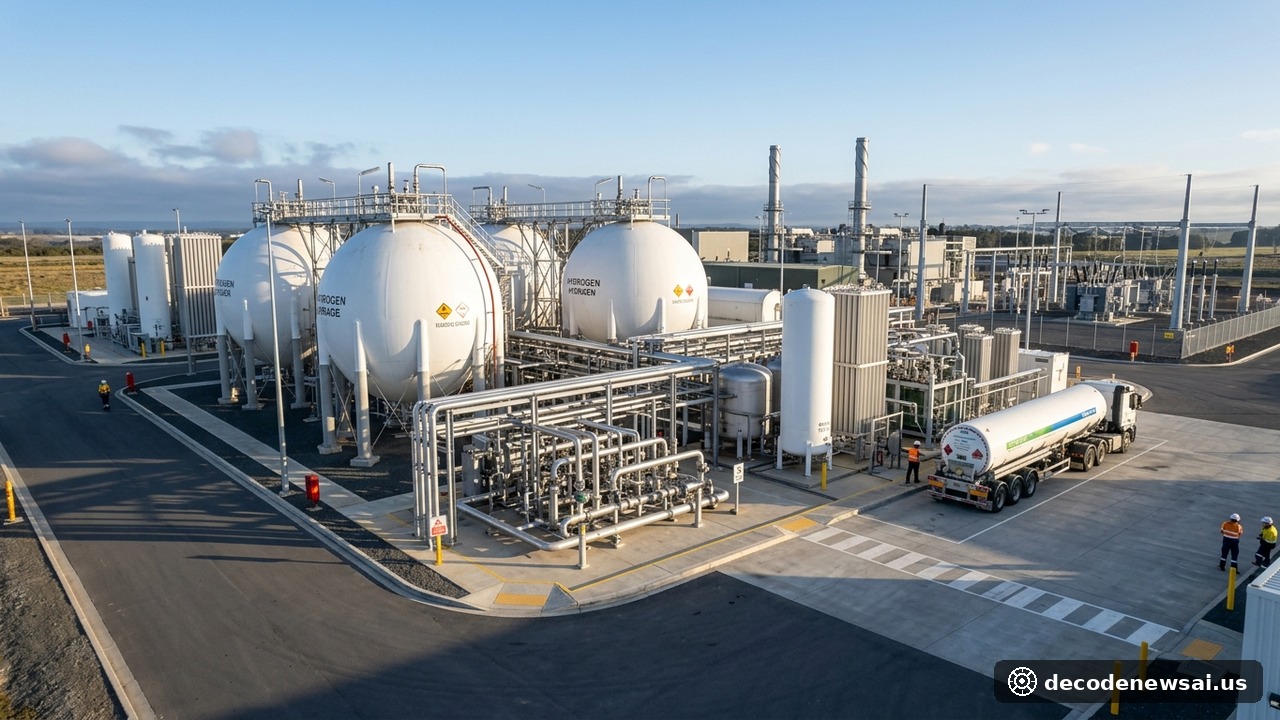
Green hydrogen generation and turnkey fuel cell technology manufacturer Plug Power Inc. released its financial and operational results for the third quarter ended September 30, 2026, after the market close on Tuesday, November 10, 2026. The company reported consolidated quarterly net revenue of $201 million. Operating gross margins exhibited substantial recovery, expanding by approximately 65 percentage points compared to the third quarter of 2025. Financial improvements were driven by scaling commercial electrolyzer shipments and increasing output across domestic liquid hydrogen production facilities.
Camden County plant drives 65-point margin recovery
Third-quarter operating metrics demonstrated tangible benefits from the company's continuous cost-optimization initiatives. Supply chain stability broadened. Equipment sales representing proton exchange membrane electrolyzers and cryogenic refueling systems accounted for more than 60 percent of total recognized revenues. Simultaneously, transitioning away from third-party wholesale hydrogen purchases eliminated significant commercial logistics surcharges, driving the dramatic 65-percentage-point gross margin recovery. Operating losses narrowed substantially year-over-year.
Addressing institutional shareholders during Tuesday's earnings conference call, Plug Power Chief Executive Officer Andy Marsh evaluated commercial execution. The chief executive stated: "Delivering a 65-percentage-point gross margin turnaround in the third quarter proves the economic validity of our vertically integrated green hydrogen strategy. Continuous liquid production at our Georgia and Louisiana generation facilities has successfully liberated our business from volatile third-party fuel procurement. We are advancing toward positive operational cash flow."
The operational ramp of regional hydrogen liquefaction plants represented the primary driver of margin expansion. Domestic production accelerated. The company's Camden County facility in Georgia maintained steady output at its nameplate capacity of 15 tons per day. Concurrently, newly commissioned production assets in Louisiana and Texas entered commercial validation trials. Producing green hydrogen internally reduced unit dispensing costs by nearly 40 percent compared to open-market wholesale contracts, restoring positive unit economics across commercial transport fleets.
Analysts track liquidity and electrolyzer deployment into 2027
Industrial equity research directors covering hydrogen infrastructure commended the gross margin improvement. In a research memorandum issued Tuesday evening, an energy transition analyst noted: "Plug Power is making demonstrable progress in rectifying historical margin vulnerabilities. Internalizing fuel production provides a durable structural defense against merchant supply volatility. Investors will track liquidity balances and commercial electrolyzer deployment rates into 2027."
Management expects fourth-quarter equipment deliveries to maintain positive momentum across North American logistics hubs and European industrial refining facilities.
In addition, chemical process engineers and industrial decarbonization researchers emphasized that green hydrogen represents a crucial chemical feedstock required to decarbonize primary steel production, petrochemical refining, and heavy freight transport. By scaling domestic clean hydrogen hubs, integrated equipment manufacturers accelerate national decarbonization goals while establishing sustainable operational architectures.
Vertical integration insulates operations from commodity volatility
In addition, chemical process engineers and industrial decarbonization researchers emphasized that green hydrogen represents a crucial chemical feedstock required to decarbonize primary steel production, petrochemical refining, and heavy freight transport. By scaling domestic clean hydrogen hubs, integrated equipment manufacturers accelerate national decarbonization goals while establishing sustainable operational architectures. Renewable energy analysts commended Plug Power for executing vertical supply chain integration, noting that internal fuel production insulates operations from merchant commodity volatility. Commercial clients look forward to expanded fuel cell deliveries across North American distribution hubs.
Furthermore, macroeconomic analysts and enterprise policy researchers highlighted that structured institutional collaboration establishes long-term operational certainty across capital markets. By aligning statutory guidelines with rigorous technical standards, regulatory agencies and commercial stakeholders cultivate resilient operational ecosystems capable of navigating evolving economic conditions. Global industry participants look forward to tracking forthcoming milestone developments as organizations implement their strategic priorities throughout 2027. Cross-sector coordination remains essential for driving sustainable innovation and delivering tangible economic benefits across public and private sectors. Technical evaluations confirm that systematic quality benchmarks ensure continuous operational readiness across commercial infrastructure deployments.