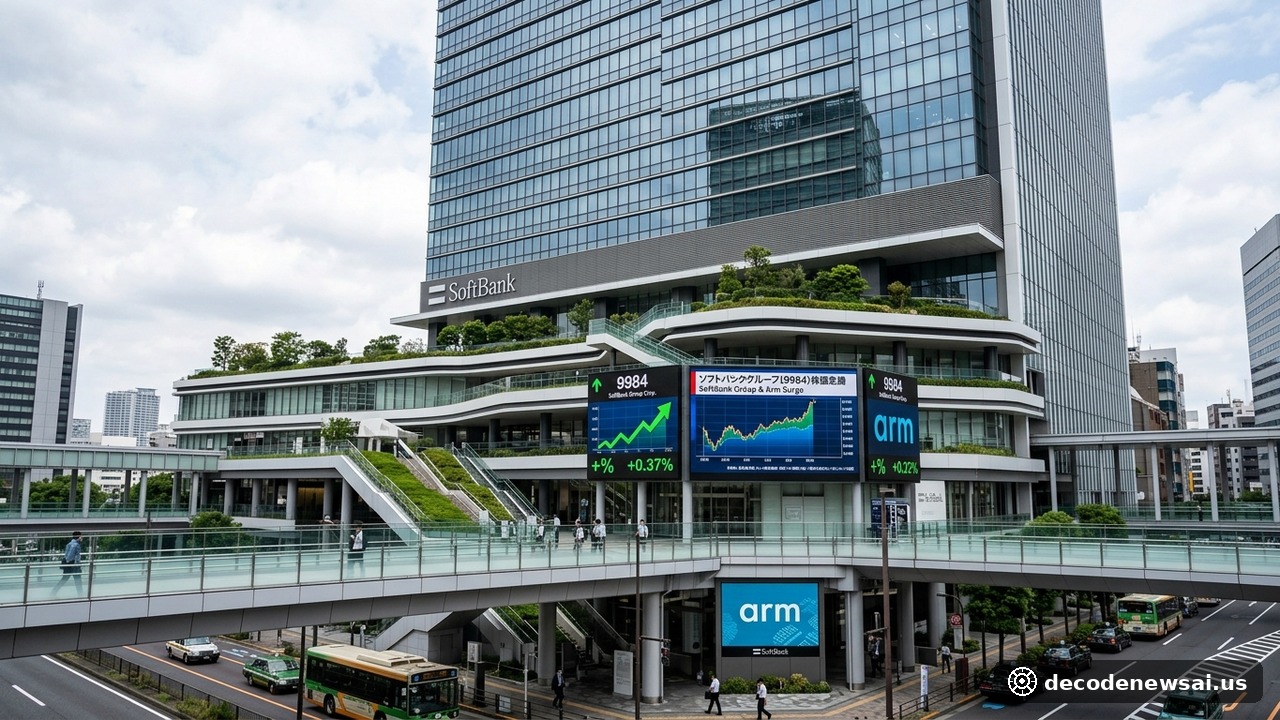
Japanese global investment conglomerate SoftBank Group Corp. officially published its consolidated financial report for the six-month period ended September 30, 2026, on November 10, revealing that its flagship Vision Fund investment segment recorded an estimated $7 billion net quarterly valuation loss driven by markdowns across private technology holdings. Despite the non-cash venture impairments, SoftBank Group's primary listing on the Tokyo Stock Exchange surged by 13.9% during Tuesday trading, as institutional equity investors celebrated stabilizing balance-sheet liquidity and expanding valuations across core semiconductor subsidiary Arm Holdings.
SoftBank fulfills $30.0 billion investment pledge
The consolidated earnings disclosure, submitted under Japanese statutory reporting standards, highlighted that fair-value adjustments focused primarily on unlisted generative artificial intelligence software startups.
SoftBank confirmed that an additional follow-on capital commitment of $10.0 billion was executed in October 2026, successfully fulfilling the $30.0 billion aggregate multi-quarter investment pledge initiated in February 2026. Commenting on the financial results during an investor webcast in Tokyo, SoftBank Group Chief Financial Officer Yoshimitsu Goto stated: "Quarterly fluctuations across venture asset portfolios represent a standard characteristic of global technology transformation. SoftBank's consolidated capitalization profile remains exceptionally resilient, underpinned by substantial cash reserves and structural monetization capacity across our controlling enterprise assets."
Financial analysts emphasized that market confidence was reinforced by resilient operational growth across Arm Holdings plc, in which SoftBank maintains an approximate 90% controlling equity interest.
Arm royalty growth decouples SoftBank valuation from ventures
Accelerating licensing demand for the advanced Armv9 architecture across hyper-scale data center microprocessors and mobile silicon generated double-digit royalty expansions. Institutional investment managers noted that Arm's robust free cash flow profiles effectively buffer macroeconomic volatility originating from speculative venture investments.
Equity research desks in Tokyo observed that market sentiment has structurally decoupled SoftBank's enterprise valuation from volatile private venture portfolios. Management reiterated commitments to financing critical physical artificial intelligence infrastructure, including multi-gigawatt clean power generation and dedicated high-performance supercomputing clusters globally.
Global technology investment analysts and cross-border equity strategists observed that disciplined balance-sheet management and robust cash reserves differentiate diversified holding corporations from speculative venture portfolios. Because semiconductor architectural licensing generates high-margin recurring royalties, resilient corporate cash flow buffers broader macroeconomic fluctuations in early-stage artificial intelligence valuations. Institutional portfolio managers noted that maintaining substantial unencumbered capital reserves equips technology conglomerates to capture high-value strategic co-investments in next-generation high-performance computing clusters and sovereign data center infrastructure worldwide.
Strategic asset monetization and disciplined capital allocation
Biopharmaceutical commercial directors and clinical research leaders affirmed that leveraging expedited review designations accelerates the delivery of breakthrough oncology medicines to clinical practitioners. By prioritizing innovative pipeline assets, pharmaceutical developers can improve patient survival outcomes while establishing sustainable commercial foundations for continued medical innovation across complex therapeutic categories. Furthermore, healthcare equity analysts noted that capital flexibility gained from voucher transactions enables innovative biopharma developers to expand clinical research into previously underserved disease indications.
Financial strategists and corporate valuation consultants highlighted that strategic asset monetization provides essential financial flexibility in dynamic technology markets. By reinvesting proceeds into high-conviction foundational architectures, enterprise conglomerates position themselves to lead emerging computational paradigms. Market participants commended disciplined financial management, confirming that strong balance sheets underwrite durable long-term technological competitiveness.
Equity research analysts and institutional investment organizations noted that efficient capital allocation strategies incentivize continuous research investment, expediting the delivery of transformative commercial solutions across competitive global markets. Additionally, commercial investment strategists highlighted that disciplined corporate governance and strategic capital reinvestment provide essential foundations for enduring technological leadership. Such strategic financial discipline positions innovative enterprises to sustain multi-year research momentum across evolving industry sectors. Equity research analysts reaffirmed that maintaining diversified asset bases and prudent cash liquidity supports sustainable shareholder value across market cycles.