Key Operating Figures and Financial Metrics for Maersk Third Quarter 2026
- Performance Metric: Reported Q3 2026 Level
- Total Consolidated Revenue: $18.095 billion;+27.0% expansion
- Operating Profit (EBIT): $3.269 billion;+151.5% increase
- Earnings Before Taxes & Depreciation (EBITDA): $4.710 billion;+74.4% increase
- Full-Year 2026 EBITDA Profit Guidance: $8.50 billion (third revision)
What Core Market Dynamics Drove Maersk's Explosive Profit Expansion?
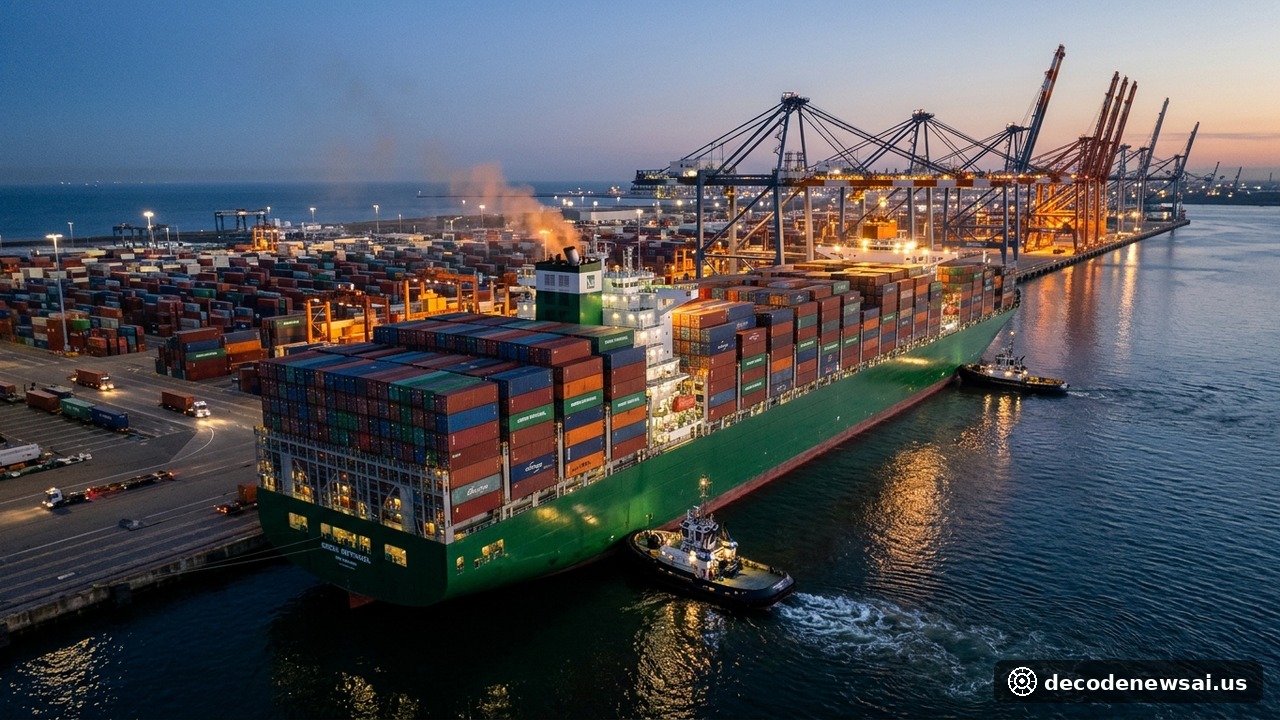
Addressing institutional investors during the earnings conference call, Maersk Chief Executive Officer Vincent Clerc attributed the group's stellar performance to the Ocean segment's ability to capitalize on systemic shipping dislocations. The sustained geopolitical crisis in the Red Sea corridor continues to force major container liners around the Cape of Good Hope, adding 10 to 14 days to standard Europe and North America sailing rotations and effectively absorbing 8% to 10% of total commercial fleet capacity. Severe bottleneck congestion across critical hub terminals in Singapore and Rotterdam further restricted container turnover, driving spot market freight rates to double their previous year averages.
Simultaneously, Clerc highlighted a profound structural evolution across international trade flows. Beyond steady inventory replenishment in North American and European retail consumer channels, transoceanic commerce is experiencing an unprecedented surge in heavy equipment shipments supporting national power grid electrification, renewable energy development, and artificial intelligence hyperscale data center infrastructure. The massive demand for transporting high-value compute hardware across transatlantic and transpacific trade lanes lifted Maersk's ocean operational margins (EBIT margin) to an exceptional 181%.
Why Does Financial Market Sentiment Remain Cautious Despite the Profit Boom?
Notwithstanding the blowout earnings report and upgraded annual outlook, shares of A.P. Møller - Mærsk experienced volatile trading on the Nasdaq Copenhagen exchange. Equity research analysts pointed out that Maersk's total shipped container volume experienced a slight year-over-year contraction, indicating that aggressive rate-realization strategies led to minor market share losses against unlisted competitors such as Mediterranean Shipping Company (MSC) along competitive Asian export corridors.
Furthermore, transportation economists question the cyclical sustainability of current cash generation. Maritime intelligence agencies project that global shipyards will deliver record volumes of ultra-large, dual-fuel container vessels between late 2026 and 2027. If geopolitical hostilities de-escalate and transit through the Suez Canal normalizes, the container shipping industry faces the prospect of substantial vessel oversupply. An abrupt deflation in freight rates across 2027 could severely compress operating margins across container carriers operating high-cost charter commitments.
How Does the Integrated Logistics Model Provide Long-Term Resilience?
To mitigate the acute cyclicality inherent in pure ocean freight, Maersk has aggressively expanded its integrated logistics ecosystem. Third-quarter segment data indicated that Maersk Logistics & Services and Terminals divisions both achieved robust double-digit revenue growth. In particular, the Terminals business capitalized on tight quayside berth capacity across North American and European gateways, increasing container dwell fees, yard efficiency, and gate automation to generate reliable, recurring operating cash flows.
Vincent Clerc reiterated that the group remains committed to disciplined capital expenditure, directing surplus liquidity toward fleet modernization, green methanol bunkering infrastructure, and the expansion of automated digital warehousing footprints. By anchoring corporate relationships through long-term, multi-year end-to-end supply chain agreements with global multinational manufacturers, Maersk seeks to insulate its balance sheet from freight volatility and cement its structural advantage across the evolving logistics landscape.