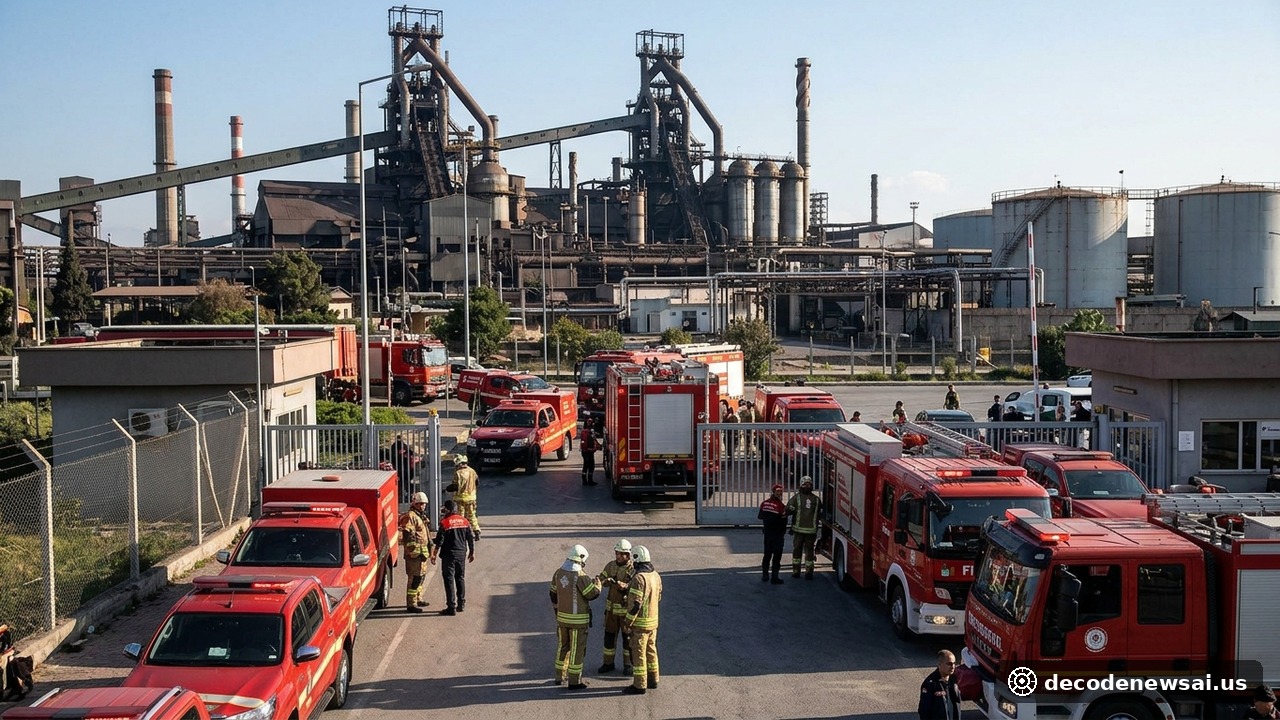
A catastrophic industrial disaster occurred in western Turkey's coastal Izmir province on Monday, November 9, 2026. A massive explosion and subsequent blaze tore through the major HABAŞ iron and steel factory during metal casting operations. Turkish authorities confirmed that 16 industrial workers lost their lives in the catastrophe. At least 13 other personnel sustained serious burn injuries.
Mechanical Crane Failure Triggers Deadly Furnace Blast
The industrial disaster unfolded within the heavy manufacturing district of Aliağa, situated approximately 60 kilometers north of Izmir city center. Plant workers stated that the explosion took place around midday during a scheduled molten steel transfer. An overhead ceiling crane snapped along its central gantry structure. The heavy machinery plummeted directly into an active electric arc furnace.
Molten steel reaching thousands of degrees contacted cooling water lines, triggering an explosive chemical decompression. The concussive shockwave damaged structural roofs and shattered industrial windows across adjacent fabrication halls. Plant employee Nuri Ali Ulker described the terrifying scene to local correspondents: "The blast was very intense and the ground shook so hard that I thought it was an earthquake."
Firefighting battalions and disaster rescue squads deployed across the industrial perimeter. Emergency teams used thermal imaging sensors to locate survivors pinned beneath collapsed metal frameworks. Medical teams evacuated critical casualties to regional trauma units. Search operations continued through the night.
Industrial Capacity and Historic Safety Record at Aliağa
The HABAŞ steel production complex was established in 1987. It serves as one of Turkey's primary heavy metallurgical facilities. The factory maintains an annual crude steel manufacturing capacity of roughly 4.5 million metric tons. Its output supplies major international construction and infrastructure contracts.
Labor unions voiced fierce condemnation following the disaster. Metalworkers union representative Oktay Turk addressed journalists outside the factory gates: "We demand accountability for this catastrophe because routine equipment maintenance protocols were neglected." Workplace safety advocates echoed these concerns.
Labor monitoring non-governmental organizations noted that the HABAŞ complex had recorded two fatal workplace accidents in recent months. Across the broader Turkish industrial sector, at least 1,736 workers lost their lives in occupational incidents during the first nine months of 2026. The recurring casualties have intensified scrutiny of manufacturing safety regulations.
Presidential Inquiry and Judicial Prosecution
Turkish President Recep Tayyip Erdogan delivered a televised address expressing condolences to the families of the victims. Erdogan affirmed that administrative ministries launched a comprehensive investigation to determine whether corporate negligence contributed to the equipment failure. State authorities promised full financial assistance for surviving dependents.
Justice Minister Akin Gurlek assigned four public prosecutors to lead a specialized criminal inquiry into the Aliağa incident. Forensic police detained the facility's on-duty operations manager and chief safety inspector for preliminary questioning. State regulators sealed the casting workshop to preserve technical evidence.
Public health officials in Izmir directed burn specialists to support injured workers receiving treatment at nearby hospital centers. Parliamentary opposition parties petitioned the Grand National Assembly to establish a permanent legislative commission on industrial workplace standards. International labor federations expressed solidarity with Turkish metalworkers as investigations proceed.
International metallurgical engineering specialists noted that heavy industrial manufacturing facilities must maintain rigorous non-destructive testing schedules for overhead lifting apparatus. The catastrophic failure of foundry hoisting machinery demonstrates the acute vulnerability of continuous steel casting workshops during peak production runs. Independent safety analysts emphasized that automated furnace barrier interlocks and emergency thermal shutoff mechanisms can significantly reduce casualty severity during unexpected mechanical collapses. Regional labor safety confederations continue pressing regulatory authorities across Ankara to enforce standardized occupational health audits across all privately operated metal fabrication centers. International logistics monitors confirm that the swift suppression of the industrial fire prevented secondary operational impacts across the regional Mediterranean pipeline terminal network.