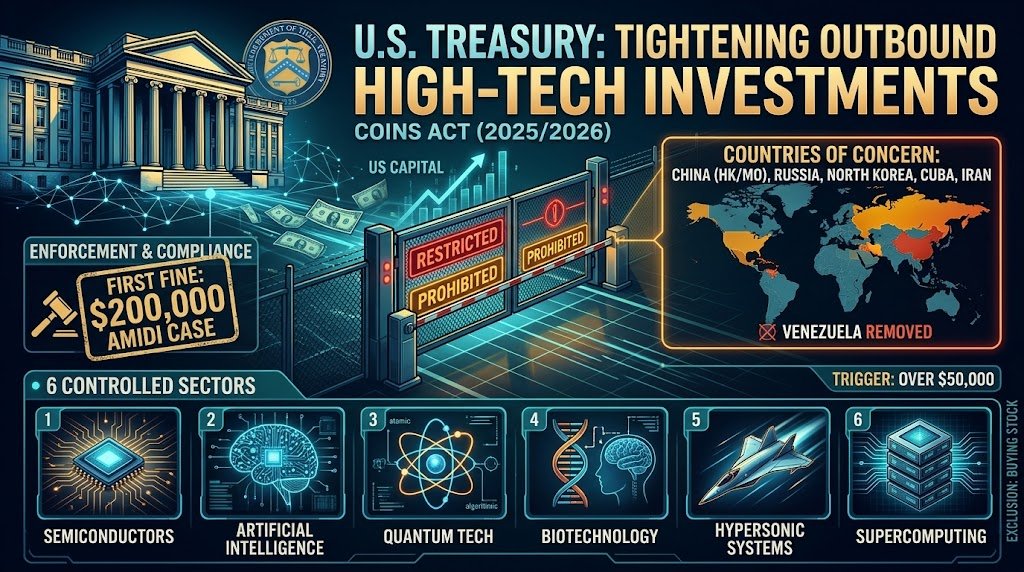
The United States Department of the Treasury officially released expansive proposed regulatory rules on November 9, 2026, implementing Subtitle C of the Comprehensive Outbound Investment National Security Act (COINSA). Published in the Federal Register, the landmark proposed regulations establish mandatory prohibitions and notification regimes targeting American outbound capital flows into covered foreign entities. The regulatory framework explicitly bars United States persons from financing cutting-edge artificial intelligence architectures and, for the first time, frontier biotechnology platforms across designated foreign jurisdictions.
AI FLOP thresholds and pre-closing filing duties
The proposed rulemaking substantially broadens the jurisdictional scope of national security investment reviews. Regulated transactions extend beyond traditional primary equity financing and venture capital syndicates to encompass convertible debt instruments, joint venture arrangements, intellectual property licensing pacts, and greenfield technical facility construction.
Within the artificial intelligence classification, the regulations articulate precise computational performance thresholds. Any investment in foreign enterprises training frontier multimodal foundation models exceeding designated floating-point operations (FLOPs), autonomous tactical combat systems, or specialized offensive cyber capabilities is strictly prohibited.
For commercial AI applications operating below absolute prohibition benchmarks, American investors must submit formal pre-closing filings detailing technical specifications, end-use verifications, and corporate control structures. Failure to comply exposes institutional asset managers to severe civil monetary penalties and court-ordered divestment mandates.
Biotech prohibitions and 30-day comment window
The most transformative dimension of the draft regulations is the formal codification of biotechnology within national security screening protocols. The Treasury Department proposed outright prohibitions on investments involving high-throughput synthetic gene synthesis machinery, deep-learning protein structural engineering tools, and automated molecular diagnostic hardware capable of dual-use biological weaponization.
In a comprehensive public guidance briefing in Washington, an Assistant Secretary for Investment Security detailed the strategic doctrine underpinning the rules. The official emphasized that targeted capital oversight safeguards critical innovation without compromising broader international trade. The Assistant Secretary stated: "Protecting sensitive American technologies from being weaponized requires clear and predictable outbound capital safeguards."
The Treasury Department established a mandatory 30-day public comment window, setting December 7, 2026, as the deadline for written stakeholder commentary. Major Silicon Valley venture firms, private equity managers, and academic research institutions are preparing detailed technical submissions addressing potential impacts on international collaborative research. The finalized administrative regulations are scheduled to take binding legal effect during the first quarter of 2027.
Scholars and attorneys assess compliance and deterrence
National security legal scholars and cross-border investment compliance specialists emphasized that expanding capital outbound screening frameworks reflects an evolving doctrine of technological deterrence. By targeting advanced dual-use foundational technologies, including generative artificial intelligence and frontier synthetic biology, federal regulators seek to prevent American institutional capital from accelerating strategic competitors' military capabilities. Venture capital syndicates and institutional limited partners will need to implement comprehensive technical due diligence and supply chain audit protocols before committing capital to foreign research enterprises. International business advisory groups anticipate that allied economies in Europe and East Asia will evaluate similar regulatory screening mechanisms to maintain unified capital governance standards globally. The Treasury Department's forthcoming public comment window provides technology industry stakeholders an essential opportunity to refine technical definitions and ensure international collaborative scientific research remains viable.
International investment attorneys noted that establishing clear regulatory boundaries allows compliant venture capital partnerships to plan long-term strategic allocations with confidence. The Treasury Department's structured public consultation process ensures that regulatory parameters are carefully tailored to address critical national security imperatives. Cross-border legal teams are actively advising institutional limited partners on implementing verifiable compliance frameworks before final rules take effect.
Technology policy strategists observed that clear outbound investment rules provide predictable guidance for institutional fund managers while safeguarding vital national security interests across emerging technological fields. Federal officials confirmed that structured regulatory compliance guidance will assist institutional limited partners across global investment corridors.