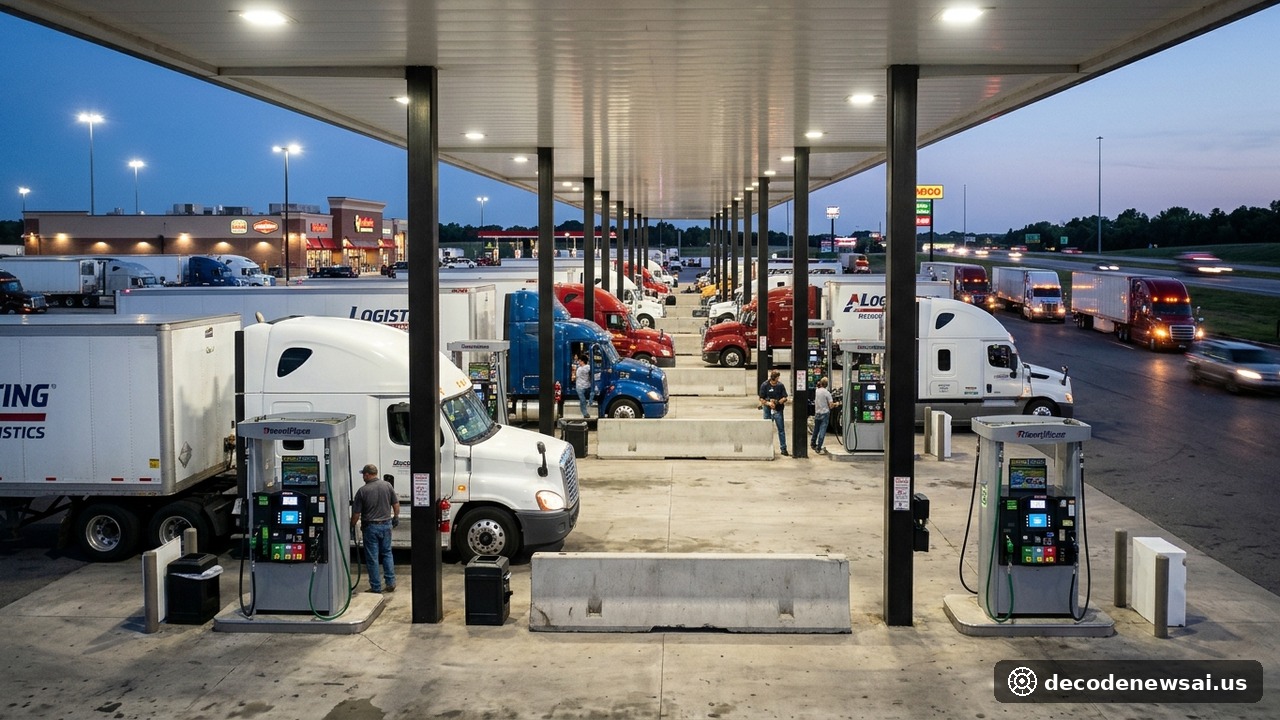
Commercial fleet operators across North America absorbed a historic energy price shock during the third quarter of 2026, with average fuel costs surging approximately 43% year-over-year, according to the newly released WEX Index report published Monday. The benchmark study revealed that commercial vehicle fill-ups averaged $4.85 per gallon nationwide. Retail diesel prices reached an unprecedented all-time record of $6.53 per gallon in late September according to industry pricing monitors. Commercial logistics budgets face severe operational strain. Inflationary pressures continue to ripple across supply chains.
Hormuz Disruption Propels Energy Inflation and Inelastic Commercial Demand
The WEX Index was compiled from real-time transaction data covering more than 600,000 corporate fleet customers across the United States. Operational profiles range from municipal delivery vans to long-haul tractor-trailers and utility line maintenance fleets. The report underscored that since regional conflict disrupted maritime transit through the Strait of Hormuz in late February, global crude oil supply networks suffered the largest single disruption in modern market history as cataloged by the International Energy Agency. Upstream import crude costs remained elevated. Wholesale refinery diesel crack spreads repeatedly set record peaks.
Unlike ordinary retail motorists who can curtail non-essential weekend travel during price spikes, commercial vehicle fleets exhibit nearly total demand inelasticity. Utility repair trucks responding to power outages and refrigerated transport carriers delivering perishable pharmaceuticals cannot pause routes to avoid expensive fuel. Transaction volume across commercial fleets remained essentially flat throughout the third quarter. Fleet operators were forced to absorb surging expenses without operational interruption. Logistics overhead climbed sharply.
WEX President and Chief Executive Officer Melissa Smith highlighted the daily commercial dilemma in the official report release. She stated: "Fleets cannot choose to buy less fuel when prices surge, so the pressure lands on every decision around those transactions. Our intention with the WEX Index is to provide guidance that helps businesses control fuel costs by looking at the details of each fill-up, including where, when, and what their drivers buy." Enterprise cost discipline has become paramount. Reducing waste is essential for carrier survival.
Record Diesel Prices Drive Broader Measures of National Inflation
Corroborating data released by the American Automobile Association confirmed the acute cost burdens facing interstate carriers. Nationwide retail diesel fuel prices, which power the vast majority of long-haul freight operations, peaked at an all-time record of $6.53 per gallon in late September. That total represented a 77% surge compared to $3.69 per gallon recorded during the prior-year period. Wholesale gasoline prices also jumped 9.1% sequentially in September. Energy inflation eroded operating cash margins across independent trucking fleets. Regional transport carriers faced existential operating challenges.
Elevated transportation expenses filtered directly into broad economic inflation metrics. The Bureau of Labor Statistics reported that total energy prices increased 20.4% in the year through September, pushing headline consumer price index inflation to 3.7%. Higher freight logistics surcharges steadily raised retail shelf prices across packaged foodstuffs and durable consumer merchandise. Consumer purchasing power continued to contract. Macroeconomic inflation showed greater persistence than earlier consensus estimates anticipated.
The index identified substantial behavioral inefficiencies across corporate fueling practices. National findings indicated that 38.1% of commercial fleets consistently paid above the localized Fuel Price Index benchmark. On long-distance interstate routes, drivers frequently stopped at premium highway junction centers rather than utilizing lower-cost regional network locations. In multiple cases, drivers fueled premium unleaded into light cargo vans that require only regular grades. Sub-optimal fueling practices created avoidable fiscal waste. Digital operational oversight offers substantial recovery margins.
Geographic Price Disparities Prompt Fleet Digital Navigation Deployments
The WEX Index documented severe geographic pricing disparities across state jurisdictions. Fleet operators in Hawaii paid an average of 6 cents per gallon below baseline street prices through contracted commercial agreements. Conversely, carriers in California, the District of Columbia, and Iowa paid between 4 and 9 cents per gallon above localized price benchmarks. Regional refining capacity constraints and varying state excise taxes widened geographical cost divides. Structural logistics costs showed stark geographical imbalances.
Confronting continued fuel price volatility, enterprise logistics operators are accelerating software route optimizations across line-haul networks. Major fleet operators are integrating real-time fuel navigation platforms into in-cab telematics systems to direct drivers toward lowest-cost contract fueling plazas. Several regional distribution carriers accelerated pilot deployments of commercial battery-electric vans across short-haul metropolitan routes. Fleet decarbonization initiatives gained renewed fiscal momentum. Transport enterprises are actively diversifying away from fossil fuel exposure.
Wall Street macroeconomic analysts noted that structurally elevated energy costs are resetting baseline supply chain expenditure assumptions. If logistics operators cannot mitigate surging fuel outlays through automated routing software, wholesale freight rate hikes will inevitably flow through to retail shelves. Containing inflation remains a formidable policy challenge. The economic shockwaves radiating from regional energy bottlenecks continue to impact commercial operations nationwide. Businesses are preparing for sustained operational headwinds.