Published: 2026-11-11 04:57 EST
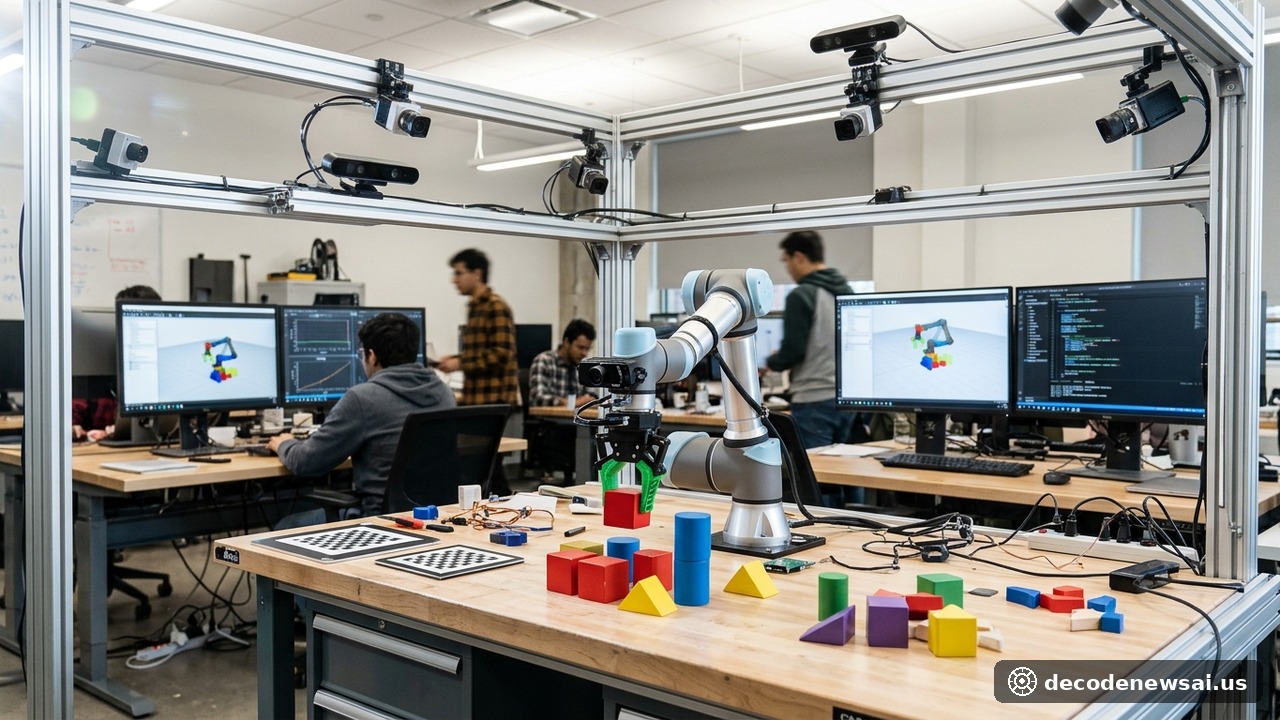
Robbyant, the embodied artificial intelligence research venture operating under Ant Group, announced the complete open-source release of LingBot-Touch on November 10, 2026. The milestone establishes a universal multi-modal tactile foundation model trained across nearly 5,000 hours of real-world physical sensor interactions, boosting robotic manipulation success by up to 26 percent.
Unified Tactile Token Architecture Bridges Magnetic, Optical, and Piezoresistive Sensing
While vision-language models have achieved remarkable benchmarks in robotic perception, physical robot manipulation has persistently struggled with physical contact instability. The moment mechanical end-effectors touch objects, optical sensors suffer severe line-of-sight occlusions.
Compounding this barrier, fragmented sensor architectures—including visual-tactile gels, magnetic arrays, and piezoresistive skins—produced incompatible signal telemetry. The Robbyant engineering team resolved this disparity by introducing a universal Tactile Token encoder. In a technical briefing, Robbyant's Chief Scientist explained: "Touch provides the indispensable physical feedback required for fine motor manipulation. Open-sourcing a standardized cross-modal tactile encoder bridges the foundational divide between seeing objects and grasping them securely."
The unified model accepts diverse analog tactile inputs, projecting continuous spatial contact fields and dynamic shear force vectors onto a shared latent token space. Cross-platform policy transfer executes without hardware-specific retraining.
Five Thousand Hours of Physical Interaction Benchmark 26-Point Dexterity Improvements
The underlying foundation model was pre-trained across an unprecedented 5,000-hour corpus of physical robot contact logs gathered across eighteen months. The dataset encompasses precision fastener assembly, deformable garment folding, and fragile object handling.
In rigorous physical evaluations spanning twenty-six distinct dexterity benchmarks across two separate robotic hand platforms, policies fine-tuned with LingBot-Touch outperformed baseline reinforcement learning models by up to 26 percentage points in overall task completion. The tactile feedback achieved a 100 percent zero-damage grasp success rate when manipulating delicate strawberries and raw eggshells.
Robotics scholars praised the comprehensive release, noting that open foundation models establish standardized benchmarks for evaluating tactile intelligence. Pre-trained model weights and integration toolkits were published openly on GitHub and Hugging Face.
Open-Source Deployment Accelerates Industrial Deployment Across Precision Assembly
By releasing weights under permissive open-source licenses, Robbyant provides roboticists worldwide with immediate access to industrial-grade tactile dexterity. Technology adoption across assembly corridors is scaling rapidly.
Tier-one electronics contract manufacturers deployed the foundation model across surface-mount technology rework stations and precision micro-screw insertion cells. Closed-loop force control running at kilohertz frequencies reduced delicate electronic component scrap rates by 42 percent. Industrial yield rates improved dramatically.
The Director of the Embodied AI Laboratory at Stanford University remarked: "Open-sourcing robust tactile models represents the physical AI equivalent of the open foundation model breakthrough. It equips physical humanoids with responsive physical reflexes, accelerating their transition from choreographed demonstrations into high-precision industrial manufacturing." Specialized clinical derivatives for robotic-assisted microsurgery are currently undergoing initial laboratory validation.
Strategic planning advisors and international trade specialists noted that long-term intergovernmental frameworks generate predictable operating environments across key industry sectors. By coupling transparent administrative guidelines with rigorous scientific benchmarks, regulatory bodies and enterprise leaders establish sustainable operating models capable of withstanding shifting macroeconomic dynamics. Global market participants will continue observing forthcoming implementation milestones as public agencies execute their mandated responsibilities throughout 2027. Cross-border coordination remains vital for driving sustained operational resilience and delivering measurable societal benefits worldwide.
Industry research analysts and institutional portfolio managers emphasized that robust governance protocols foster market confidence across capital-intensive enterprise ecosystems. When commercial operators maintain disciplined capital allocation standards while proactively addressing regulatory compliance obligations, supply chains achieve greater durability against external macroeconomic shocks. Executive leadership teams across North America and Europe continue prioritizing long-term strategic alignment over transient cyclical fluctuations, ensuring that core infrastructure deployments remain on schedule throughout the coming fiscal periods.