The Allen Institute for Artificial Intelligence released an open-source robotic simulation framework named ToyBlocks on November 6, designed to eliminate procedural bottlenecks in embodied agent manipulation research. The open platform ships with 85336 high-fidelity automated tabletop interaction demonstrations. The foundational archive comprises approximately 1600 hours of continuous physics telemetry. The underlying dataset encompasses more than 144 million annotated video and sensor frames. The technological milestone provides a scalable alternative to costly manual teleoperation. Roboticists globally praised the release.
ToyBlocks tackles reproducibility with a simulation engine
Historically, the advancement of robotic manipulation policies has been severely restricted by the arduous expense of recording physical demonstrations. Machine learning practitioners often spend months operating specialized master-slave arm controllers to compile basic reach, grasp, and assembly sequences. Variations across disparate laboratory hardware form factors, camera calibrations, and tactile sensor arrays prevented direct cross-institutional reproducibility. The lack of standard benchmarks hindered rapid algorithm iteration.
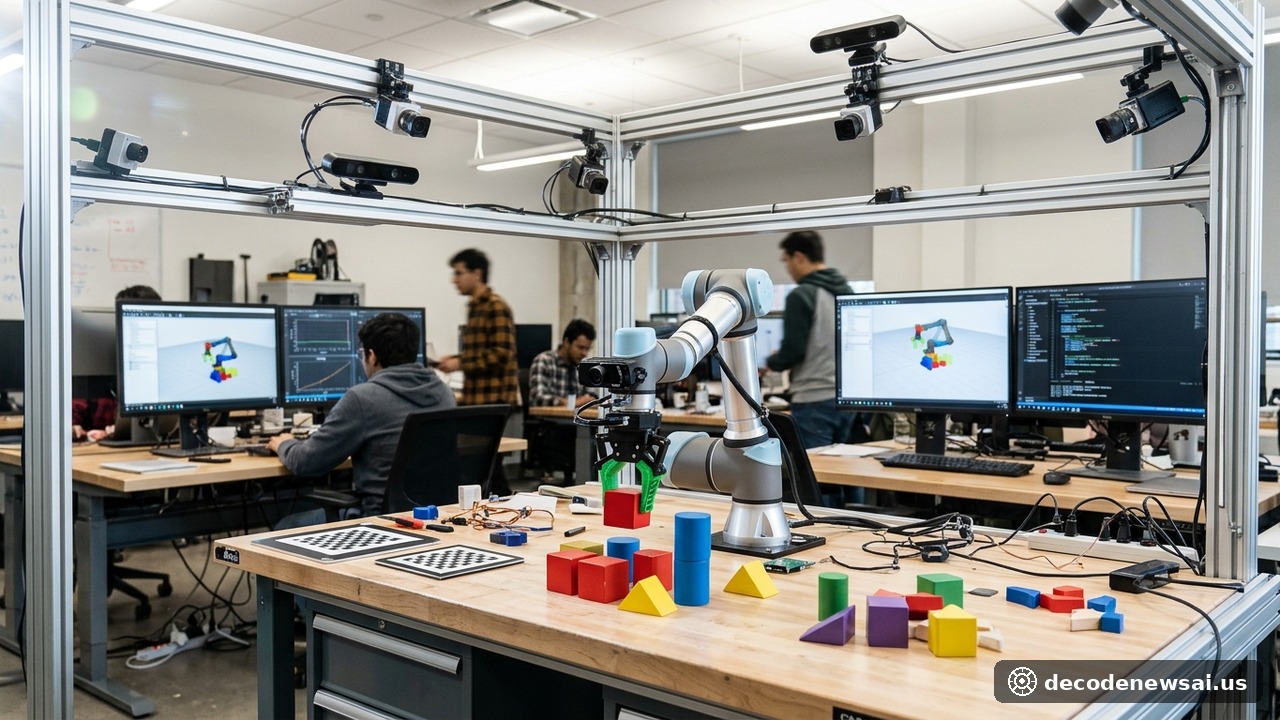
ToyBlocks addresses these systemic hurdles by deploying a deterministic simulation engine calibrated around a simulated collaborative robotic arm executing structured tabletop manipulation tasks. The environment pairs synthetic robotic effectors with randomized modular blocks featuring varied inertial attributes and frictional textures. Every automated demonstration records end-effector kinematic trajectories, joint torque profiles, and visual perspectives. Computer scientists can train Vision-Language-Action foundation models using standardized observational data. Engineering turnaround times have shrunk considerably.
Dirk Ebermann, research director for embodied cognition at the Allen Institute for Artificial Intelligence, stated in an institutional research announcement: "Robotics research has long been constrained by the absence of a ubiquitous ImageNet equivalent for physical manipulation tasks. ToyBlocks establishes an accessible, standardized simulation playground where researchers can evaluate imitation learning and reinforcement algorithms on identical physical baselines."
ToyBlocks offers accessible infrastructure for academic labs
The open initiative offers accessible computational infrastructure for academic laboratories and independent artificial intelligence developers lacking multi-million-dollar robotics hardware fleets. Research cohorts from Carnegie Mellon University and Stanford University initiated comparative evaluations testing transformer policy architectures against the benchmark. Early empirical logs indicate that policy models pretrained on ToyBlocks transfer to physical industrial robotic arms with superior zero-shot spatial generalization.
Robotics hardware engineers evaluating the open platform observed that mechanical wear and sensor calibration drift frequently compromise physical laboratory trials. ToyBlocks addresses dynamic simulation boundaries by incorporating realistic contact mechanics, surface friction coefficients, and simulated joint backlash into its physics engine. Control policies optimized in virtual trials exhibit remarkable fidelity when translated to real actuators. Industrial automation researchers reported high transfer accuracy.
Machine learning scholars noted that foundation action models are transforming factory assembly lines and logistics material handling. Open-source initiatives spearheaded by research institutions lower barriers to entry for early-stage startups and university scholars lacking expensive physical hardware fleets. Thousands of independent researchers can collaborate on synchronized benchmarks without redundant data engineering. Standardized training pipelines will compress commercial deployment timelines.
Open-source ToyBlocks accelerates industrial commercialization
Academic researchers at cooperative university robotics laboratories emphasized that standardized simulation environments accelerate the transition from pure research models to industrial commercialization. By testing behavioral cloning and policy gradient algorithms within deterministic virtual environments, engineering teams can identify kinematic edge cases prior to deploying code on expensive physical robotic hardware. The ToyBlocks initiative aligns with broader open-science frameworks that promote reproducibility and transparency across artificial intelligence disciplines. Software engineering teams worldwide continue to contribute specialized environment extensions to the public repository.
Software engineering specialists noted that open-source robotics research platforms accelerate technological cross-pollination between academic institutions and commercial automation firms. By lowering the marginal cost of training embodied manipulation agents, ToyBlocks enables dynamic algorithmic experimentation across global research laboratories. Community contributions are expanding the foundational dataset across novel object manipulation domains.
Software repositories, simulation binaries, and demonstration extraction toolkits have been mirrored across public developer registries. Ai2 affirmed that quarterly environment updates will introduce deformable soft-body manipulation challenges and multi-agent coordination protocols. Collaborative open science continues accelerating physical artificial intelligence capabilities.