Triangle Laser Array Targets Undetected Planets Around Tight White Dwarf Pairs
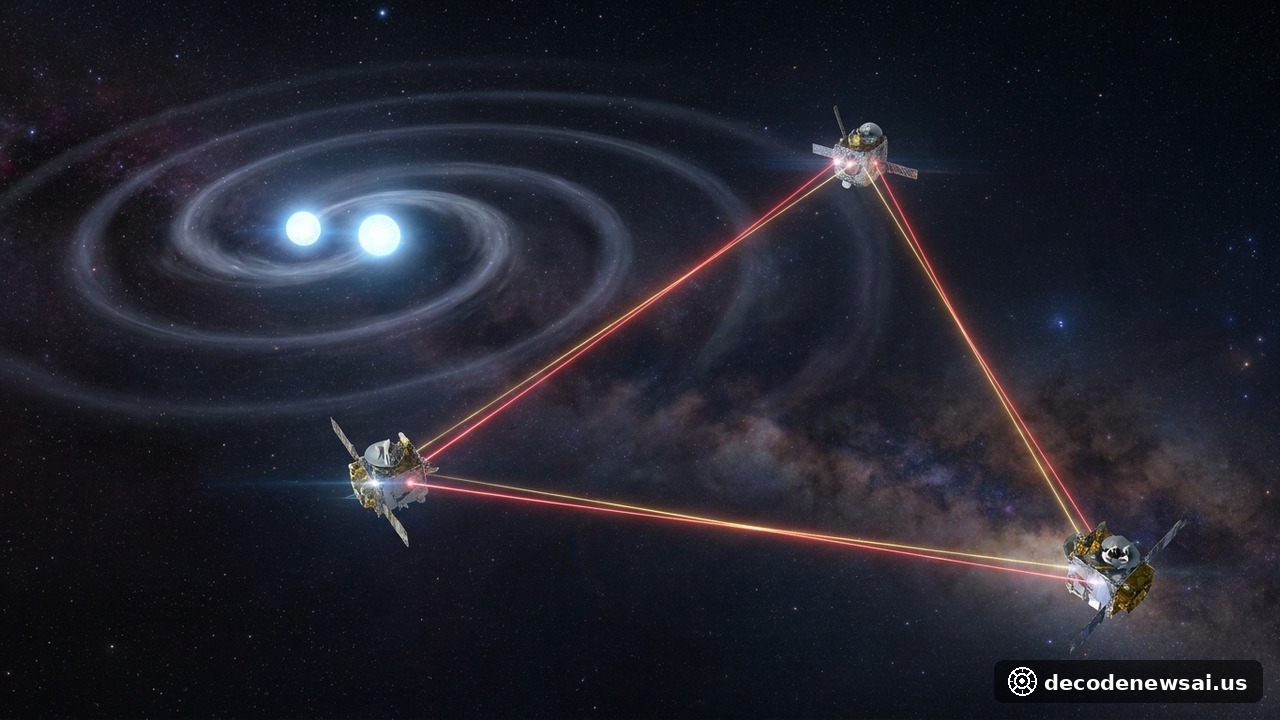
NASA astrophysicists published two new studies in The Astrophysical Journal this week demonstrating how LISA could uncover a previously unknown population of exoplanets orbiting binary white dwarfs. Led by ESA with NASA hardware contributions, LISA is slated for launch in the mid-2030s. Planned as a triangular formation of three spacecraft trailing Earth in heliocentric orbit, LISA will span 1.6 million miles (2.5 million kilometers) per side and use infrared lasers to measure distance shifts smaller than a helium atom.
Astronomers have identified exoplanets around isolated white dwarfs; none have been confirmed orbiting binary white dwarf pairs. Researchers estimate our galaxy contains roughly 10 million