The First Green Star Is a Dead Sun That Ate Its Planets
A dead star with a green glow
Warwick team led by Mark Hollands
The work, titled "Any colour you like: The diverse chromaticities of white dwarfs," was published in RAS Techniques and Instruments and led by Dr Mark Hollands of the University of Warwick's Astronomy and Astrophysics Group, with Professor Boris Gänsicke of the university's Department of Physics. "Most stars, including most white dwarfs, behave like 'perfect radiators,' so their colour is set almost entirely by temperature," Hollands said. "But nobody had really looked into what else might be possible for white dwarfs."
Sodium soaks up the orange light
Density near that of water does the rest
The underlying mechanism is density. The coolest white dwarf atmospheres reach around one gram per cubic centimetre — roughly the density of water, and millions of times denser than the sun's photosphere. In that environment, trace elements such as carbon, calcium and sodium no longer absorb light the way they do in a diffuse gas; they interact with the surrounding dense helium plasma and soak up far broader ranges of wavelengths, pushing the star's colour away from the orange-white-blue of a perfect radiator.
Colour tracks chemistry, not just temperature
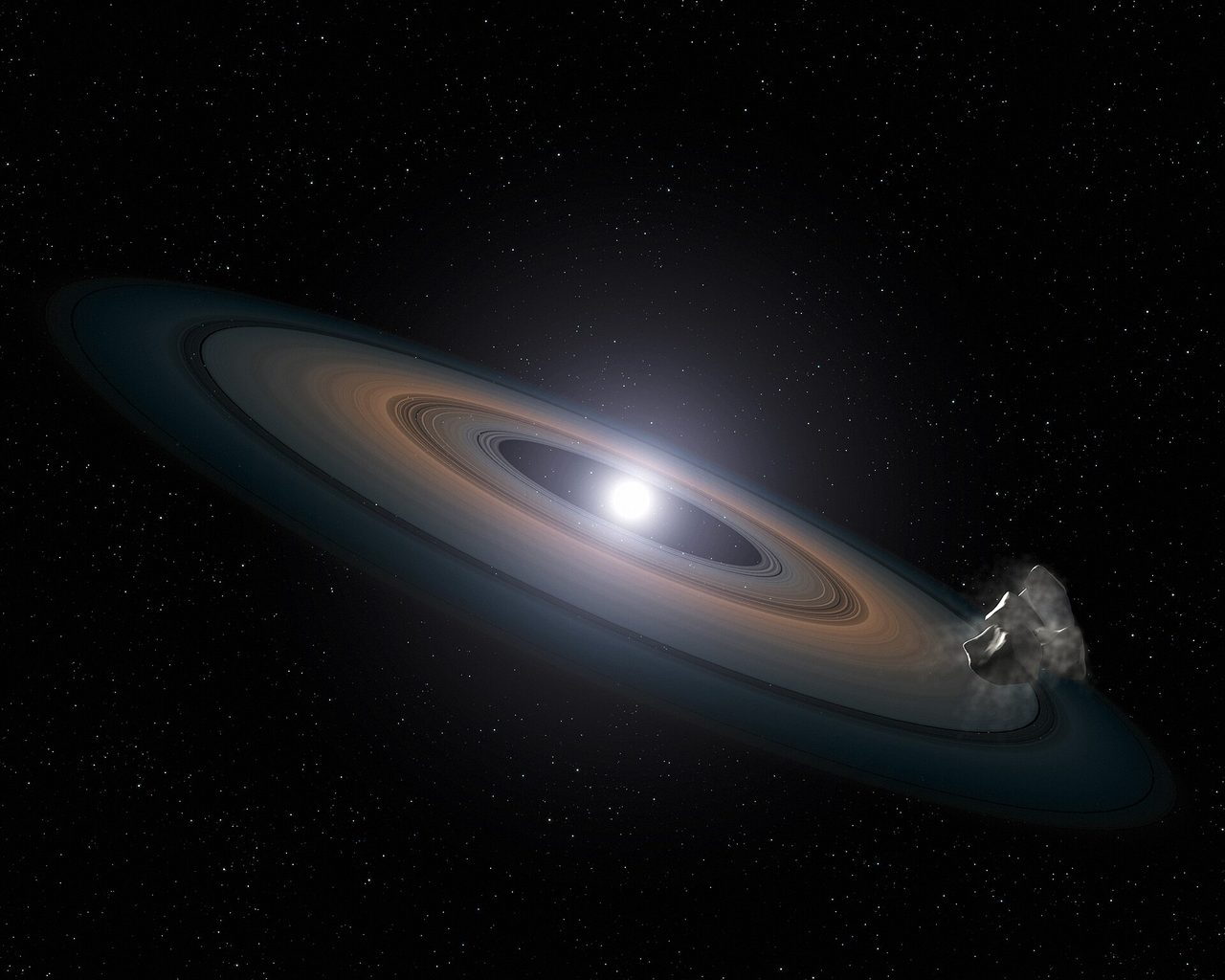
The team found the colours fall into chemical families. Carbon-rich white dwarfs come out pink or purple. Stars enriched with the debris of busted asteroids and comets — the remains of old planetary systems — lean yellow. Cool white dwarfs with mixed hydrogen and helium atmospheres glow cyan or pale blue, an effect produced as hydrogen molecules collide with helium atoms in their ultra-dense atmospheres.
The reddest star on record, too
Our own sun could go green
Space.com noted that the sun could in principle turn green as well — but only billions of years from now, after its death, and only if it then starts devouring planets like a cosmic zombie. On average, white dwarfs really are white.
A fast diagnostic for what dead stars ate
Because an odd colour flags a specific chemistry — sodium from accreted rocky debris, carbon dredged from a degenerate core, molecular hydrogen colliding with helium — colour becomes a rapid diagnostic of what a white dwarf is made of and what it has recently consumed. With large surveys cataloguing hundreds of thousands of white dwarfs, the Warwick method should surface many more green, pink and purple stars.
You have to get close to see it
The colours are what the stars would look like if we could view them close enough to resolve their stellar discs; the researchers converted spectra into human-perceived colour rather than photographing a green star. From Earth, each is only a point of light.