An international multidisciplinary research consortium led by geochemical and paleontological investigators at Curtin University in Western Australia published a landmark discovery in the Proceedings of the National Academy of Sciences (PNAS) on November 5, 2026, confirming the unprecedented chemical detection of preserved blood molecules and mineralized red blood cell structures inside the 115-million-year-old fossilized limb bones of a Brazilian theropod dinosaur, Aratasaurus museunacionali. Utilizing state-of-the-art time-of-flight secondary ion mass spectrometry alongside nanoscale focused ion beam imaging, the authors identified intact chemical signatures of heme B and its geological degradation product, 3,8-diethyl heme B, upending decades of biochemical orthodoxy that maintained organic macromolecules such as hemoglobin and blood pigments cannot survive deep geological timescales beyond a few million years.
What Are the Quantifiable Chronological and Geochemical Metrics of the Dinosaur Blood Discovery?
- Identified Theropod Dinosaur Species Taxonomy: Aratasaurus museunacionali (Basal Coelurosaur)
- Primary Preservative Mineral Matrix Identified: Hausmannite (Manganese Oxide Catalytic Phase)
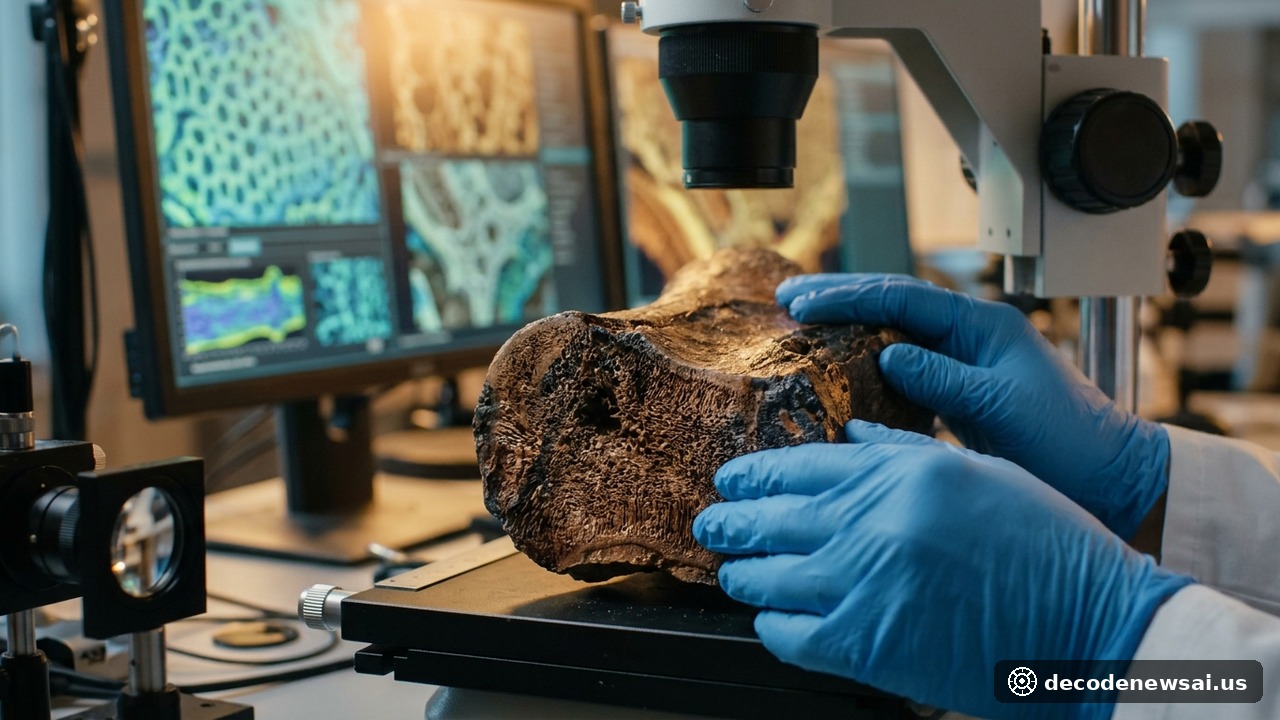
Lead author John Curtin Distinguished Professor Kliti Grice, Director of the Western Australian Organic and Isotope Geochemistry Centre, declared during the formal press briefing that identifying unambiguous molecular remnants of red blood cells across 115 million years constitutes a transformative milestone for molecular paleontology. The fossilized limb specimen was originally excavated from the fossil-rich Romualdo Formation in northeastern Brazil and famously survived the catastrophic 2018 fire that consumed much of the National Museum of Brazil in Rio de Janeiro. Nanoscale cross-sections etched from vascular canals revealed clusters of preserved elliptical microstructures displaying morphology and elemental composition consistent with avian and reptilian red blood cells.
Mass spectrometric audits established that the detected organic compounds were strictly endogenous to the dinosaur's vascular architecture, ruling out post-depositional microbiological contamination. In addition to intact iron-bearing heme porphyrin rings, the analytical pipeline identified characteristic amino acid residues associated with structural bone collagen.
How Did Catalytic Hausmannite Mineralization Create a 115-Million-Year Molecular Time Capsule?
For more than a century, classical geochemical models assumed that soft tissue biopolymers and oxygen-transporting metalloproteins inevitably succumb to rapid microbial decay, hydrolysis, and oxidative cleavage within tens of thousands of years post-mortem.
The PNAS publication elucidates an extraordinary preservation mechanism driven by specialized sedimentary conditions. The dinosaur was rapidly entombed within an anoxic, hypersaline, and sulfur-rich lacustrine environment that immediately arrested putrefying heterotrophic bacterial action. Crucially, microscopic imaging confirmed that mineralizing fluids precipitated hausmannite—a complex manganese oxide—directly within the cellular lumens. Hausmannite possesses catalytic enzyme-mimicking properties that scavenge reactive oxygen species (ROS), functioning as an inorganic antioxidant shield that insulated fragile organic porphyrin structures from free-radical degradation over hundreds of millions of years.
What Are the Transformative Implications for Molecular Paleontology and Astrobiology?
The empirical demonstration that delicate physiological macromolecules can endure across 115 million years fundamentally redefines the frontiers of evolutionary biology and astrobiology.
Co-author and Curtin University School of Earth and Planetary Sciences Professor Martin Van Kranendonk emphasized that the discovery provides a novel template for future deep-space planetary exploration. If complex bio-organic residues can persist across catastrophic geological epochs when encapsulated within protective manganese or iron mineral phases, space agencies targeting the ancient lacustrine sediments of Mars or the icy crusts of Jovian moons must recalibrate their remote spectroscopic instrumentation to search for mineralized cellular ghosts. By integrating high-resolution molecular geochemistry with fossil forensics, researchers can now interrogate the metabolic rates, blood evolution, and thermal physiology of long-extinct organisms directly at the molecular scale.