The MeerKLASS international research collaboration announced a historic observational breakthrough on Tuesday, November 10, 2026. It delivered the first direct measurement of the large-scale clustering of cosmic neutral hydrogen. The work used the South African Radio Astronomy Observatory's MeerKAT radio telescope array. The result validates 21-centimeter intensity mapping as a new observational tool for cosmology.
Overcoming Foregrounds to Map Pervasive Hydrogen Signals Across Deep Space
Neutral hydrogen is the most abundant chemical element in the universe. It emits faint radio photons at a rest-frame wavelength of 21 centimeters. This happens as electrons flip their spin alignment relative to atomic nuclei.
Cosmologists have long relied on catalogs of visible optical galaxies. These catalogs infer the underlying distribution of matter across cosmic time. That technique carries substantial observational biases.
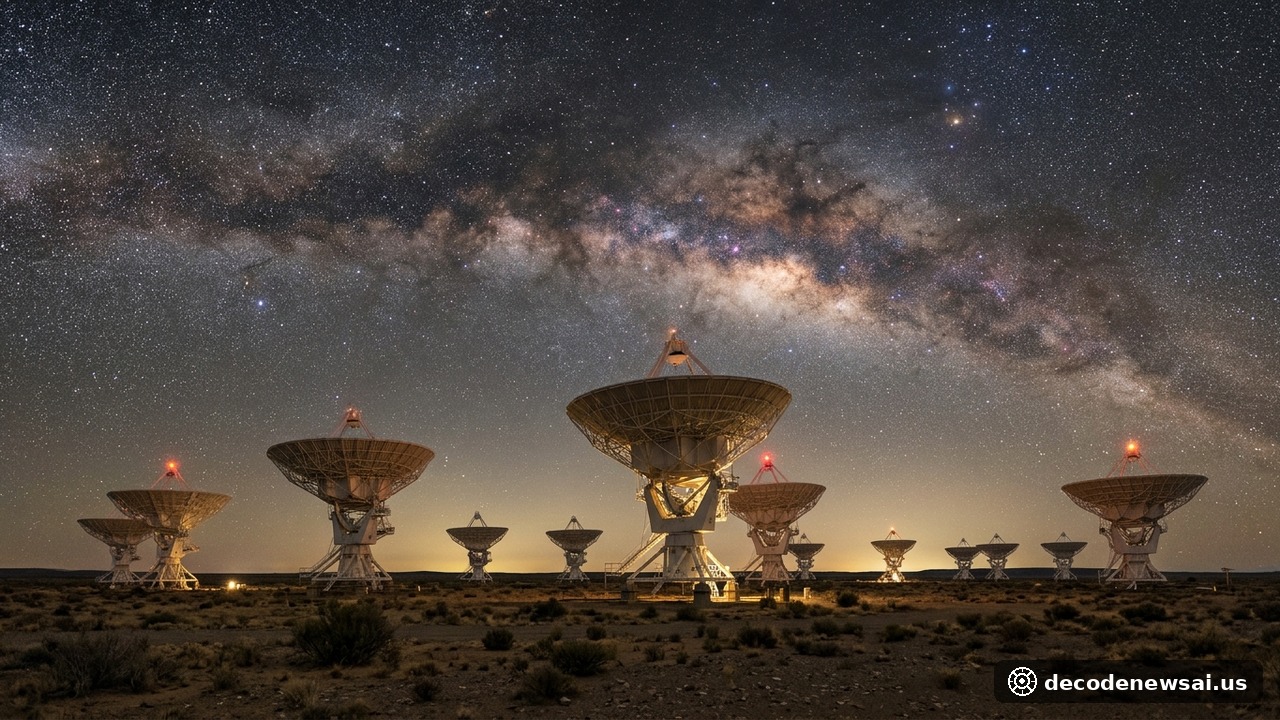
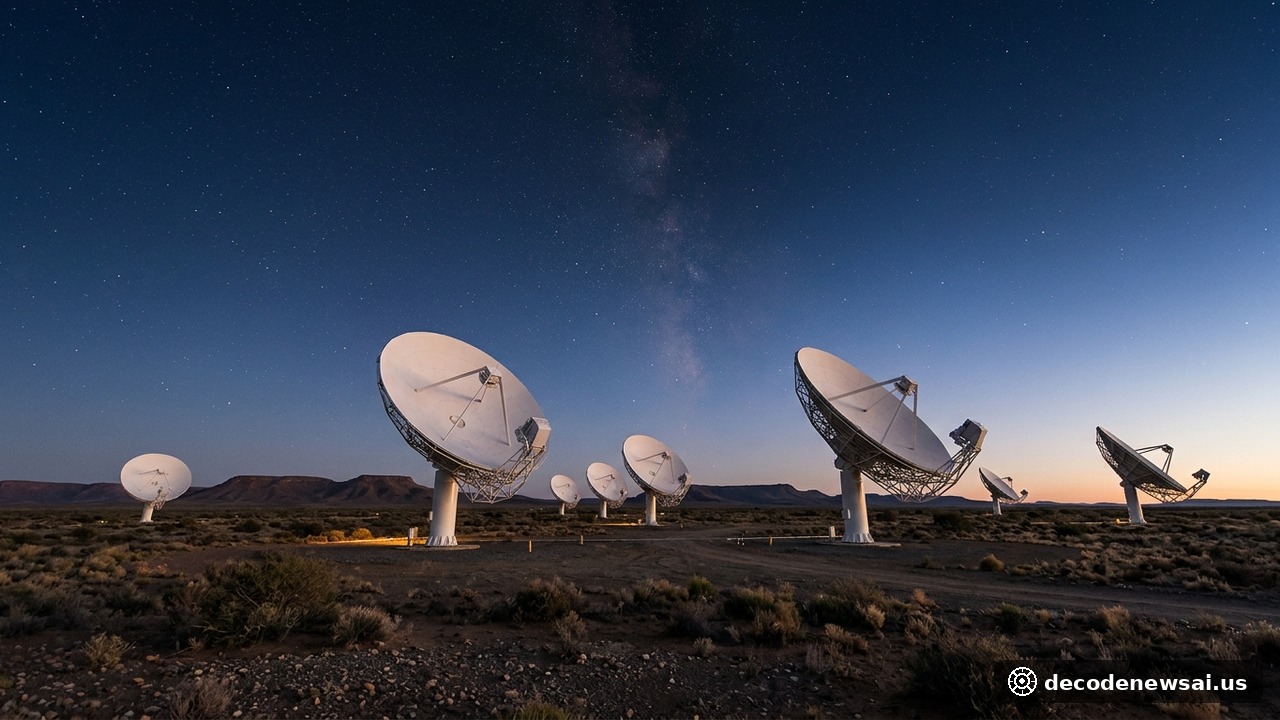
The MeerKLASS team used the 64 Gregorian-offset parabolic antennas of South Africa's MeerKAT array. The array sits in the Karoo desert. The team deployed advanced computational signal filtering. This isolated cosmological hydrogen emission from galactic synchrotron and radio frequency interference foregrounds.
Professor Mário Santos is Principal Investigator of the MeerKLASS survey at the University of the Western Cape. He stated in Cape Town: "This is a major milestone in establishing 21-cm intensity mapping as a novel tool for cosmology. This measurement took a decade of patient work by researchers spread across seven countries and three continents. Such an ambitious result requires sustained teamwork, and none of it would exist without the South African Radio Astronomy Observatory."
Providing Independent Constraints on Dark Energy Expansion and the Hubble Constant
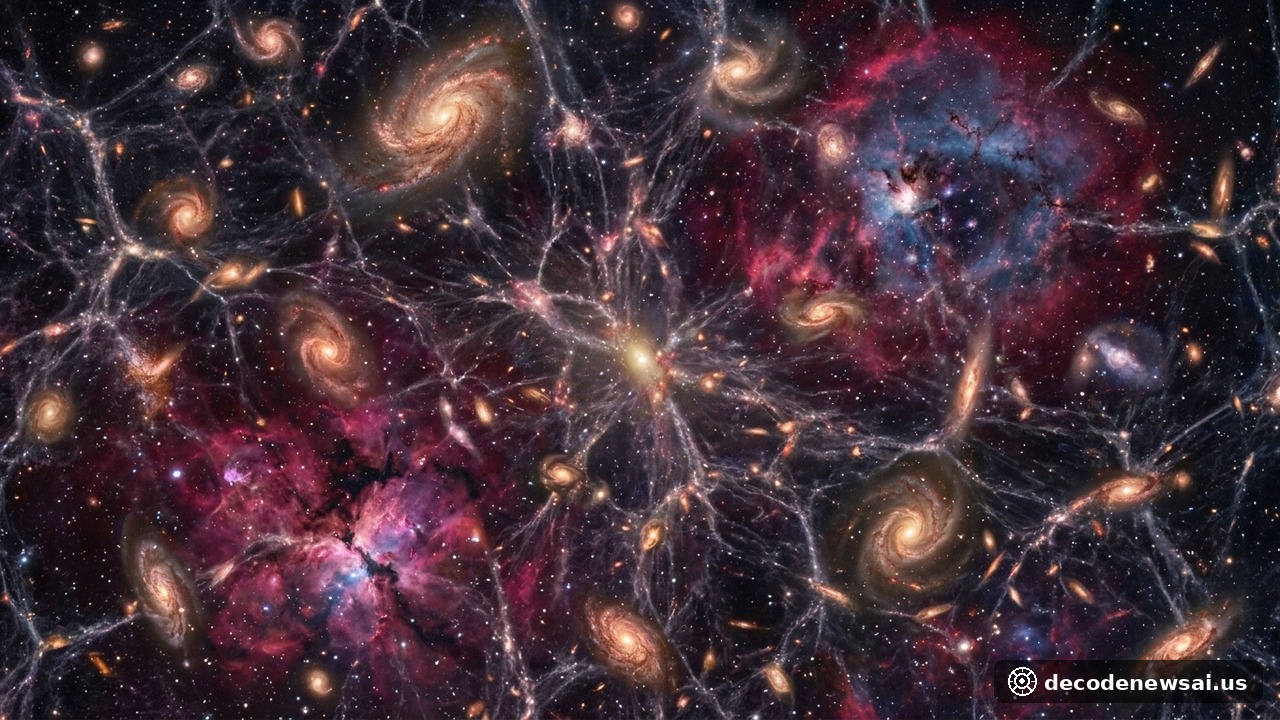
The dataset tracks neutral hydrogen clustering across billions of light-years. It provides independent parameters that constrain the geometry of space-time.
Astrophysicists can use these measurements to narrow uncertainty around the cosmic expansion rate. That rate is known as the Hubble-Lemaître Constant. The data also tests models of Dark Energy time evolution and Dark Matter spatial distribution. The success of the MeerKAT array provides empirical validation for upcoming wide-field surveys. Those surveys are planned with the global Square Kilometre Array (SKA-Mid) observatory.
A senior professor of radio astrophysics at the University of Manchester observed in an analysis published by Universe Today: "For decades, radio astronomers envisioned using diffuse hydrogen as a direct cosmic tracer. Clearing this technical hurdle provides cosmologists with an entirely independent yardstick to test general relativity on the largest scales." The collaboration confirmed that second-phase expanded sky observations are scheduled to commence in early 2027.
Observational cosmologists and theoretical physicists noted that multi-wavelength surveys provide complementary evidence on cosmic structural evolution. Radio intensity maps are cross-correlated with optical redshift surveys. This establishes empirical boundaries against systematic calibration errors. Research teams across Africa, Europe, and North America will continue refining digital signal processing pipelines throughout 2027. Collaborative big-science initiatives remain indispensable for unraveling fundamental physical mysteries governing the cosmos.
Strategic planning advisors and international trade specialists noted that long-term intergovernmental frameworks generate predictable operating environments across key industry sectors. Transparent administrative guidelines are coupled with rigorous scientific benchmarks. Regulatory bodies and enterprise leaders establish sustainable operating models capable of withstanding shifting macroeconomic dynamics. Global market participants will continue observing forthcoming implementation milestones as public agencies execute their mandated responsibilities throughout 2027. Cross-border coordination remains vital for driving sustained operational resilience and delivering measurable societal benefits worldwide.
Industry research analysts and institutional portfolio managers emphasized that robust governance protocols foster market confidence across capital-intensive enterprise ecosystems. Commercial operators maintain disciplined capital allocation standards. They also proactively address regulatory compliance obligations. Supply chains thereby achieve greater durability against external macroeconomic shocks. Executive leadership teams across North America and Europe continue prioritizing long-term strategic alignment over transient cyclical fluctuations. Core infrastructure deployments remain on schedule throughout the coming fiscal periods.