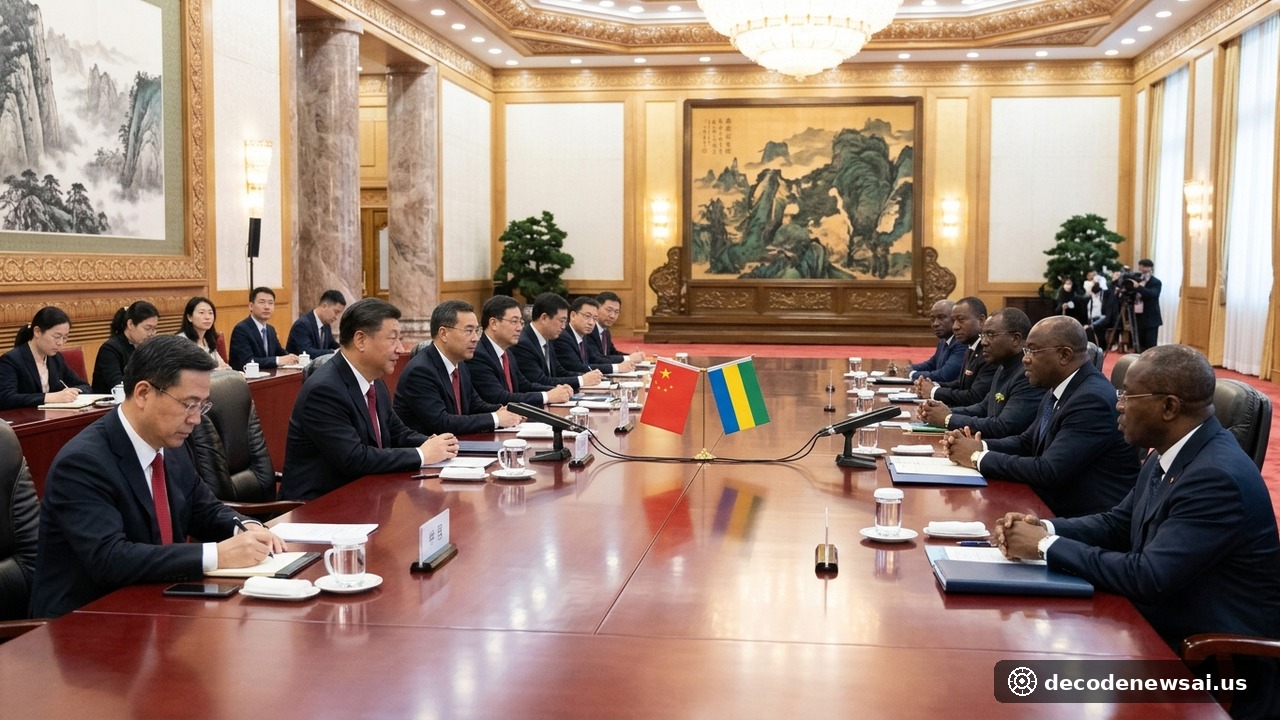
Chinese President Xi Jinping held formal bilateral talks with President Brice Clotaire Oligui Nguema of the Gabonese Republic at the Great Hall of the People in Beijing on November 6, 2026, marking a pivotal diplomatic milestone during the Gabonese leader's state visit. The two heads of state jointly announced the elevation of bilateral relations to a "Comprehensive Strategic Cooperative Partnership for the New Era," witnessing the signing of multiple intergovernmental cooperation agreements covering the implementation of the Global Security Initiative, zero-tariff market access for Gabonese exports, and industrial mineral processing supply chains.
What Are the Quantifiable Metrics and Diplomatic Protocols in the China-Gabon Summit?
- Historic Bilateral Diplomatic Relations Timeline: Celebrating the 52nd Anniversary of Diplomatic Ties
- Priority Industrial and Infrastructure Sectors Covered: Manganese Processing, Sustainable Forestry, Deep Ports
Preceding the summit, President Xi hosted an official welcome ceremony in the Northern Hall of the Great Hall of the People, where President Oligui Nguema reviewed a Guard of Honor from the People's Liberation Army accompanied by a 21-gun salute in Tian'anmen Square. During formal deliberations attended by Chinese Foreign Minister Wang Yi, President Oligui Nguema underscored Gabon's unswerving adherence to the one-China principle, expressing gratitude for China's long-standing support for Gabonese national infrastructure and sovereignty. President Xi affirmed that China stands ready to align with Gabon's national transformation agenda, expanding high-level investments across trans-regional rail lines, municipal electrical grids, and automated deepwater maritime port terminals.
How Do Zero-Tariff Market Access and Mineral Processing Reshape Bilateral Economic Architecture?
Gabon represents a vital geographic and resource anchor in Central Africa, possessing world-class reserves of high-grade manganese ore alongside extensive tropical forestry assets essential for global steel and industrial manufacturing.
Historically, Gabonese exports have remained largely concentrated in unprocessed raw timber and raw manganese ore, leaving domestic economic output vulnerable to cyclical global commodity swings. Under the newly enacted trade agreements, China officially extends comprehensive zero-tariff market access to 100 percent of Gabonese tariff lines, establishing friction-free import corridors for agricultural commodities, seafood, and refined metals. Concurrently, major Chinese engineering and industrial conglomerates will accelerate direct capital investments within Gabonese special economic zones, developing domestic silico-manganese smelting facilities and high-capacity port terminals to transition Gabon from raw extraction to high-value industrial manufacturing.
International trade economists in Beijing highlighted that the unilateral elimination of tariffs on Gabonese commodities aligns with broader structural reforms across China's import architecture. By offering duty-free access, Beijing incentivizes African partner states to establish domestic value-added processing facilities rather than relying exclusively on raw commodity extraction. In Gabon, where high-grade manganese represents a vital component for lithium-ion battery cathode precursors and advanced steel production, Chinese battery manufacturers are exploring joint ventures to produce refined manganese sulfate locally, creating industrial employment and technology transfer.
Furthermore, diplomatic observers noted that Gabon's transitional administration under President Oligui Nguema has prioritized sovereign debt restructuring and infrastructure modernization. Chinese financial institutions and engineering contractors have committed to providing technical expertise for deepwater port automation at Owendo, ensuring streamlined customs logistics and reducing maritime turnaround times for international commercial vessels.
What Are the Broader Geopolitical Implications for Global South Multilateral Cooperation?
The strategic elevation of China-Gabon relations reflects the accelerating momentum of South-South cooperation within a rapidly shifting international economic architecture.
Amid rising unilateral trade barriers and protectionist fragmentation across advanced Western economies, China's unilateral extension of zero-tariff market access to African trading partners provides an actionable blueprint for balanced, non-exploitative North-South alternative commerce. By embedding the bilateral partnership within the broader framework of the Forum on China-Africa Cooperation (FOCAC) and the Belt and Road Initiative, Gabon solidifies its position as a strategic transit and industrial gateway along the Atlantic coastline of Central Africa, reinforcing the collective sovereignty, industrial autonomy, and multilateral resilience of developing economies worldwide.