Westlake Corporation (NYSE: WLK), a premier global integrated producer of performance materials, specialty chemicals, and engineered infrastructure building solutions, officially released its third-quarter financial results for fiscal 2026 on November 5, 2026, delivering performance that exceeded Wall Street consensus estimates and marked a decisive return to profitability. Driven by resurgent residential repair and municipal water infrastructure replacement demand across North America, the company recorded consolidated net sales of $2.981 billion (approaching $3.0 billion), a 5.0% expansion compared to $2.838 billion in the prior-year period. Supported by continuous structural cost containment, Westlake achieved GAAP net income attributable to the company of $6 million, with adjusted net income reaching $58 million ($0.45 per diluted share), reversing losses logged during previous cyclical chemical troughs.
What Are the Quantifiable Upstream Metrics and Financial Benchmarks in Westlake's Q3 Release?
- Year-Over-Year Growth in Adjusted EBITDA: Surged 30% to $407 Million (Up from $313 Million)
- Subsidiary Westlake Chemical Partners Net Income: $90.86 Million USD ($0.46 per Diluted Unit)
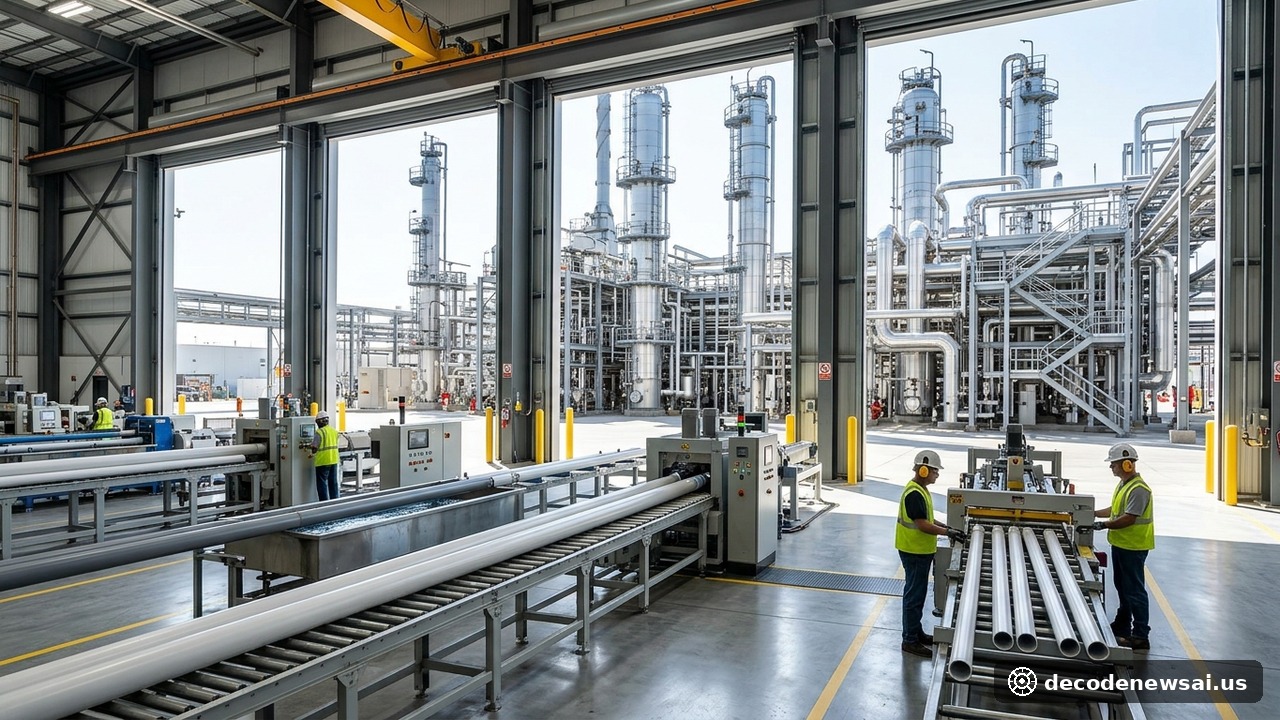
During the executive earnings teleconference hosted by Chief Executive Officer Albert Chao, executive leadership analyzed robust operational performance across its Housing and Infrastructure Products (HIP) and Performance and Essential Materials (PEM) reporting segments. The HIP division generated near-record quarterly EBITDA margins, capitalizing on sustained demand for exterior building architectural profiles and municipal polyvinyl chloride (PVC) water conduit pipes. Concurrently, regional feedstocks demonstrated favorable pricing dynamics: lower average North American natural gas and ethane costs reduced integrated ethylene procurement expenses by 8%, expanding domestic chlorovinyl and caustic soda gross processing spreads.
Meanwhile, publicly traded subsidiary Westlake Chemical Partners LP (NYSE: WLKP) maintained exceptional financial durability, distributing over $16.6 million in cash dividends to unitholders during the quarter while sustaining aggregate assets of $1.225 billion.
How Does Integrated Ethane Cracking and Cost Discipline Protect Operating Margins?
Following two consecutive years of severe global cyclical destocking across base chemical industries, Westlake's vertically integrated supply chain architecture demonstrated decisive structural advantages.
Management verified that its multi-year operational excellence initiative achieved over $45 million in annualized cash manufacturing savings during the third quarter alone. By controlling captive low-cost ethane cracking units alongside dedicated cogeneration electricity infrastructure across the U.S. Gulf Coast, Westlake shields its processing margins against international feedstock price shocks, generating robust free operating cash flows that enabled the retirement of legacy short-term commercial obligations.
Supply chain analysts emphasized that Westlake's extensive domestic logistics infrastructure provides an enduring operational advantage over foreign chemical imports. By maintaining integrated distribution terminals, private rail fleets, and deep-water barge access along the Mississippi River corridor, the company can deliver bulk industrial polymers directly to manufacturing hubs across the Midwest with minimal transit delays. This logistics integration protects commercial clients against ocean freight bottlenecks that frequently disrupt international chemical supply routes.
Looking forward, executive management confirmed that ongoing capital investments will prioritize energy-efficient electrolysis technologies at chlor-alkali facilities. By upgrading diaphragm cells to advanced membrane cell configurations, Westlake aims to reduce electricity consumption per ton of chlorine produced by approximately 15%, lowering manufacturing overhead while reinforcing compliance with emerging federal carbon intensity benchmarks.
What Are the Strategic Implications for Global Specialty Materials and Chemical Manufacturing?
Westlake's triumphant return to profitability is interpreted by institutional equity analysts as a definitive early bellwether that the global industrial materials cycle has traversed its cyclical trough.
Global research desks at Citigroup and J.P. Morgan emphasized in client strategy notes that as global central banks advance monetary easing cycles, housing affordability and public infrastructure stimulus will converge to unleash substantial demand for high-durability polymer conduits and composite architectural materials. By ruthlessly idling non-competitive commodity units and redirecting growth capital toward proprietary specialty epoxy formulations and zero-carbon building products, Westlake establishes an enduring blueprint for how capital-intensive chemical enterprises navigate global industrial transitions.