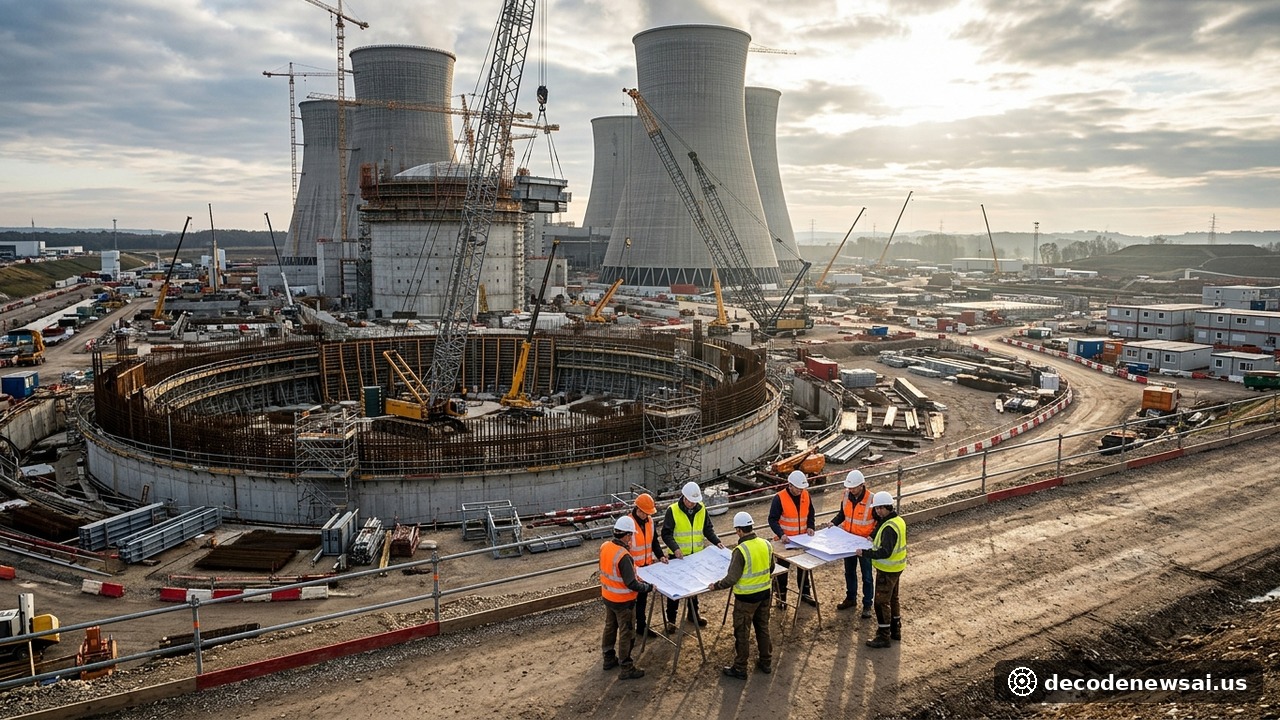
The Czech Republic's monumental $19 billion (27 trillion Korean won) project to construct two new nuclear reactors at the Dukovany power station hit a severe crisis on November 6, 2026, as domestic industrial alliances warned of major construction delays and contractual deadlock. Preferred engineering contractor Korea Hydro & Nuclear Power (KHNP) formally terminated exclusive consortium negotiations with South Korean builders Daewoo Engineering & Construction and Doosan Enerbility following an unresolvable dispute over cost-inflation liabilities. The sudden fracture within the South Korean delivery consortium poses severe threats to Central Europe's premier clean energy transition infrastructure.
Strategic Operational Milestones and Financial Baseline of Dukovany Expansion
- Planned Nuclear Capacity Addition: Two APR1000 pressurized water reactors
Why Did Negotiations Collapse Between KHNP and Its Construction Partners?
Earlier in 2026, the Czech government formally selected the South Korean state-backed conglomerate led by KHNP as the preferred bidder for Dukovany Units 5 and 6, outmaneuvering state-backed bids from France's Electricité de France (EDF) and the United States' Westinghouse. However, as bilateral engineering, procurement, and construction (EPC) contract drafting progressed into commercial risk-allocation provisions, deep rifts emerged between KHNP and its commercial partners regarding who would shoulder catastrophic commodity inflation risks.
Industrial insiders disclosed that dramatic price escalation across specialized nuclear-grade nickel alloys, heavy pressure-vessel forgings, and certified nuclear welders caused Daewoo E&C to request dynamic cost-escalation pass-through clauses. Daewoo sought contractual insulation to avoid repeating the multi-billion-dollar losses sustained by Western contractors on contemporary European nuclear projects. Bound by rigid fixed-price guarantees submitted to Czech utility CEZ during competitive bidding, KHNP rejected Daewoo's demands and abruptly severed the builder's exclusive mandate, initiating a search for alternative Asian or European construction subcontractors.
Why Has the Consortium Breakdown Triggered Panic Across Czech Industry?
The sudden rift reverberated violently across the Czech political establishment and industrial sector. The Confederation of Industry of the Czech Republic and the Alliance of Czech Nuclear Energy Suppliers issued an urgent joint assessment on November 6, cautioning that rebuilding the EPC consortium introduces intolerable execution risks. Under the statutory timetable, CEZ was scheduled to finalize binding commercial contracts with KHNP before June 2025 to enable preliminary site work ahead of the targeted November 2029 concrete pour.
Czech corporate leaders are profoundly alarmed regarding the fate of legally mandated domestic content requirements. Under the bilateral memorandum executed during bilateral state visits, Czech manufacturing and heavy engineering firms were guaranteed at least 60% of procurement contracts and sub-assembly orders. With Daewoo eliminated and KHNP compelled to renegotiate construction execution plans, Czech suppliers fear commercial terms will be diluted. Furthermore, an extended contractual delay would compromise the targeted 2036 commercial grid connection, leaving the Czech power grid vulnerable as aging coal-fired facilities are permanently decommissioned.
What Structural Vulnerabilities Does This Expose in Europe's Nuclear Renaissance?
The crisis unfolding around Dukovany highlights acute structural bottlenecks crippling Europe's broader atomic energy revival. In the aftermath of Russia's invasion of Ukraine, Eastern European nations from Poland to Romania embraced advanced nuclear power as the indispensable cornerstone of industrial decarbonization and sovereign energy independence. Yet three decades of deindustrialization across the Western hemisphere have depleted the institutional engineering base capable of executing high-complexity gigawatt-scale reactor builds.
Industry analysts emphasize that South Korea's nuclear industry built an exceptional global reputation on executing projects "on time and on budget," epitomized by the seamless commercial delivery of the Barakah nuclear power plant in the United Arab Emirates. However, transplanting that state-directed export paradigm into the European Union's intricate regulatory, environmental, and labor environment presents profoundly complex hurdles. The turmoil at Dukovany provides a sobering warning that securing carbon-free energy sovereignty requires reconciling fixed-cost discipline with transparent, realistic industrial risk sharing.