Satellite-to-cellular telecommunications provider AST SpaceMobile announced a landmark $1.3 billion propulsion supply agreement with Firefly Aerospace on November 6, 2026. The contract provides rocket engines to power Blacklift, AST SpaceMobile's proprietary 20-tonne reusable heavy-lift orbital launch vehicle. Under terms of the deal, Firefly will deliver 27 Miranda first-stage engines and nine Vira upper-stage engines to support initial flight articles, securing dedicated launch autonomy for deploying the orbital BlueBird direct-to-cell constellation beginning in late 2028.
Operational Milestones and Strategic Parameters of the $1.3B Propulsion Agreement
- Total Engine Contract Valuation: Over $1.30 billion (inclusive of production rights)
- Constellation Deployment Density: 5 next-generation BlueBird satellites per launch
- Targeted Inaugural Launch Flight Date: Q4 2028 (featuring vertical propulsive recovery)
Why Did a Space Cellular Provider Commit Immense Capital to In-House Rockets?
The historic propulsion agreement fundamentally redraws commercial aerospace boundaries. AST SpaceMobile has engineered massive low-orbit satellites outfitted with enormous phased-array antenna apertures designed to connect directly with standard smartphones worldwide without terrestrial cell towers. However, each next-generation BlueBird satellite spans thousands of square feet when unfurled in orbit, possessing massive payload mass that requires dozens of dedicated heavy-lift launches to establish global uninterrupted broadband coverage.
Over the past twenty-four months, commercial orbital launch manifests have experienced acute bottleneck shortages. United Launch Alliance capacity is largely consumed by Amazon's Project Kuiper, European Ariane 6 manifests are fully booked through 2028, and while SpaceX maintains high Falcon 9 cadence, its simultaneous development of competing Starlink Direct-to-Cell capabilities creates acute competitive friction. Fearing that launch dependencies could strand its satellites, AST SpaceMobile Chief Executive Officer Abel Avellan made the bold strategic gamble to vertically integrate dedicated launch operations through Blacklift.
How Does Firefly Aerospace Propulsion Accelerate Blacklift Vehicle Development?
For Firefly Aerospace, which achieved critical launch credibility through its commercial Alpha vehicle and tactical responsive space contracts for the Department of Defense, the $1.3 billion award cements its standing as a tier-one rocket propulsion supplier. Crucially, the agreement provides AST SpaceMobile with immediate hardware for the first three Blacklift orbital rockets while conveying long-term intellectual property manufacturing licenses to construct engines domestically.
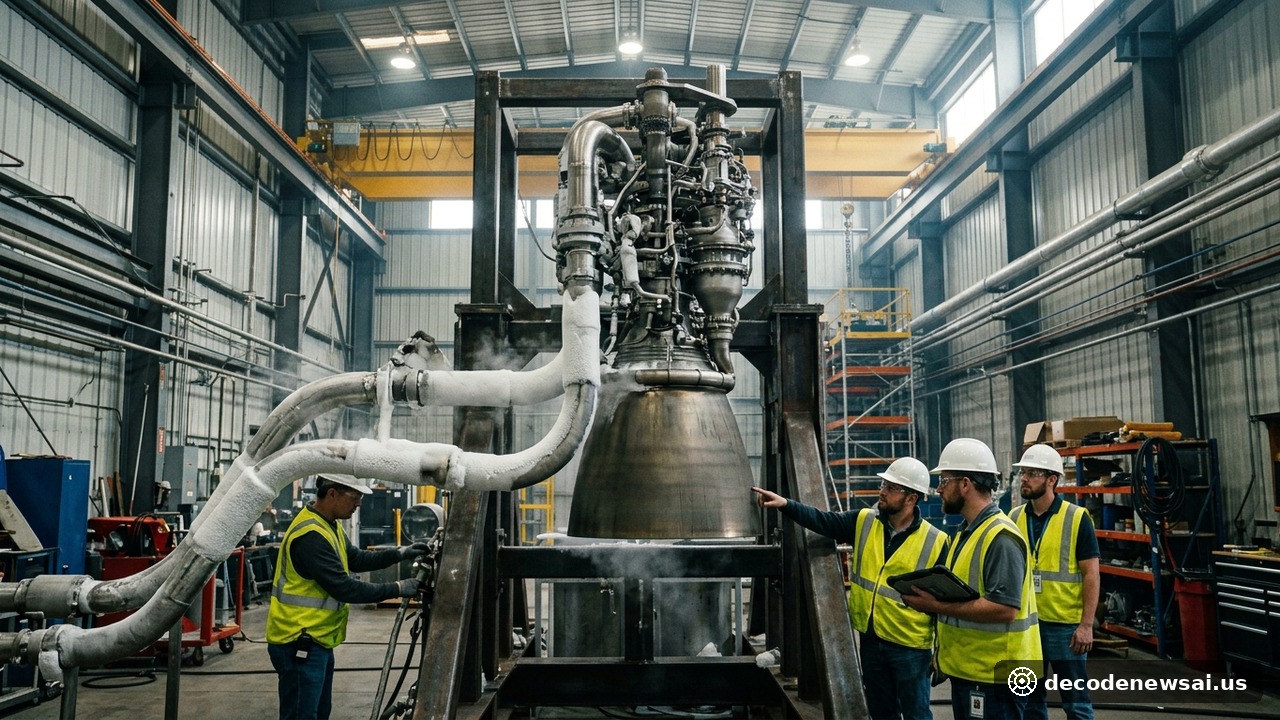
The technical architecture provides robust flight heritage: the Miranda engine utilizes cryogenic liquid oxygen and methane to generate over 230,000 pounds of sea-level thrust, incorporating throttling capabilities optimized for vertical booster recovery on autonomous ocean recovery platforms. The upper-stage Vira engine delivers multi-restart capabilities in deep vacuum, ensuring high-precision orbital deployment across distinct orbital planes. Procuring flight-proven rocket engines allows AST SpaceMobile to bypass standard half-decade propulsion testing cycles, compressing overall vehicle integration timelines.
Strategic Realignment Across Global Low Earth Orbit Constellation Deployment
AST SpaceMobile's move to build its own rocket crystallizes an aggressive shift toward complete vertical integration across commercial space telecommunications. Historically, satellite operators operated as asset-light technology developers, outsourcing orbital delivery to commercial launch providers. However, as satellite networks evolve into strategic planetary telecommunications utilities worth hundreds of billions of dollars, securing guaranteed, dedicated launch manifests has emerged as the ultimate competitive moat.
When Blacklift enters commercial operations in late 2028, it will represent the world's first operational reusable heavy-lift rocket developed and controlled by a dedicated telecommunications carrier. The vehicle will dramatically lower orbital deployment costs per satellite while applying intense competitive pricing pressure across commercial launch providers. In an orbital operating environment defined by escalating spectrum scarcity and limited launch slots, technology firms possessing both satellite manufacturing and dedicated launch infrastructure will dictate the future of orbital broadband.