- Primary Observational Asset: X-Shooter instrument on ESO’s Very Large Telescope (VLT);Broad-wavelength high-efficiency spectrograph in Chile
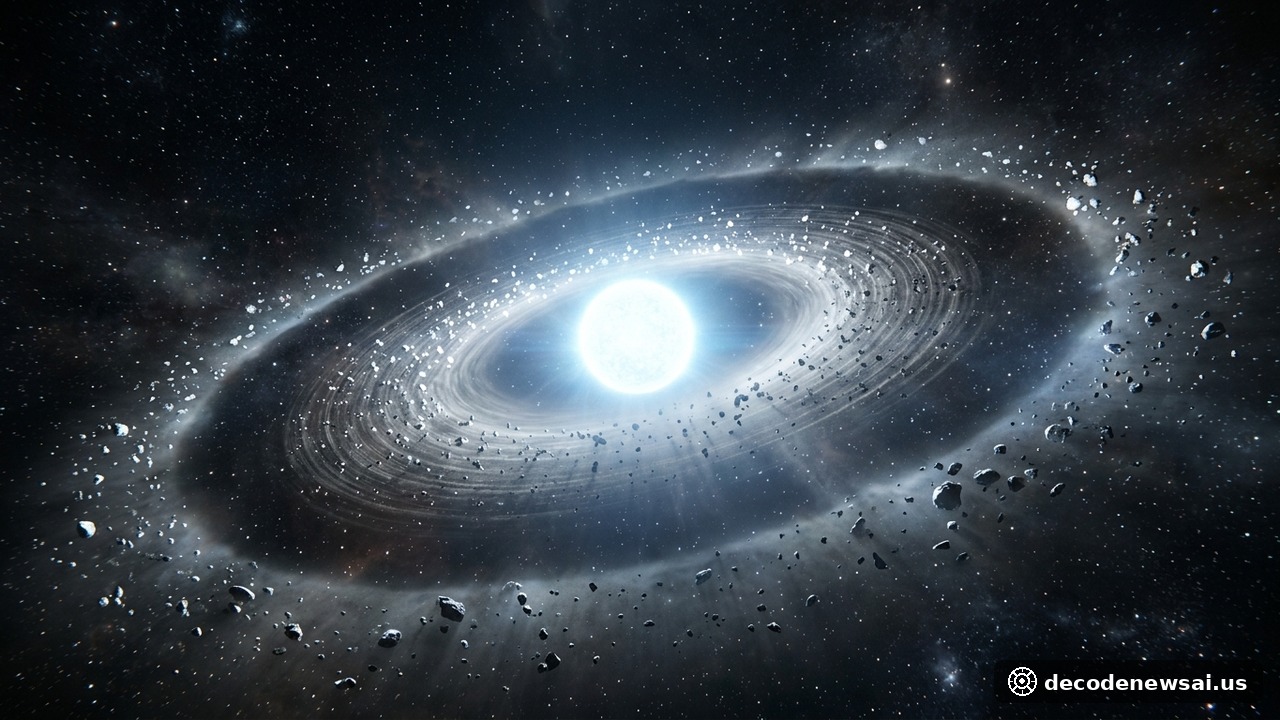
- Structural Morphological Gap: Distinct bifurcation dividing inner and outer rings;Dynamic gap preserved by gravitational shepherding bodies
- Surviving Planetesimal Scale: Outer shepherding body comparable in mass to Pluto or Moon;Solid planetary core that survived red giant engulfment phase
- Spectroscopic Elemental Clues: Inner ring rich in gaseous Mg; outer ring severely depleted;Indicates debris originates from disparate destroyed rocky bodies
Two surviving planetary bodies shepherd the double debris rings
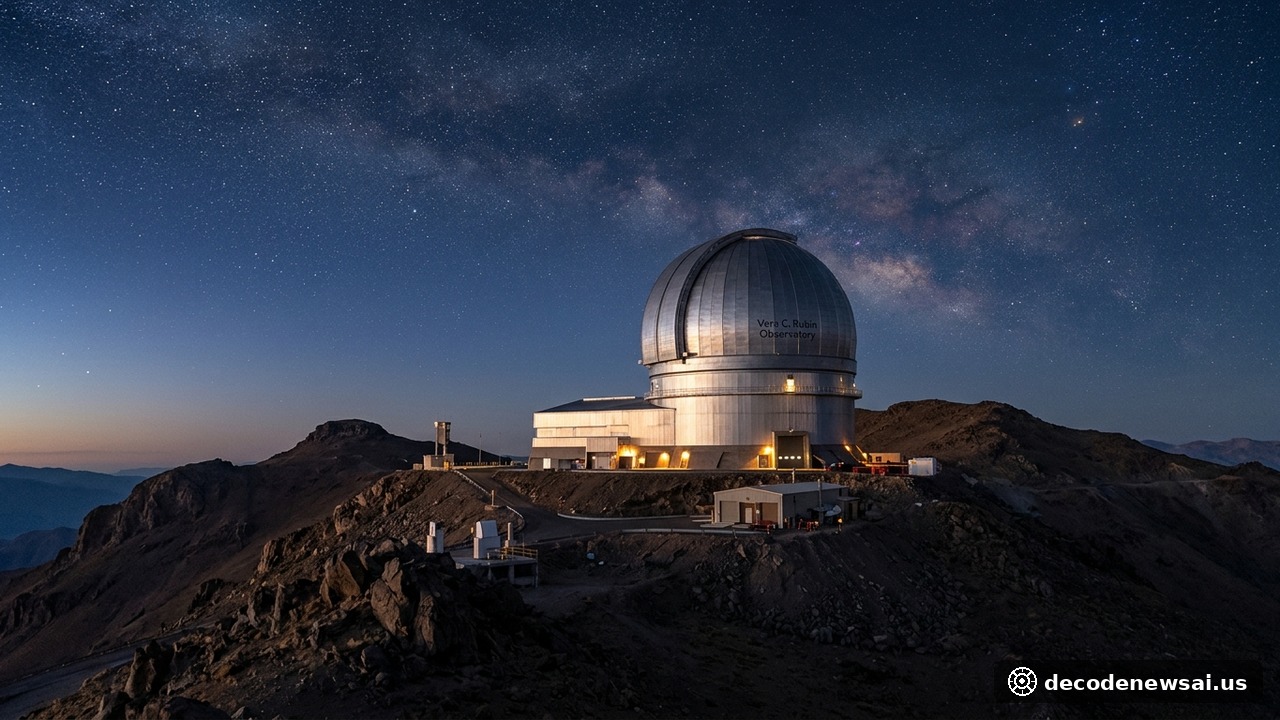
Astronomers utilizing the European Southern Observatory’s Very Large Telescope (ESO’s VLT) in the Atacama Desert of Chile have documented an extraordinary circumstellar discovery: a double ring of planetary debris encircling a cooling stellar remnant. Centered on the white dwarf designated J1328−1450, the observation—detailed in Nature Astronomy—provides the first conclusive empirical evidence of a bifurcated, two-tier debris disc orbiting a degenerate star, offering an authentic observational preview of the catastrophic physical transformation that awaits our own Solar System billions of years from now.
In standard observational models of post-main-sequence stellar evolution, rocky asteroids and minor planets perturbed into close periastron passages around white dwarfs are disrupted by intense tidal gravitational shear, forming a homogeneous, flat, rotating accretion disc. White dwarf J1328−1450 completely diverges from this historical baseline. High-resolution spectroscopic profiles gathered by the VLT's X-Shooter instrument revealed four distinct kinematic velocity peaks in ionized calcium emission lines, demonstrating that the circumstellar material is organized into two distinct, concentric debris rings separated by a pronounced orbital void.
Astrophysical modeling indicates that the persistent structural gap between the inner and outer rings is maintained by the active gravitational influence of two surviving planetary bodies. The outer perturber is estimated to approach the physical dimensions of Pluto or Earth’s Moon, successfully weathering the violent stellar expansion and mass-loss phases that characterized the star's transition through the asymptotic giant branch.
Inner ring magnesium gas versus outer ring depletion
Spectroscopic interrogation revealed profound chemical dissimilarities between the two structural rings. While both rings exhibit prominent absorption signatures of terrestrial planetary building blocks—specifically oxygen, iron, and calcium—the inner ring is densely saturated with vaporized magnesium gas, whereas the outer ring exhibits pronounced magnesium depletion. Principal investigator Dr. Lagos-Vilches explained that this striking elemental divergence indicates the debris either represents the pulverized remains of two chemically distinct rocky planets, or alternatively, the sequential tidal peeling of a single differentiated planetesimal whose crustal silicate shell was deposited into the outer ring while its dense, iron-magnesium core migrated inwards.
The discovery serves as a profound cosmic prologue for our own celestial neighborhood. In approximately five billion years, the Sun will expand into a red giant, likely engulfing Mercury and Venus while irrevocably sterilizing the inner Solar System, before collapsing into a white dwarf. The unique architecture of J1328−1450 proves that the death of a star does not extinguish its planetary architecture; rather, surviving planetary cores continue to orbit their dead star, sculpting the cosmic wreckage of destroyed worlds across deep cosmological timescales.
Astrophysicists and planetary cosmologists emphasized that the discovery of white dwarf J1328−1450’s double debris disc marks an observational milestone in understanding post-main-sequence planetary dynamics. By capturing the spectroscopic signature of two distinct rings sculpted by surviving planetesimals, the European Southern Observatory has provided invaluable empirical constraints on the long-term survival of planetary architectures. The distinct elemental compositions observed across the rings offer rare insights into the interior differentiation of rocky exoplanets, providing a tangible astronomical preview of our own Solar System’s distant evolutionary fate.