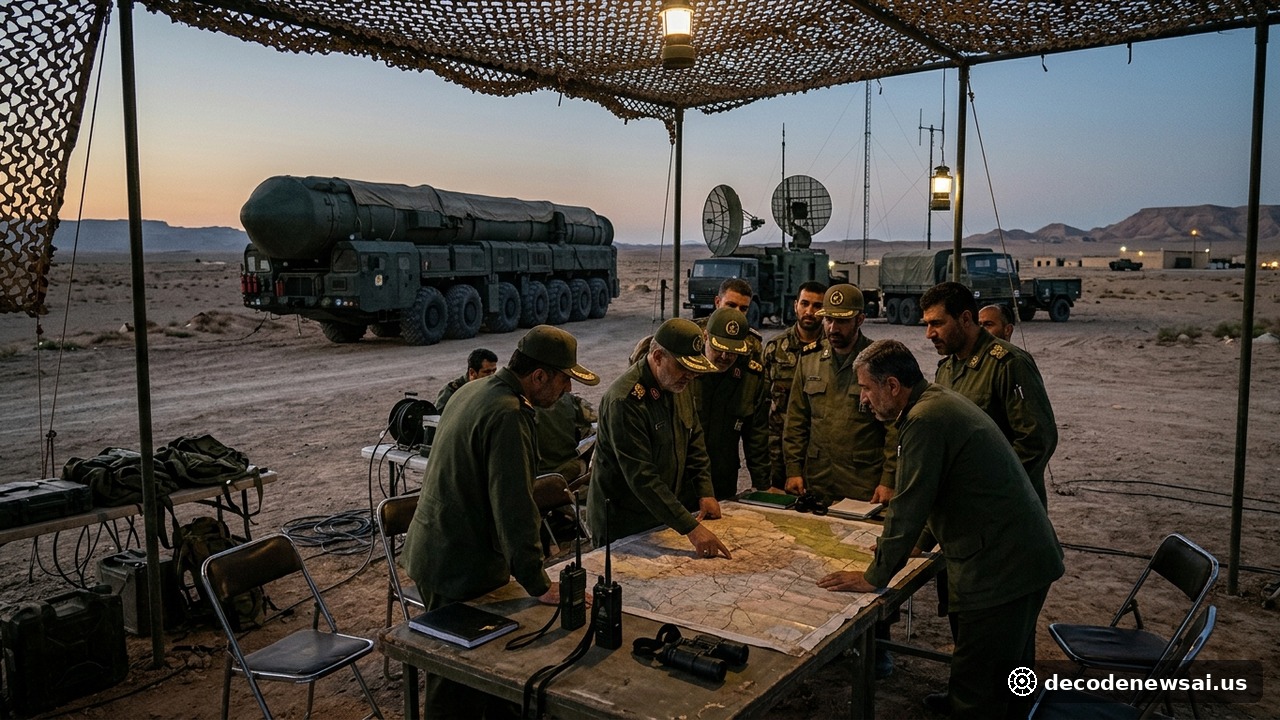
The Islamic Revolutionary Guard Corps (IRGC) officially declared on November 7, 2026, that it has eliminated its longstanding self-imposed ceiling of 2,000 kilometers (approximately 1,240 miles) on the operational range of its ballistic missiles. Speaking during an extraordinary defense briefing in Tehran, military spokespersons asserted that expanded United States naval blockade enforcement across the Persian Gulf and Strait of Hormuz compelled Iran to lift sovereign technological constraints, confirming that its aerospace forces possess the engineering capability to field long-range strike architectures to safeguard sovereign territory against external aggression.
Strategic Metrics and Threat Projection Under Iran's Uncapped Missile Architecture
- Extended Strike Reach Following Cap Removal: 3,500 to 5,000+ kilometers (reaching Southern Europe)
- Primary Heavy Ballistic Delivery Systems: Khorramshahr-4 and Fattah-2 Hypersonic Glide Vehicles
- Allied Naval Task Force Presence in Gulf: Over 15 Aegis destroyers and multinational frigates
- Humanitarian Impact in Central Gaza Camps: Tens of thousands of refugee shelters flooded
Why Did Tehran Formally Abandon Its Longstanding 2,000-Kilometer Strategic Boundary?
For nearly two decades, Iranian defense planners treated the 2,000-kilometer boundary as a vital geopolitical signaling device, calibrated to reassure European capitals that Iran's missile forces were strictly regional rather than intercontinental threats. However, recent escalations across the Levant, paired with long-range Israeli precision strikes against Iranian radar defense complexes and coordinated United States naval blockades in the Gulf of Oman, fundamentally undermined the deterrence value of self-restraint among senior security councils in Tehran.
Revolutionary Guard commanders argued that United States strategic bombers operate with virtual impunity from Diego Garcia in the Indian Ocean—a facility strategically situated just beyond Iran's historical 2,000-kilometer engagement radius. Dismantling the range limitation allows Iranian aerospace engineers to adapt heavy solid-propellant architectures to target staging facilities across the Indian Ocean basin and eastern Mediterranean, seeking to restore strategic parity by placing forward allied command hubs within range of saturation missile salvoes.
Technical Feasibility of Converting Space Launch Vehicles into Intermediate-Range Missiles
Western defense analysts note that Iran's extensive space launch vehicle program provides an immediate technological springboard to operationalize longer-range missiles. Through multiple orbital insertions utilizing the multi-stage Qased and Zuljanah solid-fuel launch platforms, Iranian technicians have successfully validated thrust vector control, high-temperature composite casing manufacturing, and exo-atmospheric stage separation. Transitioning these space launch propulsion systems into intermediate-range ballistic missiles (IRBMs) requires minimal structural modification.
Defense economists stress that while the public announcement represents an aggressive psychological escalation, it also serves as a high-stakes bargaining maneuver. By signaling an imminent capacity to target distant logistics hubs, Tehran seeks to coerce European powers into restraining American naval pressure and re-opening diplomatic backchannels. However, the move dramatically increases risks of pre-emptive confrontation, accelerating demands across Washington for enhanced ballistic missile defense deployments.
Compounding Humanitarian Emergencies Across Central Gaza Flood Disasters
The geopolitical brinkmanship in Tehran unfolded alongside catastrophic natural disasters in the central Gaza Strip. On Saturday morning, severe torrential rainfall battered displacement camps across Deir al-Balah, overwhelming rudimentary drainage systems and inundating tens of thousands of improvised refugee shelters with mud and floodwaters. Frail pediatric patients and amputees struggled through waist-deep waters, as regional relief networks warned that contaminated runoff has paralyzed primary healthcare delivery.
The convergence of military escalation and acute humanitarian distress illustrates the severe fragility gripping the broader Middle East. As diplomatic crisis-management frameworks deteriorate under relentless regional warfare, the risk of an uncontained conflagration continues to mount. Without immediate international diplomatic interventions to secure durable humanitarian corridors and establish verifiable strategic de-escalation, the collapse of traditional military boundaries threatens to precipitate systemic regional catastrophe.