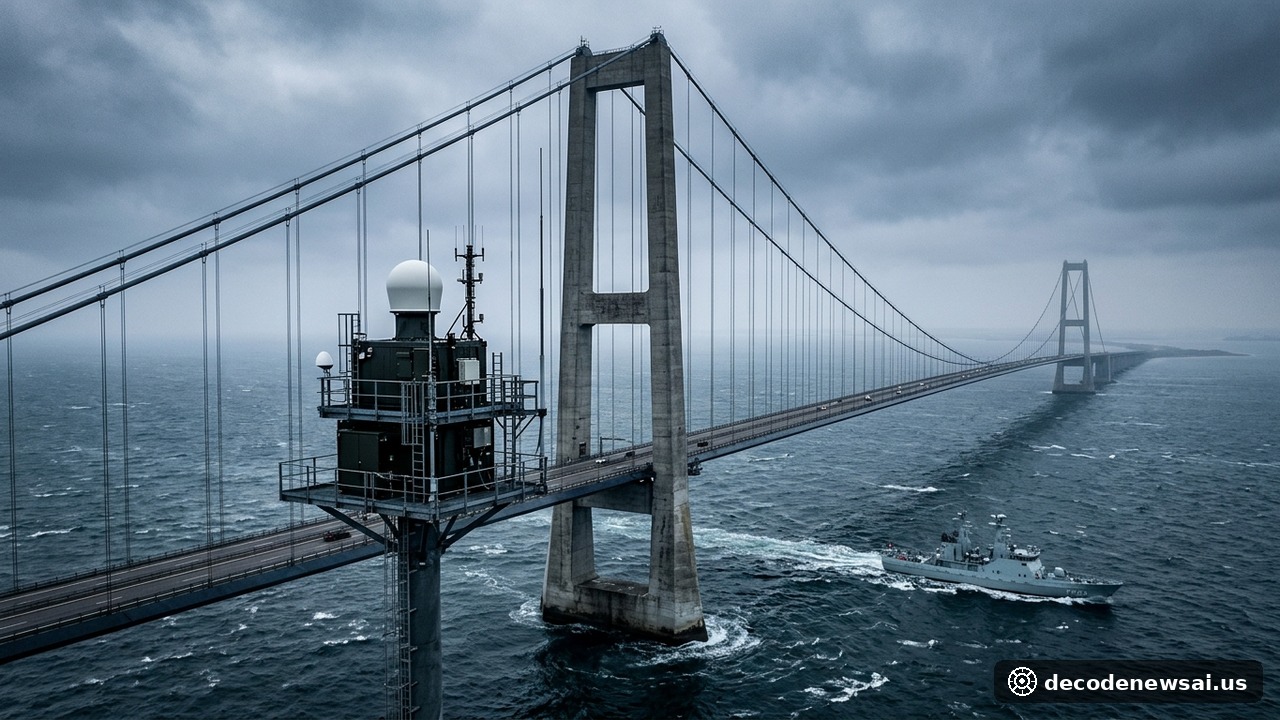
Danish infrastructure authority Sund & Bælt officially announced on November 6, 2026, the comprehensive deployment of an advanced radar surveillance system across the Great Belt Bridge (Storebælt Bridge) in direct coordination with the Danish Armed Forces and the Danish National Police. The permanent installation establishes 24-hour airspace and maritime tracking to neutralize illegal drone incursions and monitor naval movements along the strategic maritime chokepoint connecting the North Sea to the Baltic Sea. Radar masts completed structural elevation in autumn 2026, with the operational network scheduled to achieve full live capability before the end of the year.
Operational Benchmarks and Technical Baseline of the Great Belt Radar Defense
- Complete Operational Commissioning Date: Before December 31, 2026 (fall tower erection)
- Daily Average Bridge Traffic Volume: Over 36,000 passenger vehicles and freight trains
- Annual Maritime Transit Density: Over 20,000 international commercial vessels
- Lead Inter-Agency Enforcement Cohort: Danish Armed Forces, Police & Maritime Authority
- Technical Architecture Modality: Dual-use 3D airspace radar and thermal optics
Why Did Denmark Expedite Comprehensive Radar Deployment on Its Flagship Crossing?
Spanning approximately 18 kilometers across the Great Belt Strait, the Storebælt Bridge represents Denmark's paramount transportation artery, linking the islands of Zealand and Funen while serving as the primary international deep-water channel between the Baltic Sea and world oceans. Sund & Bælt Chief Executive Officer Mikkel Hemmingsen declared during a Copenhagen briefing that municipal and federal agencies detected numerous unauthorized micro and small drone flights near the bridge towers over the past year. These uncoordinated aerial operations approached critical load-bearing pylons and infrastructure monitoring nodes, creating unacceptable operational hazards.
The initiative unfolds against escalating geopolitical tensions across the broader Baltic Sea littoral. Following severe sabotages targeting regional undersea telecommunications cables and subsea gas conduits, combined with the continuous transit of unregulated shadow-fleet oil tankers circumventing Western sanctions, Danish defense planners identified an urgent requirement for autonomous radar coverage. The new installation operates independently of transponder cooperation, delivering high-fidelity three-dimensional situational awareness to NATO combined air and maritime operations commands within seconds of target acquisition.
How Does the Inter-Agency Framework Integrate Surveillance with Daily Transport?
Hemmingsen explained that Sund & Bælt spent twelve months designing the technical architecture alongside military engineers to ensure that commercial freight and civilian railway flows remain entirely uninterrupted. The defensive array incorporates ruggedized, marine-grade radar transmitters affixed to bridge superstructures, augmented by long-range electro-optical and infrared imaging payloads. Specialized digital signal-processing algorithms filter out clutter caused by marine wave action and migratory seabirds, isolating slow-moving, low-altitude quadcopters and fixed-wing uncrewed aerial systems with high geometric fidelity.
In standard operations, Sund & Bælt utilizes licensed commercial drones for cable inspections and concrete structural monitoring. The radar network incorporates a dynamic cryptographic whitelist, automatically validating authorized industrial maintenance flights while tagging unregistered aerial objects. If an unidentified intruder is detected near the bridge suspension cables or approaching navigation spans, automated telemetry immediately alerts the Danish National Police tactical command center. Standard operating procedures dictate coordinated responses involving law enforcement interdiction and military directional electronic warfare suppression.
Strategic Implications for Baltic Maritime Chokepoints and NATO Infrastructure
Defense analysts emphasize that the Great Belt radar program reflects a critical evolution in European homeland defense against hybrid and gray-zone threats. Over the past twenty-four months, critical transportation terminals, offshore wind farms, and regional broadcast facilities across Northern and Eastern Europe have faced coordinated waves of hoax disruptions, uncrewed surveillance, and cyber-physical reconnaissance. Denmark's modular solution of mounting sovereign sensor arrays directly onto civilian civil engineering marvels sets a precedent for safeguarding infrastructure across Scandinavia.
When the radar arrays achieve full continuous commissioning at year-end, Denmark will possess an unbroken electronic tripwire across the western Baltic exit. This programmatic enhancement provides robust physical protection for national logistical arteries while furnishing NATO commanders with vital maritime surveillance telemetry, reinforcing the alliance's defensive posture without constraining legitimate freedom of global commercial navigation.