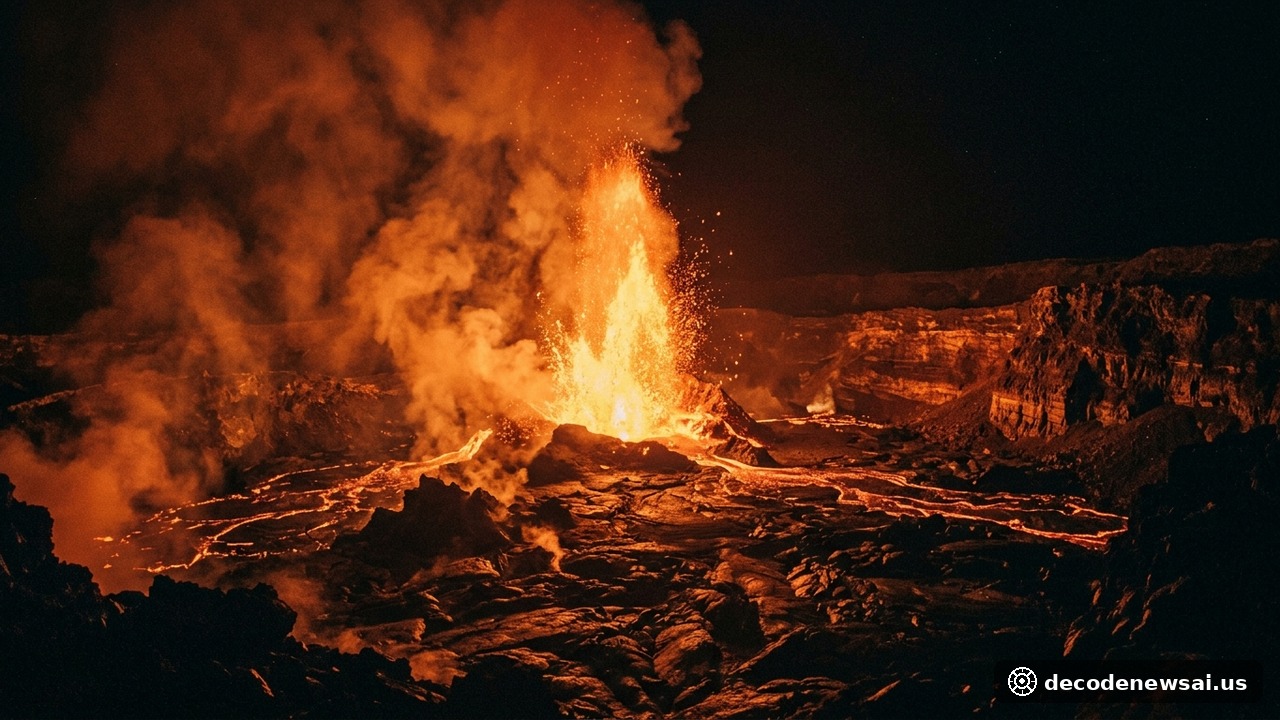
The United States Geological Survey's Hawaiian Volcano Observatory (HVO) issued an emergency activity update on November 6, 2026, confirming that Episode 56 of Kīlauea volcano's summit eruption terminated abruptly after nearly six hours of vigorous high-fountaining activity. Originating within Halemaʻumaʻu crater inside Hawaii Volcanoes National Park, the eruption propelled continuous basaltic lava fountains dozens of meters into the night sky before surface effusion ceased without preliminary warning. Rapid deflation of the active lava lake paired with seismic swarms deep within the southwest rift zone has placed volcanologists on heightened alert regarding subsurface magma redistribution.
Empirical Geodetic Benchmarks and Geophysical Metrics of Kīlauea Episode 56
- Continuous Vigorous Fountaining Duration: 5 hours 48 minutes sustained effusion
- Peak Fountain Plume Elevation Attained: 45 to 65 meters above vent orifice
- Summit Tiltmeter Deflationary Amplitude: >14 microradians (μrad) rapid contraction
- Post-Eruptive Lava Lake Surface Subsidence: Exceeded 10 vertical meters within two hours
- Co-Eruptive Seismicity and Micro-Quakes: Over 180 localized events (M0.5 to M2.8)
Why Did Vigorous Multi-Hour Lava Fountaining Terminate Abruptly?
Recognized globally as one of the most thoroughly instrumented basaltic shield volcanoes on Earth, Kīlauea initiated Episode 56 around midnight as volatile-rich magma breached shallow structural faults bounding the southwestern caldera floor. Tremendous hydrostatic pressure generated continuous curtains of incandescent magma erupting at volumetric rates exceeding dozens of cubic meters per second, feeding cascades of liquid rock into the cooling crust of Halemaʻumaʻu lake.
However, precisely as volcanologists anticipated an extended eruptive sequence spanning multiple days, acoustic and thermal telemetry plummeted precipitously at dawn, with active fountaining terminating completely within fifteen minutes. HVO senior geophysicists emphasized that such immediate cessation represents an anomalous hydraulic disruption. Rather than indicating total depletion of the deeper summit magma reservoir, the abrupt halt reflects a catastrophic shift in shallow conduit equilibrium—either caused by massive wall-rock collapses choking the primary ascending vent or the rapid diversion of magma into unbreached subterranean fracture networks.
Geodetic Tilt Anomalies and Subsurface Magmatic Dike Propagation Risks
What deeply concerns geophysical research teams is the behavior of geodetic instruments following vent shutdown. High-precision borehole tiltmeters anchored along the caldera rim did not stabilize after the cessation of fountaining; instead, sensors recorded erratic, rapid rebound and horizontal shear stress anomalies across the upper East Rift Zone. While harmonic volcanic tremor subsided, high-frequency brittle-failure seismic swarms escalated across depths of two to four kilometers southwest of the caldera.
Geophysicists hypothesize that while the direct conduit to Halemaʻumaʻu has been throttled, unremitting pressure from deeper mantle conduits continues to inject fluid magma into the shallow crust. Denied an open surface vent to release dissolved gas pressure, ascending melt frequently forces its way laterally along pre-existing rift faults, forming intrusive magmatic dikes. If these high-pressure dikes propagate beyond the boundaries of the national park toward unpopulated coastal zones, they could trigger sudden fissure eruptions across regional highways.
Coordinated Civil Defense Mitigation and Volcanic Fog Hazard Management
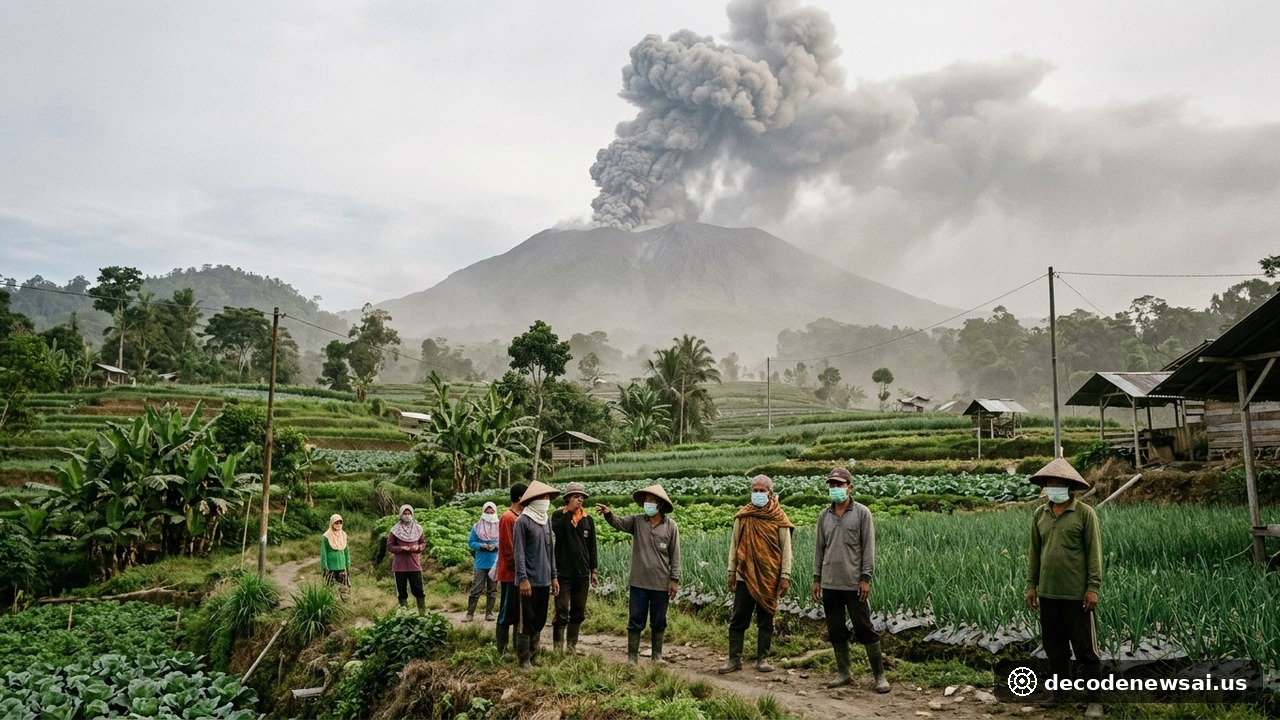
In response to persistent geological uncertainty, Hawaii County Civil Defense and the National Park Service executed joint precautionary protocols. Although the cessation of fountaining eliminated immediate risks of lava overtopping caldera observation berms, hazardous trail closures and summit overlooks remain strictly enforced. Ambient air monitoring stations recorded thousands of tonnes of sulfur dioxide (SO2) degassing from cooling fissures, creating heavy concentrations of hazardous volcanic smog ("vog") drifting toward downwind agricultural communities.
HVO scientific teams have deployed autonomous aerial drones equipped with forward-looking infrared sensors alongside satellite interferometric synthetic aperture radar (InSAR) passes to track subsurface ground displacement. The abrupt conclusion of Episode 56 does not signal the end of Kīlauea's eruptive unrest, but rather marks the precarious transition toward magmatic re-equilibration. Scientists remain engaged in round-the-clock monitoring to decipher subtle geophysical signals before subterranean forces orchestrate the next phase of basaltic activity.