- Counting Tabulation Phase: More than 50% of nationwide ballots tallied;Electoral Commission targets Nov 27 for official final results
- Major Party Vote Share: National Party 29.2% vs Labour Party 29.0%
- Incumbent Governing Bloc: National, ACT New Zealand, and NZ First;Coalition fluctuates directly around the 66-seat majority threshold
- Primary Campaign Focal Points: Persistent inflation, unemployment, public austerity;Stagnant household incomes dominated candidate debates
Coalition on edge of 61-seat majority
New Zealand’s 2026 general election has delivered a nail-biting parliamentary deadlock, according to preliminary election returns released Saturday evening by the New Zealand Electoral Commission. Prime Minister Christopher Luxon’s governing center-right National Party and Chris Hipkins’ opposition center-left Labour Party are locked in a near-dead heat, each securing approximately 29% of the party vote. The razor-thin margins ensure that neither dominant political organization can secure a standalone majority in the 120-seat House of Representatives, setting the stage for prolonged and complex multi-party coalition negotiations.
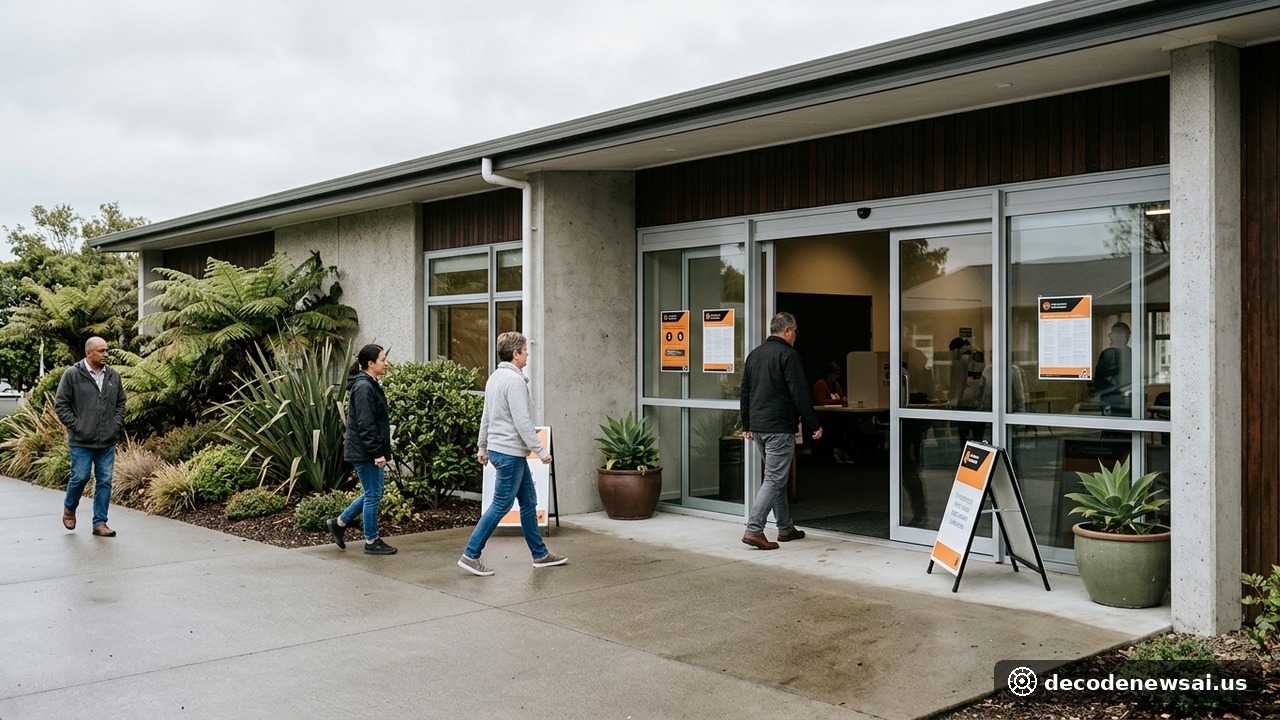
The national ballot took place against a backdrop of mounting economic anxiety, characterized by entrenched inflation across staple consumer goods, elevated mortgage borrowing benchmarks, and nationwide unemployment reaching decade-high levels. Reflecting widespread voter engagement amid domestic economic headwinds, almost 1.7 million of the country’s 3.8 million eligible voters cast advance ballots during the designated early voting period that opened on October 26, according to official Electoral Commission disclosures.
The preliminary returns indicate an exceptionally precarious path to power for Luxon’s incumbent governing coalition. The tripartite governing arrangement comprising National, the free-market ACT party led by David Seymour, and Winston Peters’ populist New Zealand First party hovered directly on the edge of the 61-seat threshold required to command a legislative majority. Meanwhile, while the Labour Party succeeded in arresting previous polling declines, a potential left-of-center alliance alongside the Green Party and Te Pāti Māori also appeared to fall short of a definitive governing bloc without courting minor political factions.
Final results delayed until November 27
New Zealand operates under strict election-day blackout legislation designed to preserve the integrity of the ballot, prohibiting domestic media reporting, political advertisements, and public campaigning from 6:00 a.m. until polling stations formally close at 7:00 p.m. Electoral officials emphasized that final, certified results—incorporating an estimated hundreds of thousands of special votes and international overseas ballots—will not be officially finalized until November 27.
Comparative constitutional scholars noted that the fractured parliamentary outcome underscores the evolving dynamics of New Zealand’s Mixed Member Proportional (MMP) electoral mechanism. With fiscal policy choices, public healthcare investments, and geopolitical positioning in the Pacific hanging in the balance, both major parties face the immediate necessity of brokering extensive policy compromises with smaller cross-bench factions to cobble together a functional executive government.
The impending coalition discussions are anticipated to center heavily on contentious tax reform proposals, statutory spending ceilings, and indigenous co-governance frameworks that sharply polarized voters throughout the campaign. Minor party leaders have already signaled their intent to leverage their kingmaker positions aggressively during initial bilateral soundings in Wellington. The protracted transition period highlights how macroeconomic stagnation and persistent cost pressures can destabilize incumbent administrations, demanding unprecedented diplomatic dexterity across New Zealand's political spectrum.
Knife-edge outcome tests multi-party governance
Constitutional scholars and international political observers noted that the knife-edge election outcome highlights broader democratic challenges facing parliamentary systems across the Commonwealth. As post-pandemic inflation and persistent housing affordability deficits strain middle-class households, voters increasingly fracture across non-traditional political parties, creating fragmented parliaments that demand extraordinary legislative dexterity to form stable governing majorities. The impending cross-party consultations in Wellington will be scrutinized closely across the Asia-Pacific region as a benchmark for multi-party democratic governance amidst global macroeconomic volatility.