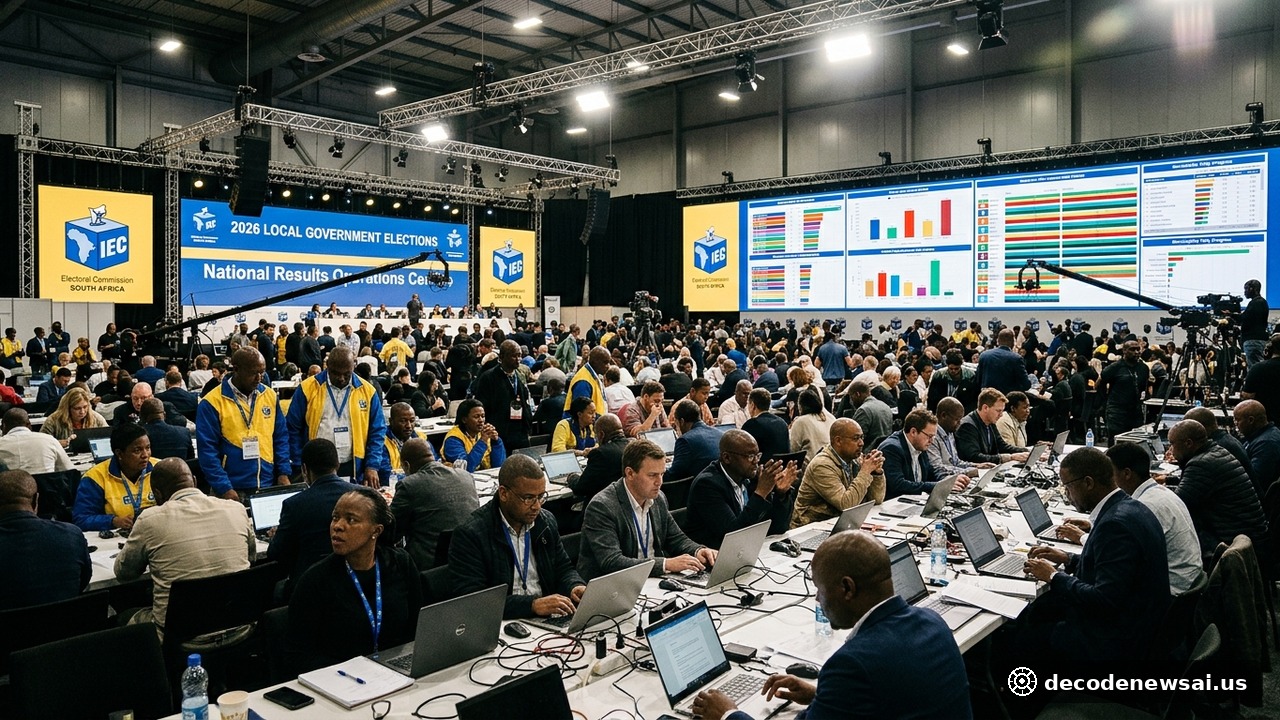
JOHANNESBURG — South Africa's ruling African National Congress suffered its worst electoral performance in history, securing just 30.76 percent of the national vote in the 2026 local government elections. The official results released by the Electoral Commission of South Africa confirmed an unprecedented slump for the governing party. The outcome has left 142 of the nation's 213 municipal councils without a majority party. A profound political restructuring is now underway across the country. Historic Electoral Slump Across Key Metros According to final tallies released at the National Results Operations Centre in Midrand, the ANC won 3,246 council seats nationwide. The national vote share dropped sharply from the 45.59 percent recorded in the 2021 municipal elections.
DA 24.64 percent and MK Party 9.76 percent reshape councils
The pro-business Democratic Alliance maintained second place nationally with 24.64 percent and captured 1,695 council seats. The uMkhonto weSizwe Party, led by former President Jacob Zuma, emerged as a major new force, capturing 9.76 percent of the vote and 785 seats in its first municipal contest. The Economic Freedom Fighters earned 6.22 percent with 588 seats. ActionSA followed with 5.67 percent and 313 seats. Independent candidates and localized civic groupings collected a combined 22.9 percent of the vote.
The electoral shift proved devastating for the ANC in Gauteng province. In the commercial capital Johannesburg, the DA secured roughly 35 percent of the ballots, well ahead of the ANC at 20 percent and ActionSA at 16 percent. Similar losses displaced the ANC from single-party municipal dominance in Tshwane and Ekurhuleni. Nationwide Logistics and Technological Deployment Administering the municipal poll required extensive institutional mobilization. Chief Electoral Officer Sy Mamabolo announced that the commission deployed 188,000 electoral staff to manage 23,696 voting stations. Over 100 million ballot papers were printed for the election.
To maintain integrity, the commission deployed 56,000 Voter Management Devices across polling stations. The technological rollout was comprehensive. The operational fleet included 40,000 units procured in 2021 and 16,000 additional terminals deployed for this cycle, including 8,000 donated by the Gauteng provincial government. These handheld units connected wirelessly to central operations hubs.
Court ruling and 142 hung councils trigger 14-day talks
The balloting also followed a critical Constitutional Court ruling. The apex court granted an application allowing 181 ANC candidates back onto the ballot after missed filing deadlines, an administrative relief subsequently extended to 32 candidates from rival political parties. Surge in Hung Councils and Mandatory Negotiations Municipal executive power is now severely fractured across every province. Only 74 councils produced an outright majority party, leaving 142 municipalities facing coalition governance.
The ANC captured outright control in only 53 municipalities, though it finished as the leading party in 128 councils. The DA secured outright control in 12 municipalities and led in 32. The Inkatha Freedom Party gained absolute control in five municipalities and led in 19 councils. The MK Party took outright control in three municipalities and led in 19.
ANC Secretary-General Fikile Mbalula openly conceded the severe electoral setback. Mbalula stated: "When the people tell us we have fallen short, the honest answer is not to argue with them but to go home and put our house in order." South African political parties now face a strict statutory 14-day negotiation window to form local governing pacts. Ramaphosa Demands Prompt Coalitions to Protect Basic Services President Cyril Ramaphosa addressed political leaders and election observers in Midrand on Sunday evening, calling on all sides to approach local pacts with humility and civic urgency. Ramaphosa stated: "Councils must be constituted without delay. The delivery of essential services cannot be held hostage by political disagreement."
Ramaphosa urges coalitions as Mashaba rejects Zille in Johannesburg
Ramaphosa cautioned parties against pursuing narrow executive patronage at the expense of residents. He emphasized that voters cast their ballots expecting functional water, power, and sanitation infrastructure, rather than extended political infighting over municipal committee posts. The public demands tangible municipal delivery.
Forming stable municipal executives presents severe practical hurdles. ActionSA leader Herman Mashaba told reporters his party would refuse to back the DA's mayoral candidate Helen Zille in Johannesburg. With no political grouping commanding a working majority, the stability of South Africa's largest metropolitan centers now rests on complex compromises between ideological rivals.