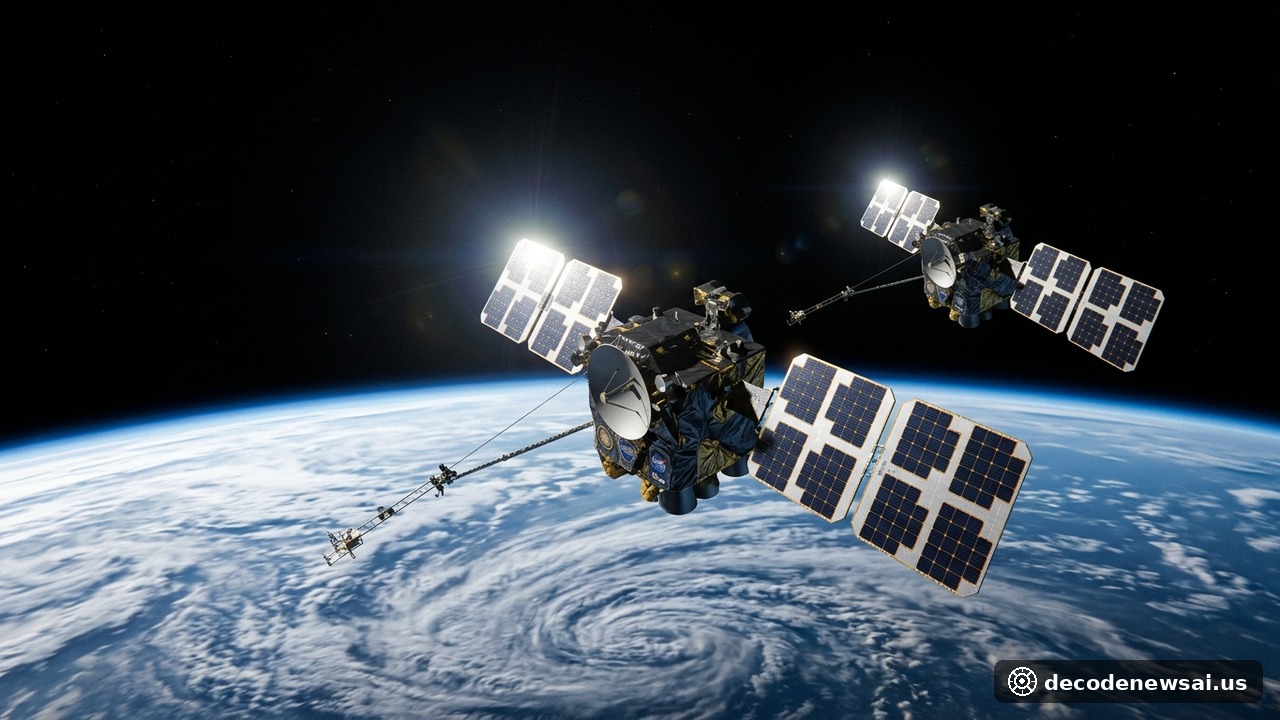
NASA's Science Mission Directorate and the University of California, Berkeley's Space Sciences Laboratory jointly confirmed on November 6, 2026, that the twin robotic spacecraft comprising the Escape and Plasma Acceleration and Dynamics Explorers (ESCAPADE) mission—christened "Blue" and "Gold"—have concluded their one-year loiter at the Earth-Sun Lagrange point 2 (L2) and successfully returned to near-Earth orbital space. In mid-November 2026, the twin spacecraft will execute an Earth gravity-assist slingshot maneuver, utilizing the planet's gravitational well to achieve the trans-Mars injection (TMI) velocity required to break free from the Earth-Moon system. The orbital maneuver eliminates the necessity of a direct, high-propellant translunar dash, setting up both spacecraft for orbital insertion around Mars in September 2027 to investigate the real-time dynamics of solar wind-driven atmospheric stripping.
What Are the Core Astrodynamic Milestones and Mission Metrics in the ESCAPADE Earth Flyby?
- Twin Robotic Spacecraft Formally Tasked with Distributed Mars Mission: "Blue" and "Gold" Identical Small Satellite Probes
- Operational Duration Expended at Earth-Sun L2 Loitering Orbit: Approximately 1 Year (Launched November 2025 Awaiting Geometry)
Robert Lillis, ESCAPADE Principal Investigator at UC Berkeley's Space Sciences Laboratory, articulated the paradigm shift during a technical briefing: "Traditional interplanetary architectures mandate launching during narrow, rigid 26-month planetary alignment windows using high-energy launch vehicles. ESCAPADE decouples this limitation by parking small, low-cost spacecraft in an energy-neutral Earth-Sun Lagrange point until planetary mechanics align. By returning to execute an Earth gravity assist in November 2026, our twin probes leverage our home planet's angular momentum to harvest the required escape velocity essentially for free, validating a scalable commercial small-satellite model capable of conducting multi-point planetary science across the solar system."
Astrodynamics engineers note that the flyby trajectory requires micro-radian navigational accuracy. By utilizing deep-space radio tracking networks and autonomous optical stellar references, ground controllers will execute fine-tuning trim maneuvers ensuring both spacecraft graze Earth's upper exosphere at precise velocity vectors before firing their chemical propulsion thrusters.
Furthermore, flight controllers confirmed that all scientific payloads onboard both probes—including fluxgate magnetometers and electrostatic analyzers—successfully completed deep-space calibration tests during the outbound L2 cruise phase, demonstrating absolute instrument sensitivity ahead of active science operations.
How Do Gravity-Assist Trajectories and SmallSats Disrupt Interplanetary Exploration?
In conventional planetary mission design, dedicated spacecraft must absorb the massive delta-V expenditure of trans-planetary injection directly from the primary upper stage of their launch vehicle, constraining payload mass and driving mission costs into the hundreds of millions of dollars.
ESCAPADE circumvents these economic barriers through an unconventional orbital path. Following their November 2025 launch, Blue and Gold were placed into an elongated halo orbit around L2, approximately one million miles from Earth. As orbital calculations confirmed optimal geometric alignment between Earth and Mars in late 2026, flight controllers initiated minor hydrazine burns that nudged the probes into a precision hyperbolic approach toward Earth. Gravity-assist dynamics amplify the spacecraft's heliocentric velocity while tilting the orbital inclination toward Mars, allowing an efficient 11-minute trans-Mars injection engine burn to complete trajectory insertion with modest onboard propellant reserves.
What Scientific Breakthroughs Does Multi-Point Stereoscopic Observation Bring to Mars Science?
While previous Mars orbiters operated as isolated single-point platforms capable of capturing only localized observational snapshots, ESCAPADE's core scientific advantage stems from simultaneous multi-point stereoscopic measurements.
Upon entering elliptical science orbits around Mars in September 2027, Blue and Gold will fly in distinct yet coordinated trajectories, with differing orbital inclinations and orbital periods (4.9 and 6.6 hours). This distributed constellation allows simultaneous cross-correlation of real-time solar wind plasma shocks entering the upper Martian exosphere against localized magnetic reconnection events occurring thousands of kilometers away. By capturing the three-dimensional physics governing how the Sun strips away volatile water and atmospheric gases from an unmagnetized rocky planet, ESCAPADE delivers empirical environmental telemetry essential for modeling the deep historical climate collapse of Mars while engineering predictive space weather mitigation protocols for future human crewed expeditions.