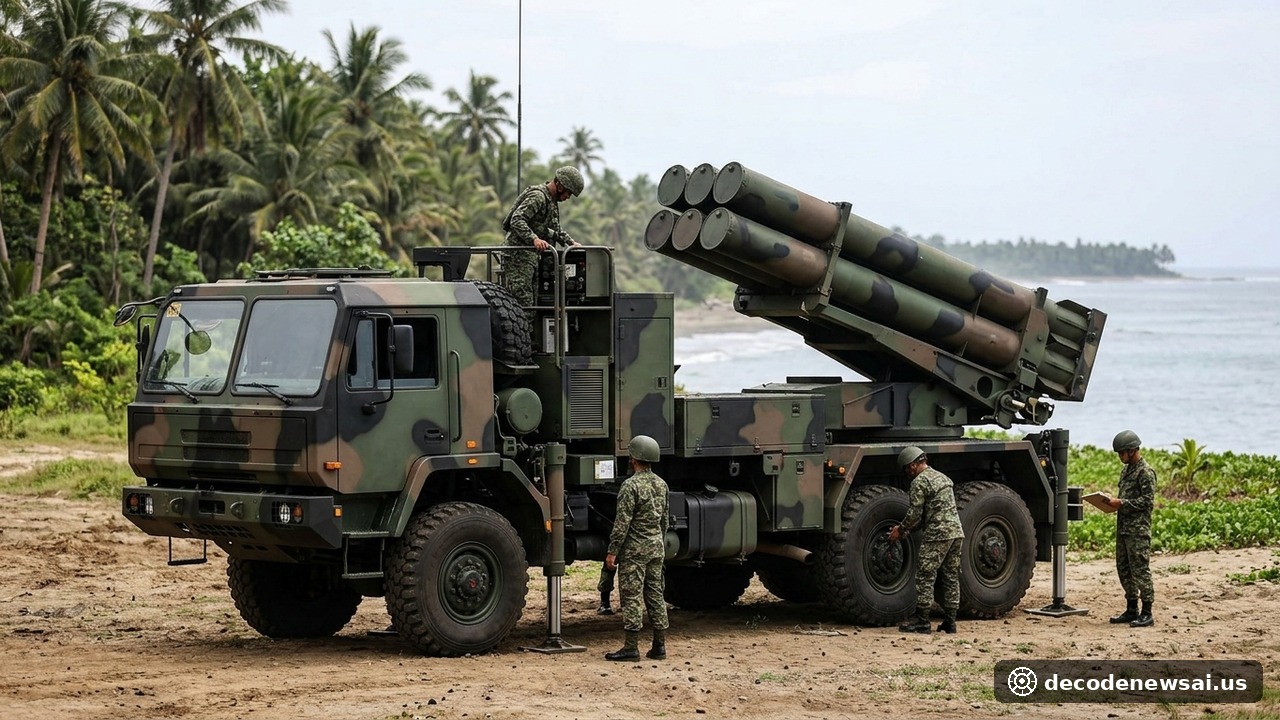
The Coastal Defense Regiment of the Armed Forces of the Philippines (AFP) formally operationalized its newly acquired BrahMos shore-based supersonic anti-ship cruise missile batteries during an induction ceremony conducted at a primary coastal garrison in western Luzon on November 6, 2026. The Philippine Department of National Defense confirmed that all three missile batteries procured under a landmark $375 million defense pact—encompassing mobile launcher platforms, mobile command posts, and dedicated target acquisition radar suites—have completed combat alert deployments, providing an all-weather 290-kilometer anti-access and area-denial (A2/AD) strike perimeter over critical maritime passages in the West Philippine Sea. Concurrently, the Joint United States Military Assistance Group (JUSMAG) and AFP leadership announced the commissioning of four advanced high-mobility coastal air-and-surface surveillance radar installations along the coasts of Palawan and Zambales provinces, marking a decisive escalation in Manila's integrated territorial defense posture.
Key Strategic Metrics: Philippine BrahMos Missile Deployment and Coastal Radar Grid
- Operational BrahMos Batteries Deployed: 3 Full Batteries (6 Mobile Heavy Launchers)
- Joint US-Philippine Coastal Radar Stations: 4 Fixed and Mobile 3D Air-Surface Radars
- Exclusive Economic Zone (EEZ) Coverage: Full Radar Arc Across 200-Nautical-Mile Limit
How Does Mach 2.8 Supersonic Speed Alter Philippine Archipelagic Defense?
Historically, Philippine territorial defense operations across the South China Sea were severely constrained by an acute shortage of capital naval hulls and lack of organic heavy missile artillery. The coastal littoral was patrolled primarily by light offshore patrol cutters that lacked long-range defensive countermeasures. The operationalization of the BrahMos missile system—developed through a joint venture between India's Defence Research and Development Organisation (DRDO) and Russian design bureaus—fundamentally reverses this operational imbalance.
Powered by a solid-fuel rocket booster and liquid-fueled ramjet sustainer engine, the BrahMos cruises at Mach 2.8, executing sea-skimming flight profiles that reduce opposing warship reaction horizons to less than two minutes. The kinetic energy generated by the missile's supersonic terminal dive, combined with a 300-kilogram semi-armor-piercing high-explosive warhead, delivers catastrophic structural shock to major naval combatants up to guided-missile destroyer displacement. Commanding generals of the Philippine Army emphasized that this deployment marks the transition of the Coastal Defense Regiment from a dispersed territorial infantry constabulary into a precision-strike littoral denial force capable of holding contested maritime channels under direct threat.
What Are the Implications of US-Philippine Sensor Integration and Radar Sharing?
Long-range anti-ship missile firepower depends entirely on robust over-the-horizon targeting, track-correlation, and kill-chain closure. The synchronized deployment between Manila and Washington reflects calculated operational interdependence. While the AFP maintains sovereign tactical command over mobile firing batteries dispersed along concealed jungle highways, the United States funded the installation of four AN/TPS-class long-range maritime surveillance radars at strategic high-elevation nodes across Palawan and western Luzon under the Enhanced Defense Cooperation Agreement (EDCA).
These hardened radar arrays feed continuous target tracks directly into unified command-and-control architectures, interfacing seamlessly with United States Seventh Fleet assets, including P-8A Poseidon maritime patrol aircraft and high-altitude MQ-4C Triton unmanned reconnaissance platforms operating out of regional bases. Defense intelligence analysts note that integrated real-time track sharing effectively embeds the Philippine coastal barrier into the broader trans-Pacific allied situational awareness umbrella, dramatically shrinking the unmonitored maritime operational space and converting single-platform patrolling into automated distributed network warfare.
Where Does Southeast Asian Littoral Security Head Amid Heightened Tensions?
The deployment of supersonic coastal strike capabilities in the Philippine archipelago introduces significant strategic dynamics across the Association of Southeast Asian Nations (ASEAN). As regional diplomats continue delicate negotiations aimed at drafting a binding South China Sea Code of Conduct (COC), the permanent introduction of precision strike missile infrastructure alters regional escalation equations.
Maritime security analysts observe that the waters off Palawan and Luzon flank some of the planet's busiest international commercial sea lines of communication, through which trillions of dollars in containerized industrial trade and vital Middle Eastern crude oil pass annually. While maintaining freedom of navigation and commercial shipping security remains the stated imperative for regional stakeholders, managing inadvertent radar illumination incidents and preventing tactical miscalculations will require rigorous multilateral communication protocols as high-speed weapons systems assume permanent vigil along these crowded international waters.