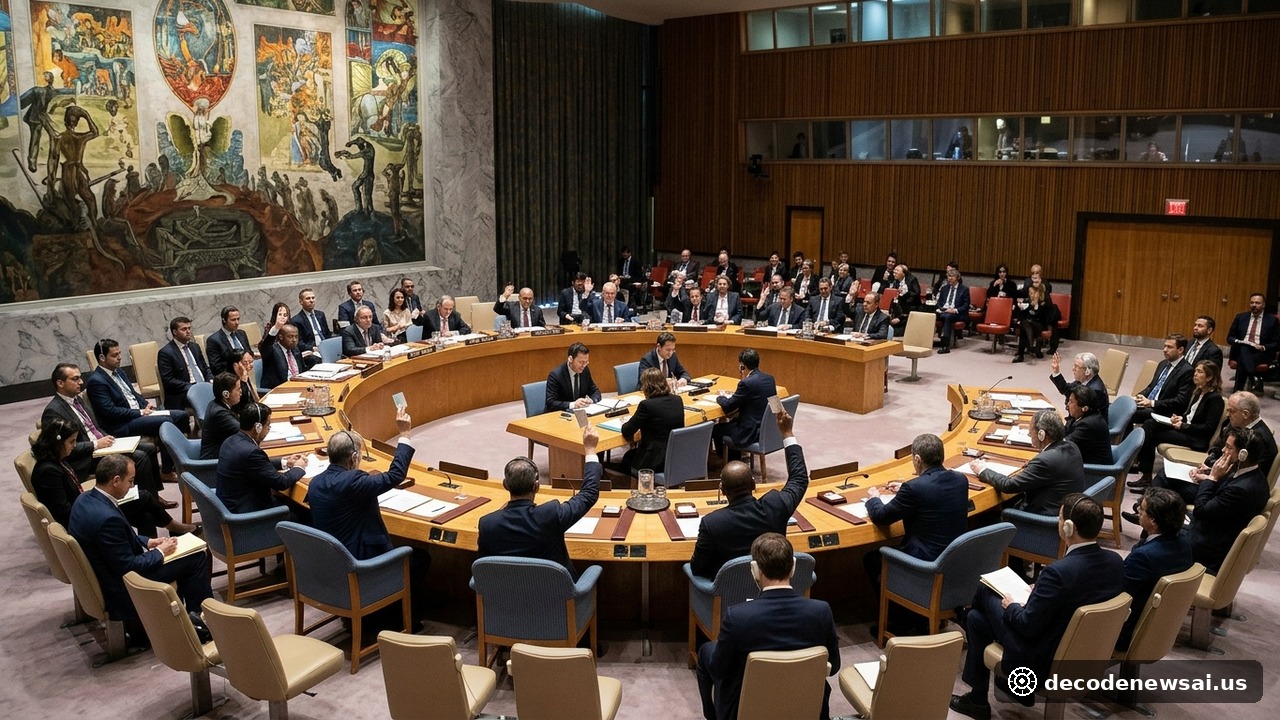
The United Nations Security Council officially completed formal diplomatic gazetting and member-state transmission of Resolution 2819 on November 6, 2026. Adopted unanimously by all 15 Council members, the landmark resolution formally extends the statutory mandate of the Panel of Experts assisting the 1970 Libya Sanctions Committee until August 1, 2027. The measure reauthorizes multinational maritime naval interdictions targeting vessels suspected of illicit petroleum and refined fuel exports on the high seas, while renewing targeted travel bans and financial asset freezes on destabilizing entities. Crucially, aligning with fragile momentum toward a unified national budgetary framework in Tripoli, the resolution establishes a breakthrough technical exemption mechanism permitting calibrated management of long-frozen sovereign state assets, balancing collective embargo enforcement with sustainable sovereign financial administration.
Key Statutory Provisions: UN Security Council Resolution 2819 on Libya
- High Seas Petroleum Interdiction Zone: International Waters of the Mediterranean Sea
- Core Substantive Sanctions Pillars Covered: Arms Embargo, Asset Freeze, Fuel Illicit Traffic
- Libyan Investment Authority (LIA) Governance: Obligated to File Third-Party Audited Strategy
Why Did the Council Focus on Suppressing Illicit Maritime Petroleum Exports?
Since the destabilization of state institutions in 2011, Libya's fragmented political factions have engaged in continuous struggle over control of the National Oil Corporation (NOC) and its substantial hydrocarbons revenues. Transnational illicit bunkering syndicates have systematically diverted subsidized domestic refined fuels and extracted crude through illegal offshore ship-to-ship lightering transfers off the ports of Zawiya and Tobruk, costing the Libyan treasury billions of dollars annually.
What Practical Relief Does the Calibrated Asset Freeze Exemption Provide?
In a calculated evolution from blanket financial sequestration, Resolution 2819 addresses the long-standing erosion of Libyan sovereign wealth. The Libyan Investment Authority (LIA) manages tens of billions of dollars across overseas equities, sovereign bonds, and cash accounts that have remained frozen under Chapter VII sanctions since 2011. Denied the legal capacity to reinvest maturing fixed-income instruments or rebalance cash equivalents, the sovereign fund has suffered hundreds of millions of dollars in inflation decay and negative-interest erosion.
In response, Resolution 2819 establishes a specialized technical protocol allowing the LIA to execute non-extractive, value-preserving reallocations under the direct oversight of the 1970 Sanctions Committee and international audit monitors. The capital principal remains completely inaccessible to domestic political actors, preventing the diversion of sovereign reserves by regional warlords while preserving state equity intended for post-conflict civil reconstruction. The President of the Security Council emphasized that this calibrated mechanism protects state wealth on behalf of future Libyan generations without weakening anti-corruption guardrails.
Where Does Multilateral Diplomacy Lead for Libyan Political Stabilization?
The unanimous adoption of Resolution 2819 reflects alignment among permanent Council members, the African Union, and Mediterranean littoral states on the imperative of preserving Libyan crude market stability. With Libya producing roughly 1.2 million barrels of sweet crude per day, uninterrupted legitimate maritime export flows provide an indispensable stabilizing anchor for broader Southern European energy infrastructure.
Diplomatic strategists observe that sanctions regimes serve fundamentally as leverage to compel entrenched factions toward institutional compromise. Special Representative of the Secretary-General Abdoulaye Bathily continues intensive shuttle diplomacy to finalize constitutional baselines for national legislative and presidential elections. By reinforcing the international arms embargo and dismantling shadow fuel smuggling networks, Resolution 2819 establishes the baseline security environment required for Libyan institutional reunification.