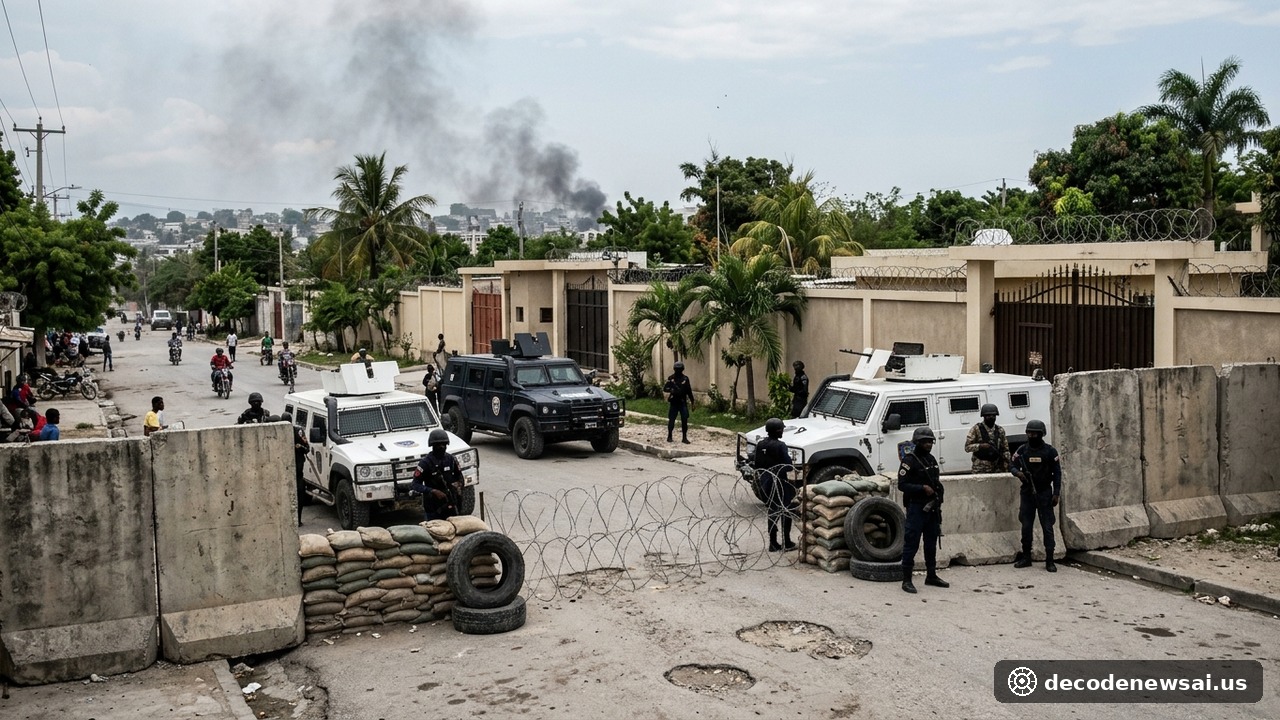
The United States Embassy in Port-au-Prince issued a highest-level emergency security alert on November 7, 2026, warning of intense gunfire and ongoing security operations in the immediate vicinity of its diplomatic compound in Tabarre. Heavy automatic gunfire erupted along key transit corridors connecting the diplomatic quarter to the international airport early Saturday, prompting the Haitian National Police and the multinational security support mission to deploy armored units and seal off surrounding avenues. The embassy immediately triggered mandatory shelter-in-place protocols for all personnel, underscoring the severe security deterioration facing the Caribbean nation despite months of international police deployments.
Core Security Metrics and Tabarre Firefight Developments
- Issuing Body & Alert Classification: US Embassy Port-au-Prince (Top Alert)
- Incident Location & Key Sector: Tabarre Compound Corridor, Port-au-Prince
- Engaged Forces & Hostile Actors: Armed Gang Alliances vs MSS & SWAT Units
- Emergency Consular Hotline Window: 24/7 Diplomatic & Citizen Crisis Network
- Civilian Directive for US Citizens: Immediate Shelter in Place, Avoid Transit
Why Did Heavy Fighting Suddenly Erupt Around the Tabarre Compound?
Situated in the northeastern Tabarre district of Port-au-Prince, the US Embassy compound represents one of the most fortified diplomatic facilities in the Caribbean, equipped with reinforced blast walls and armored gatehouses. However, Tabarre is also a vital geopolitical corridor connecting Toussaint Louverture International Airport to northern transit routes, making it a recurring battleground for the powerful gang alliance known as Viv Ansanm.
According to military observers and diplomatic sources, the skirmishes began before dawn when heavily armed gang members took up tactical positions inside residential buildings and commercial properties overlooking principal transit roundabouts. The assailants unleashed sustained bursts of automatic fire against fortified police checkpoints, deploying burning tire barricades and improvised explosive devices to disrupt reinforcements. The volume of stray rounds hitting residential infrastructure forced embassy tactical security elements to raise base defense readiness and man rooftop machine gun positions to guard against perimeter incursions.
How Are Multinational Forces and National Police Responding?
In direct response to the gang push toward the diplomatic perimeter, specialized tactical units from the Haitian National Police partnered with Kenyan armored elements of the Multinational Security Support mission to mount a coordinated counteroffensive. Heavily armored personnel carriers deployed to principal intersections, returning heavy suppressive fire to dislodge gang riflemen stationed on warehouse roofs.
Where Does the Caribbean Geopolitical Crisis Go From Here?
The violent flare-up near the US Embassy has reignited intense debate in Washington regarding the adequacy of ongoing stabilization assistance for Haiti. The US Department of State reiterated its Level 4 Do Not Travel advisory, instructing American citizens to avoid all non-essential movement across Port-au-Prince while alerting US Southern Command air mobility assets in Florida for potential crisis contingencies.
Geopolitical and security analysts emphasize that while multinational forces have secured vital seaports and government ministries, the lack of close air support and comprehensive tactical surveillance leaves surrounding neighborhoods vulnerable to persistent guerrilla insurgencies. As political friction within Haiti's Transitional Presidential Council continues to complicate domestic governance, criminal coalitions are using targeted friction around foreign installations to force concessions in national political negotiations. The confrontation in Tabarre demonstrates that restoring stability to Haiti requires sustained international operational commitment to prevent the outright collapse of state authority.