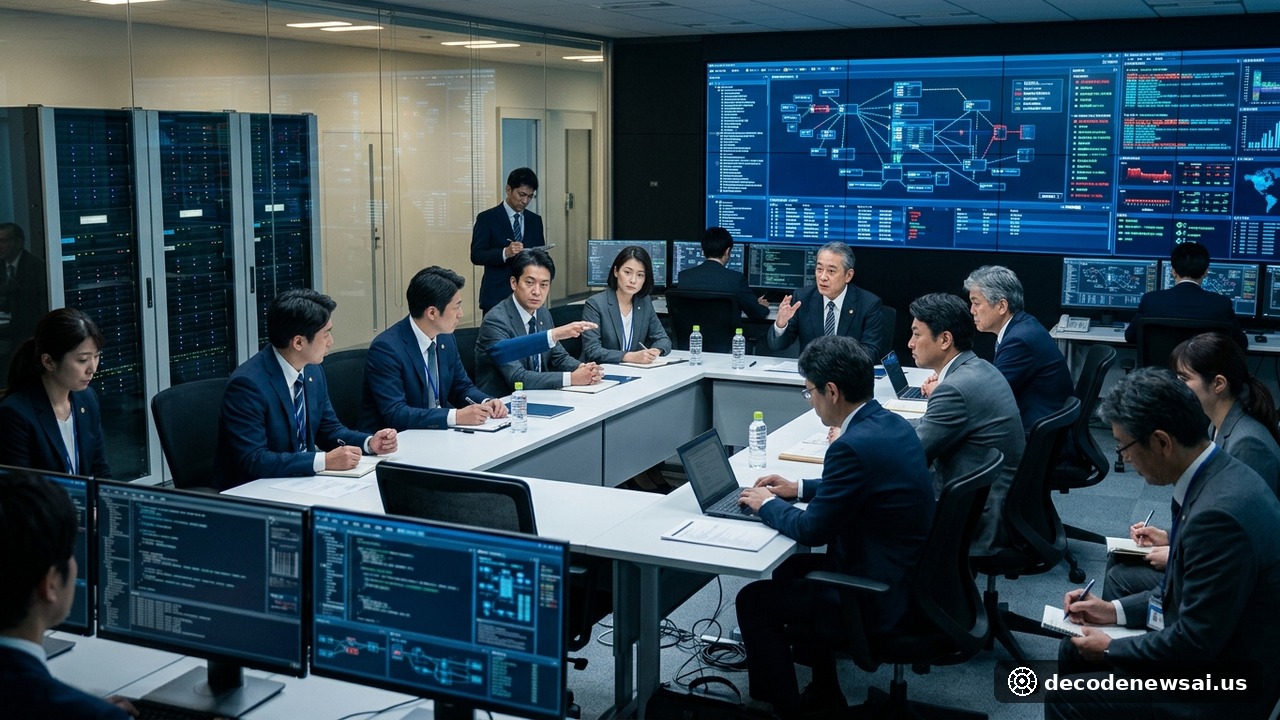
Japanese Prime Minister Sanae Takaichi convened a dedicated ministerial cabinet conference on November 6, 2026, formally ratifying a comprehensive emergency cybersecurity package valued at approximately 10 billion yen ($63 million). Financed directly through national budgetary reserves, the executive directive establishes advanced artificial intelligence-driven cyber defense squads known as Top Gun teams within the Ministry of Economy, Trade and Industry, alongside 24/7 cross-sector rapid response rescue units within the National Cybersecurity Center. Crucially, the measure authorizes national police and the Self-Defense Forces to execute newly codified active cyber defense protocols, granting legal clearance to neutralize adversary command-and-control servers before pending breaches compromise critical infrastructure.
Operational Deployment Parameters of Japan's Cybersecurity Package
- Executive Leadership & Inter-Agency Body: Prime Minister Sanae Takaichi Cabinet
- Specialized Technical Response Force: METI AI-Powered Top Gun Tactical Unit
- Expanded Military & Police Legal Authority: Operational Active Cyber Defense Protocols
Why Did the Japanese Government Authorize an Immediate Emergency Package?
Over recent operational quarters, Japanese public administration and private enterprise suffered a sustained wave of disruptive cyber intrusions. Targeted assaults ranged from commercial theft of aerospace and manufacturing blueprints to extensive distributed denial-of-service barrages disrupting municipal port management and municipal utility systems. Legacy perimeter defenses and fragmented internal security monitoring proved structurally inadequate against highly automated penetration toolsets deployed by state-aligned threat actors.
National concern intensified following formal disclosure from telecommunications giant NTT Docomo, which revealed that unauthorized attackers breached partner network pathways to exfiltrate 294,839 customer account dossiers containing national identification numbers, addresses, and automated bank clearance credentials. Speaking before cabinet ministers, Prime Minister Takaichi stated that the rapid weaponization of generative artificial intelligence by hostile actors necessitates a fundamental transition toward preemptive doctrine, stressing that administrative inertia in cyberspace directly undermines national economic sovereignty.
How Will the Top Gun Units and Active Defense Mandates Operate?
Under the operational roadmap, the Ministry of Economy, Trade and Industry will complete personnel staffing for its elite Top Gun unit before the close of November. Integrating technical specialists from domestic technology leaders and international security partners, the team will leverage high-capacity machine learning algorithms to conduct persistent vulnerability mapping across commercial semiconductor foundries, power grids, and central government network topologies to patch critical zero-day exploits before adversaries weaponize them.
The most transformative element involves operationalizing active cyber defense provisions legalized through recent legislative reforms. Historically constrained by constitutional protections regarding secrecy of communications, Japanese defense authorities were legally barred from taking preemptive action against overseas hostile systems. The new operational framework establishes lawful procedures allowing joint cybersecurity units to infiltrate and neutralize offshore proxy networks and botnet staging servers targeting Japanese infrastructure, eliminating malicious payloads prior to deployment.
What Are the Broader Geopolitical Implications for Indo-Pacific Security?
International defense analysts writing for Jiji Press and The Washington Post emphasize that Tokyo's 10 billion yen investment marks a profound doctrinal shift, formalizing cyberspace as a fifth sovereign operational domain alongside land, sea, air, and space.
As trilateral intelligence sharing among the United States, Japan, and South Korea deepens alongside European Union digital defense agreements, Japan's development of forward-leaning active defense capabilities significantly hardens regional semiconductor manufacturing hubs and trans-Pacific submarine cable junctions. Academic experts in Tokyo conclude that establishing dedicated public-private defensive units helps reverse historical dependence on foreign commercial security software, securing Japan's strategic technological autonomy within an increasingly contested regional theater.