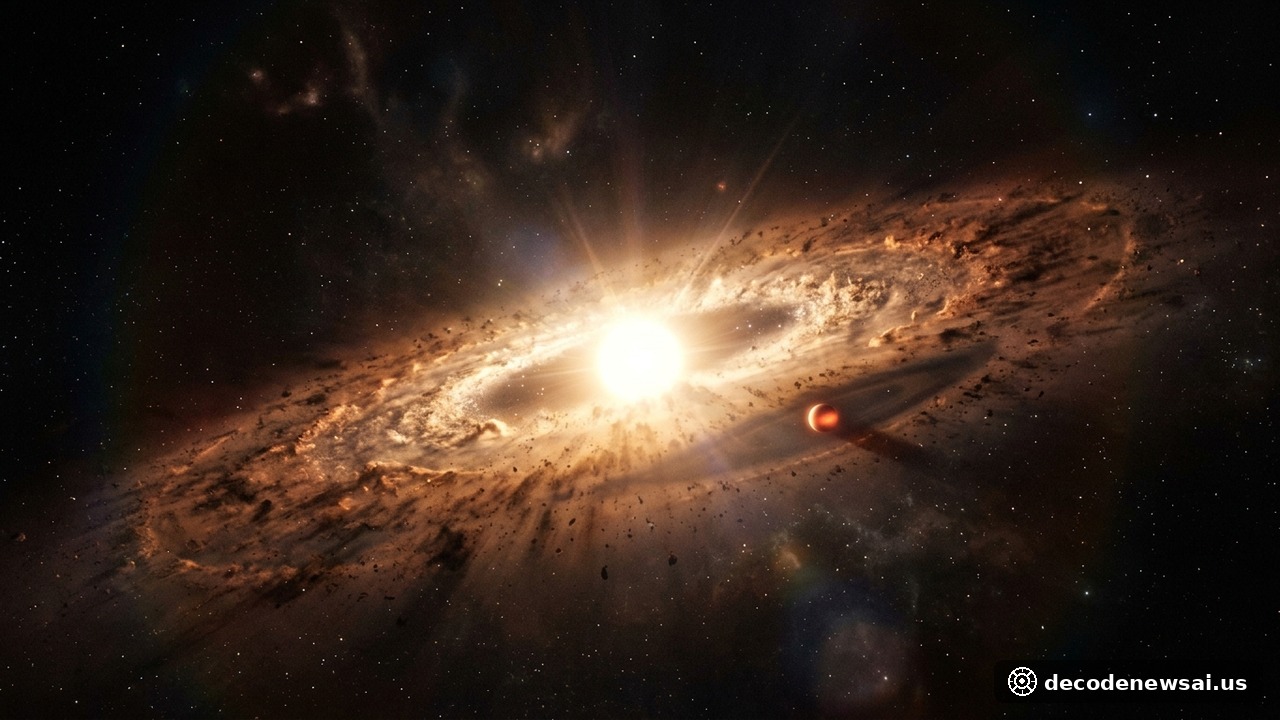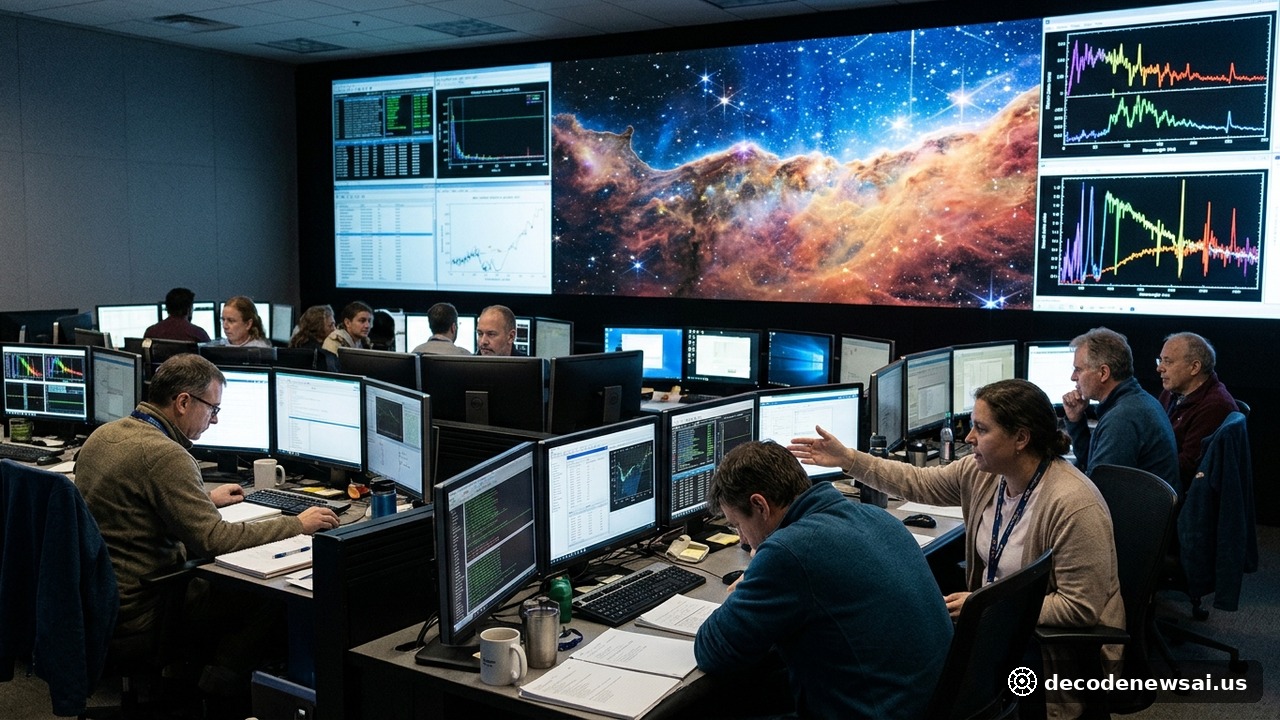
The National Aeronautics and Space Administration (NASA) and the European Space Agency (ESA) jointly announced landmark observational astrophysics findings on November 6, 2026, resolving long-standing mysteries regarding the chemical evolution of the outer solar system. Leveraging high-resolution infrared spectrographic data from the James Webb Space Telescope (JWST) alongside coordinated ultraviolet-optical imaging from the Hubble Space Telescope (HST) during joint Cycle 5 observing campaigns, an international research consortium executed high signal-to-noise surface spectroscopic analyses of six distant trans-Neptunian objects (TNOs) residing in the frigid core of the Kuiper Belt. The observations revealed unambiguous spectral signatures of pristine volatile ices—specifically carbon monoxide clathrates, methane, ammonia ice, and complex macromolecular refractory tholins. Because these ultra-volatile compounds sublimate at temperatures above thirty Kelvin, their persistent presence confirms that these bodies have remained chemically unaltered since the collapse of the primordial protosolar nebula 4.56 billion years ago, providing conclusive empirical support for smooth planetary migration models.
Key Observational and Chemical Metrics: Kuiper Belt Astronomical Survey
- Heliocentric Orbital Baseline Distance: 42.0 to 47.5 Astronomical Units (AU)
- Confirmed Surface Volatile Ice Signatures: Carbon Monoxide (CO), Ammonia (NH3), Methane
- JWST Near-Infrared Spectroscopic Grating: NIRSpec Medium-Resolution Mode (1-5 Microns)
How Did Coordinated JWST and Hubble Observations Unlock Faint Outer Solar System Targets?
The Kuiper Belt extends across the outer periphery of our planetary system, spanning heliocentric distances beyond four billion miles where ambient solar irradiance is less than 0.1% of terrestrial levels. Due to extreme faintness and heavy atmospheric telluric absorption bands, ground-based optical observatories have historically been unable to resolve compositional absorption lines across distant trans-Neptunian surfaces, categorizing them primarily as unresolved, reddish continuum point sources.
Why Do Ultra-Volatile Ice Signatures Redefine Early Planetary Migration Theory?
Planetary dynamicists emphasize that hyper-volatile molecules like carbon monoxide and methane exhibit extremely low sublimation temperatures, turning directly from solid to gas at roughly thirty degrees above absolute zero (-240°C). Had these celestial bodies originated within the warmer planetary zones of the inner solar system, or suffered violent, thermally disruptive collisions during giant planet orbital rearrangement, their volatile envelopes would have evaporated into interplanetary space billions of years ago.
The detection of high-concentration pristine volatile ices and complex carbonaceous polymers across all six surveyed cold-classical targets provides direct physical proof that these planetesimals formed in situ and were never scattered by resonant gravitational perturbations from migrating ice giants like Neptune. This observation firmly validates the modern smooth-migration paradigm of planetary architecture, while demonstrating that the outer Kuiper Belt represents a pristine chemical repository containing the foundational building blocks of the protosolar accretion disk.
What Are the Broader Implications for Astrobiology and Exoplanet Research?
NASA and ESA astrophysics leadership confirmed that the calibrated multi-spectral data sets have been uploaded to international astronomical archives to serve as benchmark chemical models for the future Habitable Worlds Observatory (HWO) flagship mission currently in formulation.
Planetary scientists emphasize that icy planetesimals and primitive cometary nuclei served as interplanetary transport mechanisms during the Late Heavy Bombardment, delivering water oceans and prebiotic organic precursors to early terrestrial worlds like Earth and Mars. As JWST expands its outer solar system survey campaigns across wider orbital dynamical classes, astronomers are systematically reconstructing the molecular chemical continuum connecting interstellar molecular clouds, protoplanetary accretion disks, and the emergence of habitable planetary environments.